Certain books strike me as having different flavors.
Books and food. It's not a bad analogy really. The reader ingests and then digests the material, retaining nourishment for the mind. To take the analogy further, sometimes a person doesn't digest the materiel very well and then just regurgitates it (typically this happens in school). With food, the eater ingests it and it is then digested in the body for nourishment. Sometimes it only makes it to the stomach; after summary digestion it is regurgitated. While some food is unhealthy "junk food," there are also unhealthy "junk books."
But, back to the flavors. Two of the first books that struck me as having a flavor were The Lord of the Rings and The Story of Rolf and the Viking Bow. After those realizations, I pondered a bit and made comparisions between other books and food.
Here is a list below of different books and their flavors:
The Lord of the Rings, by J. R. R. Tolkien - Ice cold lemon water. It's pure, refreshing, and wholesome. The flavor is magical yet with out an sugar added. I think I made this connection because the first time I had lemon water, it was at an outdoor dance. The atmosphere was almost magical. We were all dressed prettily in long elegant gowns we had sewn. We wore no shoes and felt the cool grass beneath our bare feet. Strands of lights illuminated the yard. Light, classy refreshments were served on a side table. And there in a clear dispenser was the ice cold lemon water, so rejuvenating on that summer night.
The Story of Rolf and the Viking Bow, by Allen French - Cold Icelandic spring water. When I'd first read it, I'd likened it to fresh spring water, but now that I've been to Iceland and drank the water there, I insist that it is Icelandic spring water, like what comes right out of the tap over there!
The Complete Richard Hannay, by John Buchan - Espresso. Rich earthy flavor, strong and warm. It also has the same effects on me as too much caffeine in my system! I get hyper. When talking about Richard Hannay, I start talking really fast and excitedly (like when I drink too much coffee). Similarly, I also want to do some sort of physical activity, like ride a bike and feel the wind in my face, exercise, fight, lift weights, run around, jump over things or dive under them! These books get my blood pumping!
Cyrano de Bergerac, by Edmond Rostand - This one I don't associate with a flavor, but rather a sound. Imagine the sound of a violin rising to the stars in a lonely crescendo in the night air under a full white moon. If I were to pick a flavor, I think it would be some sort of wine. Something that's not quite as sweet as rosé.
I asked my friends on facebook if they associate different books with flavors. Here is what they had to say:
A Song of Ice and Fire series, by George R. R. Martin - "The milk at the end of a bowl of Honeycomb."
The Little House on the Prairie, by Laura Ingalls Wilder - A bowl of stew. A second friend chimed in, agreeing with this description.
Sherlock Holmes series, by Sir Arthur Conan Doyle - A cup of steaming of black tea.
The Girl of the Limberlost, and The Harvester, both by Gene Stratton Porter- A thick mint milk shake. "Refreshing but something to let melt in your mouth a little."
Sense and Sensibility, by Jane Austen - An ice cream parfait in a fancy glass. She found the book to have different layers.
Monday, July 15, 2013

Tuesday, July 2, 2013
The Hobbit, Would you have opened the door?
I often contemplate the beginning of The Hobbit, by J. R. R. Tolkien. How would I have responded to an Unexpected Party, comprised of strangers? Frankly, it never would have happened. Atleast, not in this age, at this location.
I always look before I open the door, even when I am expecting someone, and if an unknown person looking taller and stronger than me is out there, the last thing I'm going to do is open the door while I'm home alone. If they stand there waiting too long, then I'd call the police. No party for anyone.
Now Bilbo had invited Gandalf to tea and when he heard the ring of the door bell he opened it expecting Gandalf but was surprised to find a dwarf (page 7) We are told, "as soon as the door opened, he pushed inside, just as if he had been expected" (page 7). How frightening! I'm not sure what I'd do if someone pushed into my house. I'm guessing I'd ask them what they wanted. By the time the second stranger entered, however, I'd be plotting my escape from the house so as not to be murdered. It's rather sad, to think about how dark the world is, living on the edge of a crime-infested city.
And now I pose the question to you: What would you have done?
The Hobbit, J. R. R. Tolkien. Ballentine Books, New York: 1982.
I always look before I open the door, even when I am expecting someone, and if an unknown person looking taller and stronger than me is out there, the last thing I'm going to do is open the door while I'm home alone. If they stand there waiting too long, then I'd call the police. No party for anyone.
Now Bilbo had invited Gandalf to tea and when he heard the ring of the door bell he opened it expecting Gandalf but was surprised to find a dwarf (page 7) We are told, "as soon as the door opened, he pushed inside, just as if he had been expected" (page 7). How frightening! I'm not sure what I'd do if someone pushed into my house. I'm guessing I'd ask them what they wanted. By the time the second stranger entered, however, I'd be plotting my escape from the house so as not to be murdered. It's rather sad, to think about how dark the world is, living on the edge of a crime-infested city.
And now I pose the question to you: What would you have done?
The Hobbit, J. R. R. Tolkien. Ballentine Books, New York: 1982.
Sunday, June 30, 2013
The Voice of Smaug
It whispers, it purrs, and its deep tones are laced with power and cunning. It is the voice of Khan.
All along, I couldn't see why Benedict Cumberbatch had been chosen as the voice of Smaug, the terrible dragon from The Hobbit. I figured he would do fine, but I couldn't picture it, it wasn't an obvious choice to me. I had seen him in BBC's Sherlock (just two episodes), but nothing about his voice struck me as particularly dragonish. Yesterday, I saw Star Trek, Into Darkness at a theater. In this film, Cumberbatch plays Khan, the very confusing enemy of Starfleet.
As I heard him speaking, I realized that his voice was perfect for Smaug!
I am now very excited for a captivating performance in the The Hobbit film trilogy. I know that Cumberbatch has the voice, I just hope the directors have him use it.
The photo is from the official website and then cropped by me:
Star Trek Official Website Gallery
 |
| Benedict Cumberbatch as Khan |
As I heard him speaking, I realized that his voice was perfect for Smaug!
I am now very excited for a captivating performance in the The Hobbit film trilogy. I know that Cumberbatch has the voice, I just hope the directors have him use it.
The photo is from the official website and then cropped by me:
Star Trek Official Website Gallery
Wednesday, May 29, 2013
Roverandom
It's a tale you don't hear about too often, but it is a good one.
Written by J.R.R. Tolkien, it's the story of a little dog named Rover and the adventures he has after being turned into a toy by a wizard.
An easy read, if you like other books by Tolkien and fairy tales, I recommend you give it a go. The places and creatures he describes are very imaginative and it contains some lovely ideas. For example: a seagull that flies to the moon with messages for the wizard who lives there with a little white flying dog.
I don't want to say too much because it's lovelier if you read it for yourself.
The edition at my house even has illustrations by Tolkien himself!
I find his depictions of mermaids interesting because one of them married a wizard and they moved to the land. He mentions mermaid tails with aversion. He remarks on her "deplorable" tail. Having a fish tail would certainly be shocking for humans to see, but he seems to disdain them for some reason in the midst of all the unusual things that are going on. Is he just projecting the views of the two-legged people's society (from the story) into his narration, or is it something else?

Written by J.R.R. Tolkien, it's the story of a little dog named Rover and the adventures he has after being turned into a toy by a wizard.
An easy read, if you like other books by Tolkien and fairy tales, I recommend you give it a go. The places and creatures he describes are very imaginative and it contains some lovely ideas. For example: a seagull that flies to the moon with messages for the wizard who lives there with a little white flying dog.
I don't want to say too much because it's lovelier if you read it for yourself.
The edition at my house even has illustrations by Tolkien himself!
I find his depictions of mermaids interesting because one of them married a wizard and they moved to the land. He mentions mermaid tails with aversion. He remarks on her "deplorable" tail. Having a fish tail would certainly be shocking for humans to see, but he seems to disdain them for some reason in the midst of all the unusual things that are going on. Is he just projecting the views of the two-legged people's society (from the story) into his narration, or is it something else?
Monday, May 13, 2013
A Passion for Rings
In The Saga of King Hrolf Kraki there is a ring that is coveted greatly. The passion for this ring and the terms in which it is spoken of is similar to The One Ring from The Lord of the Rings, by J. R. R. Tolkien.
The story of this ring begins thus: "A ring owned by King Helgi was a widely famed treasure. Both brothers wanted it, and so too did their sister Signy."
King Hroar offered to give his brother, King Helgi, his share of the kingdom in exchange for the ring, saying, "I want the ring, the one that is the best treasure in your possession and that both of us would like to own." Basically, Hroar saw this ring as worth half a kingdom.
Helgi agreed to this deal, "after such a speech, nothing else is fitting but that you should have the ring."
However, that is not the end of the episode. Hrok, with the encouragement of his mother Signy, also decided he wanted the ring. He demanded that King Helgi (his uncle) give him a third of the kingdom or "the great ring." Helgi informed him that Hroar had the ring and that his claims were arrogant.
Hrok then went to Hroar, and asked for the ring. Hroar replied, "I have given so much to get this ring that I will by no means part with it."
Hrok then asked to see it, saying he wanted to know if it was really "as much a treasure as it is claimed." Hroar readily showed it too him and Hrok threw it into the sea after saying, "I have never seen a comparable treasure, and the reason you esteem the ring so highly is obvious. The best solution, it seems to me, is that neither of us, or, for that matter, anyone else should enjoy it." He had no right to such an action. His claim on the ring was small enough, and Hroar had traded half the kingdom for it. Hroar chopped of Hrok's foot in response. After healing, Hrok assembled an army with which he defeated and killed Hroar. Helgi then defeated Hrok and instead of slaying him, broke all his limbs so that he was a cripple the rest of his life. And this was all between family! Many people searched the waters for the ring and Hroar's son, Agnar, finally found it after diving for it.
So, that's a summary of the ring episode. Although this ring was not imbued with the magical and evil properties that The One Ring possessed, it was coveted in much the same way, resulting in wars and the loss of limbs (Frodo lost his finger, Hrok, his foot). Hrok referred to it as "the great ring," giving it a title, much like, "The One Ring." In The Lord of the Rings, it was suggested the the ring be thrown into the sea, but that idea was rejected because it could be found again eventually.
However, Hroar's ring could have been an arm ring and not a finger ring like The One Ring.
The Saga of Hrolf Kraki. Translated by Jesse L. Bylock. Published by Penguin Books, 1998.
The story of this ring begins thus: "A ring owned by King Helgi was a widely famed treasure. Both brothers wanted it, and so too did their sister Signy."
King Hroar offered to give his brother, King Helgi, his share of the kingdom in exchange for the ring, saying, "I want the ring, the one that is the best treasure in your possession and that both of us would like to own." Basically, Hroar saw this ring as worth half a kingdom.
Helgi agreed to this deal, "after such a speech, nothing else is fitting but that you should have the ring."
However, that is not the end of the episode. Hrok, with the encouragement of his mother Signy, also decided he wanted the ring. He demanded that King Helgi (his uncle) give him a third of the kingdom or "the great ring." Helgi informed him that Hroar had the ring and that his claims were arrogant.
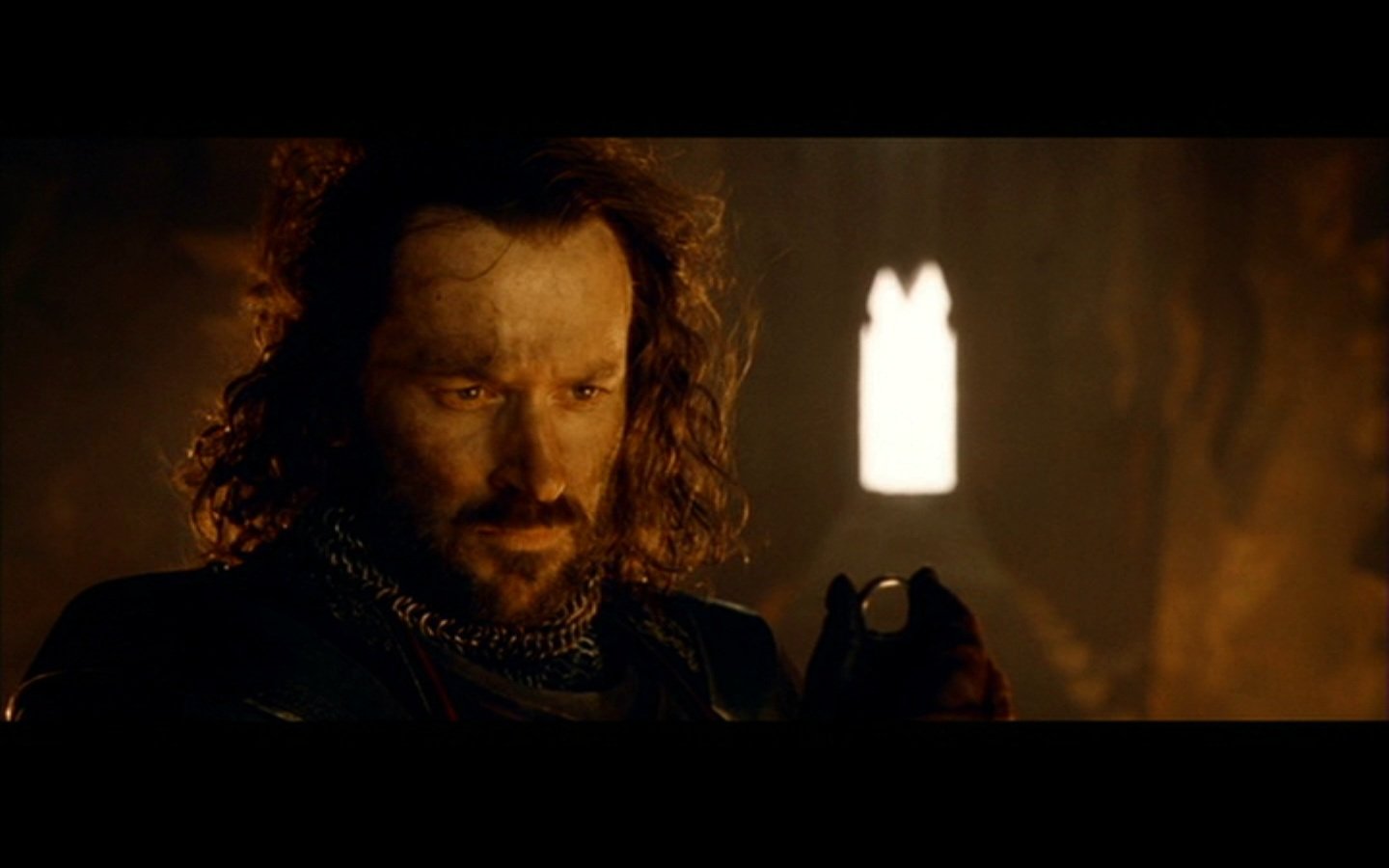 |
| Isildur and The One Ring |
Hrok then asked to see it, saying he wanted to know if it was really "as much a treasure as it is claimed." Hroar readily showed it too him and Hrok threw it into the sea after saying, "I have never seen a comparable treasure, and the reason you esteem the ring so highly is obvious. The best solution, it seems to me, is that neither of us, or, for that matter, anyone else should enjoy it." He had no right to such an action. His claim on the ring was small enough, and Hroar had traded half the kingdom for it. Hroar chopped of Hrok's foot in response. After healing, Hrok assembled an army with which he defeated and killed Hroar. Helgi then defeated Hrok and instead of slaying him, broke all his limbs so that he was a cripple the rest of his life. And this was all between family! Many people searched the waters for the ring and Hroar's son, Agnar, finally found it after diving for it.
So, that's a summary of the ring episode. Although this ring was not imbued with the magical and evil properties that The One Ring possessed, it was coveted in much the same way, resulting in wars and the loss of limbs (Frodo lost his finger, Hrok, his foot). Hrok referred to it as "the great ring," giving it a title, much like, "The One Ring." In The Lord of the Rings, it was suggested the the ring be thrown into the sea, but that idea was rejected because it could be found again eventually.
However, Hroar's ring could have been an arm ring and not a finger ring like The One Ring.
The Saga of Hrolf Kraki. Translated by Jesse L. Bylock. Published by Penguin Books, 1998.
Sunday, May 5, 2013
A thousand years ago feels like yesterday
I felt like they were my neighbors, my relations, my community, these Icelanders from a thousand years ago.
I think it was the style in which their sagas were written.
Many authors these days take an over-the-shoulder, inside-the-soul, point of view with their characters, telling you exactly what the character is thinking and feeling in every excruciating detail. I like that. However, the sagas were not written that way, they were written in a rather external fashion. Yet I felt close to the people.
They seemed real because the lens through which I saw them was as if I were a part of the community. I am told a bit of what they are feeling, I hear of their actions, I know who is best friends with who and how they are related. Just like in real life. In real life I don't know every thought, every pleasure, every pain that passes through my friends, let alone acquaintances that I see frequently. And so the sagas, by being distant, seem real because I see a community functioning, like my home school co/op, like my extended family, like my Christian community. I see the major events that take place and I hear a little of the inside scoop through those more directly involved.
Additionally the descriptions of people are sometimes vivid, so it's like you can see them. I can see their face and external appearance (physique, clothing), but I can't see their mind. Like real life.
Interestingly, books written in first person or with a very over-the-shoulder view often leave you guessing as to the person's looks.
They were so human, driven by their feelings of greed, anger, ambition, brokenheartedness and by what was acceptable in their culture. The women were not meek sheep in the kitchen. A number had strong characters and were driving forces in the stories as they struggled for revenge. And they often manipulated/strong-armed their husbands into getting their way.
And so the sagas easily bridge the gap between then and now, despite culture and language barriers.
I think it was the style in which their sagas were written.
Many authors these days take an over-the-shoulder, inside-the-soul, point of view with their characters, telling you exactly what the character is thinking and feeling in every excruciating detail. I like that. However, the sagas were not written that way, they were written in a rather external fashion. Yet I felt close to the people.
They seemed real because the lens through which I saw them was as if I were a part of the community. I am told a bit of what they are feeling, I hear of their actions, I know who is best friends with who and how they are related. Just like in real life. In real life I don't know every thought, every pleasure, every pain that passes through my friends, let alone acquaintances that I see frequently. And so the sagas, by being distant, seem real because I see a community functioning, like my home school co/op, like my extended family, like my Christian community. I see the major events that take place and I hear a little of the inside scoop through those more directly involved.
Additionally the descriptions of people are sometimes vivid, so it's like you can see them. I can see their face and external appearance (physique, clothing), but I can't see their mind. Like real life.
Interestingly, books written in first person or with a very over-the-shoulder view often leave you guessing as to the person's looks.
They were so human, driven by their feelings of greed, anger, ambition, brokenheartedness and by what was acceptable in their culture. The women were not meek sheep in the kitchen. A number had strong characters and were driving forces in the stories as they struggled for revenge. And they often manipulated/strong-armed their husbands into getting their way.
And so the sagas easily bridge the gap between then and now, despite culture and language barriers.
Thursday, April 4, 2013
Icelandic Sagas - Translation: What's Lost and Gained.
Somethings are just lost in translation, we all know that. If you can't read the original, somethings are found by reading translations by different authors.
I'm now reading The Laxdoela Saga, translated by A. Margaret Arent (copyright 1964). Some of the people in this saga also appeared in The Story of Burnt Njal, however their names are spelled differently. Hauskuld/Hoskuld. Unna/Unn. Snorri Godi/Snorri the Priest. Tongue/Tunga. "Godi" is a title for a priest/chieftain so instead of calling him "Snorri the Priest," she called him "Snorri Godi." Additionally, instead of translating the name of his home to "Tongue," she left it as "Tunga."
Snorri was one of those men. If you read either name by itself, it doesn't mean a whole lot. One must dig into the notes in the book and the history or Iceland itself.
Time makes a difference in translation. The sagas were written a long time ago and culture has changed considerably since then. The translators also come from different eras, affecting their translations. Sir George Webbe Dasent lived from 1817-1896 (translator of The Story of Burnt Njal, which was first published in 1861). We now live in a different era with different customs. Sir Dasent used archaic language in his translation (probably even archaic for his time), including English words that are no longer used but approximated the Icelandic word better than any words we have now.
For example, Dasent used the words "boun" and "busked" while Arent used more current language: "made ready, fitted out." Instead of saying "Easterling" she informs us the person is from Norway. Dasent used the word "daysmen" which refers to an arbitrator. This word appears in the King James Bible in Job 9:33. The King James Bible is from the 1600s, which is well before Dasent's time.
So, what we've got is a story from nearly a millennium ago, translated by a man who lived two hundred years ago (during the Victorian era) who used words atleast two hundred years older than himself (from Shakespeare's time), read by people of a vastly different era (us).
For more on the archaic words themselves:
Icelandic Sagas - A Cultural Glossary and Location Illuminator
Works Cited:
Arent, A. Margaret. The Laxdoela Saga. University of Washington Press, 1964
Dasent, Sir George Webbe. The Story of Burnt Njal. J. M. Dent and Sons LTD, 1960
I'm now reading The Laxdoela Saga, translated by A. Margaret Arent (copyright 1964). Some of the people in this saga also appeared in The Story of Burnt Njal, however their names are spelled differently. Hauskuld/Hoskuld. Unna/Unn. Snorri Godi/Snorri the Priest. Tongue/Tunga. "Godi" is a title for a priest/chieftain so instead of calling him "Snorri the Priest," she called him "Snorri Godi." Additionally, instead of translating the name of his home to "Tongue," she left it as "Tunga."
So, by reading both translations, the notes, and learning a little history, I learned what his name really was (Snorri Godi) and what it meant to those who heard it in his day (Snorri the Priest). "Godi" (more authentically: goði) doesn't just mean "priest," you have to understand how it was used in the days of the sagas. According to Arent in her introduction, the priests of the old Norse religion had lots of power (to be a priest was to be a chieftain). She further explains that when Iceland became a republic, the goðar (plural of goði) automatically became members of parliament, the lawmakers.
Time makes a difference in translation. The sagas were written a long time ago and culture has changed considerably since then. The translators also come from different eras, affecting their translations. Sir George Webbe Dasent lived from 1817-1896 (translator of The Story of Burnt Njal, which was first published in 1861). We now live in a different era with different customs. Sir Dasent used archaic language in his translation (probably even archaic for his time), including English words that are no longer used but approximated the Icelandic word better than any words we have now.
For example, Dasent used the words "boun" and "busked" while Arent used more current language: "made ready, fitted out." Instead of saying "Easterling" she informs us the person is from Norway. Dasent used the word "daysmen" which refers to an arbitrator. This word appears in the King James Bible in Job 9:33. The King James Bible is from the 1600s, which is well before Dasent's time.
So, what we've got is a story from nearly a millennium ago, translated by a man who lived two hundred years ago (during the Victorian era) who used words atleast two hundred years older than himself (from Shakespeare's time), read by people of a vastly different era (us).
For more on the archaic words themselves:
Icelandic Sagas - A Cultural Glossary and Location Illuminator
Works Cited:
Arent, A. Margaret. The Laxdoela Saga. University of Washington Press, 1964
Dasent, Sir George Webbe. The Story of Burnt Njal. J. M. Dent and Sons LTD, 1960
Subscribe to:
Posts (Atom)