Showing posts with label sea. Show all posts

Monday, May 13, 2013

A Passion for Rings

In The Saga of King Hrolf Kraki there is a ring that is coveted greatly. The passion for this ring and the terms in which it is spoken of is similar to The One Ring from The Lord of the Rings, by J. R. R. Tolkien.

The story of this ring begins thus: "A ring owned by King Helgi was a widely famed treasure. Both brothers wanted it, and so too did their sister Signy."

King Hroar offered to give his brother, King Helgi, his share of the kingdom in exchange for the ring, saying, "I want the ring, the one that is the best treasure in your possession and that both of us would like to own." Basically, Hroar saw this ring as worth half a kingdom.

Helgi agreed to this deal, "after such a speech, nothing else is fitting but that you should have the ring."

However, that is not the end of the episode. Hrok, with the encouragement of his mother Signy, also decided he wanted the ring. He demanded that King Helgi (his uncle) give him a third of the kingdom or "the great ring." Helgi informed him that Hroar had the ring and that his claims were arrogant.
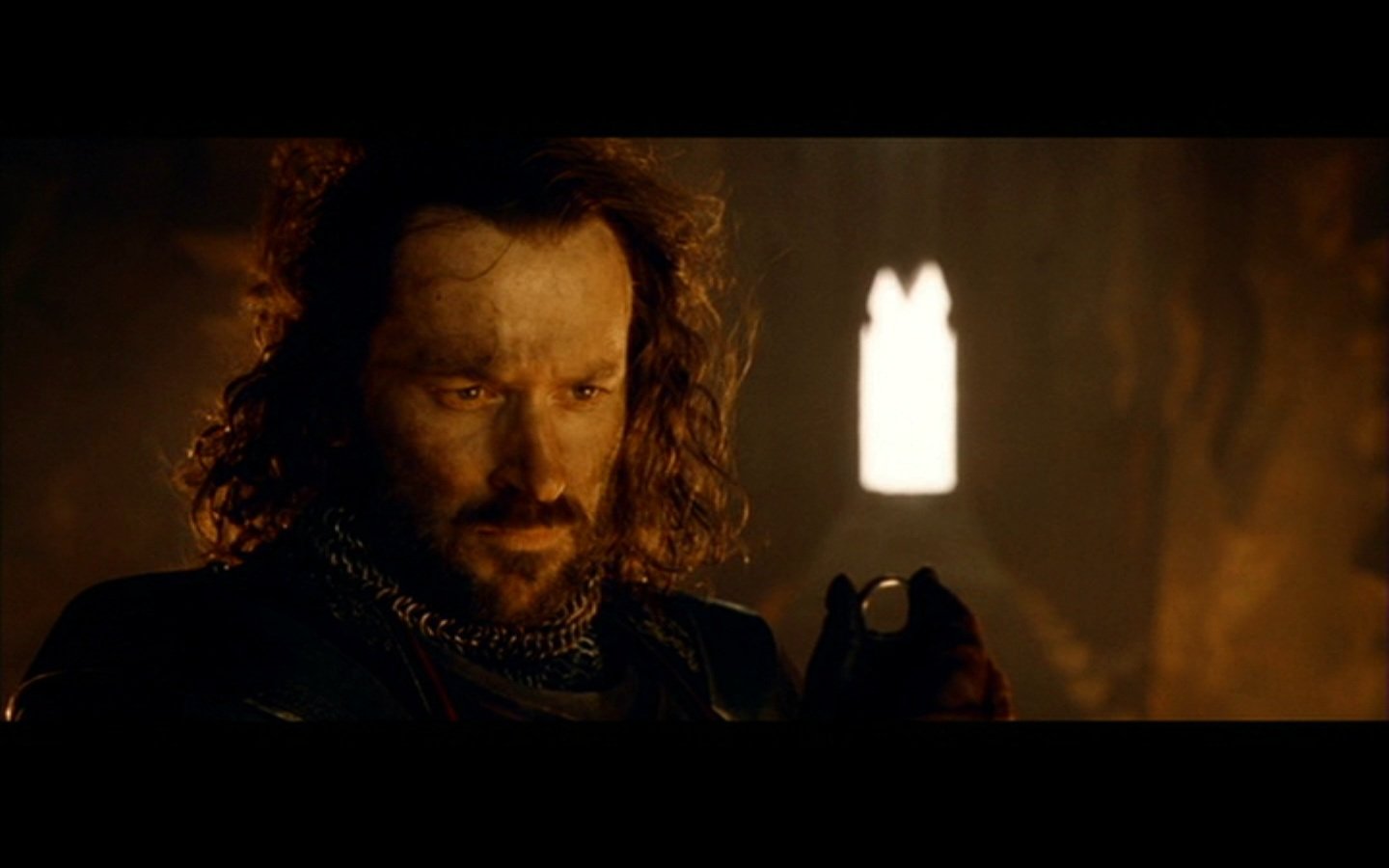
Isildur and The One Ring
Hrok then went to Hroar, and asked for the ring. Hroar replied, "I have given so much to get this ring that I will by no means part with it."

Hrok then asked to see it, saying he wanted to know if it was really "as much a treasure as it is claimed." Hroar readily showed it too him and Hrok threw it into the sea after saying, "I have never seen a comparable treasure, and the reason you esteem the ring so highly is obvious. The best solution, it seems to me, is that neither of us, or, for that matter, anyone else should enjoy it." He had no right to such an action. His claim on the ring was small enough, and Hroar had traded half the kingdom for it. Hroar chopped of Hrok's foot in response. After healing, Hrok assembled an army with which he defeated and killed Hroar. Helgi then defeated Hrok and instead of slaying him, broke all his limbs so that he was a cripple the rest of his life. And this was all between family! Many people searched the waters for the ring and Hroar's son, Agnar, finally found it after diving for it.

So, that's a summary of the ring episode. Although this ring was not imbued with the magical and evil properties that The One Ring possessed, it was coveted in much the same way, resulting in wars and the loss of limbs (Frodo lost his finger, Hrok, his foot). Hrok referred to it as "the great ring," giving it a title, much like, "The One Ring."  In The Lord of the Rings, it was suggested the the ring be thrown into the sea, but that idea was rejected because it could be found again eventually.

However, Hroar's ring could have been an arm ring and not a finger ring like The One Ring.
 
The Saga of Hrolf Kraki. Translated by Jesse L. Bylock. Published by Penguin Books, 1998.

Wednesday, January 30, 2013

Iceland and The Story of Rolf and the Viking Bow

The Story of Rolf and the Viking Bow has long been one of my favorite books. Allen French did a wonderful job when he wrote this book for just as The Secret of Kells really captures Irish history and lore, so this book captures many elements of Icelandic history, culture, and lore.

Just some notes on Icelandic letters that are not in our alphabet and on the Alþingi:

þ makes the "th" sound in "thing" (unvocalized "th").
ð makes the "th" sound in "that" (vocalized "th").
The Alþingi is the Icelandic parliament. It began in 930 A.D. and it was in session for many years until Iceland came under foreign powers. It was started again after WWII and is currently functioning, though it is now located in Reykjavik.
Þingvellir is a plain that is its historic location. 
 
Here is a list of common elements between the book and things I've learned about Iceland or experienced on my trip.

1. The Story of Rolf and the Viking Bow was written in a saga style. Iceland has a collection of sagas called Íslendingasögur, and I am guessing that Allen French read those for he mentions some of the characters in his book. Grettir the Strong, and Njal, namely.

2. The names of at least two of the characters are/have been used recently. In the flea market I saw the name "Einar" as an author's name on a book. "Snorri" appeared on a building from the 18 or 1900s.

Location of Snorri's booth. The wall remnants date from a later time.
3. Snorri the Priest from the book was a real man. I saw the ruins of his booth at Þingvellir (the location of the Alþingi at the time of the story.) In the story, Rolf goes to the Alþingi at Þingvellir, and also to Snorri's booth there.
(See my next post for more on the Alþingi and what Allen French has to say about it.)

Allen French's description of 
Þingvellir fits with what I saw there. 

4. Rolf's family owned sheep. Woolen goods are a hot commodity in Iceland these days. They are in every tourist shop and the Icelanders themselves frequently wear woolen sweaters.

5. In the story the sheep were marked by cuts on the ears, and had to be sorted when they were brought down from summer pastures for the winter. This is still done today. Their ears are marked, the sheep are brought down according to customs set by the Alþingi (Althingi) long ago, and they are sorted using a sheep sorter.

Icelandic cliffs
6.  We are told that there was a great number of birds and that Rolf climbed the craggy cliffs for eggs and young birds. He also shot the adults with his bow. Iceland is still known for its abundance of bird colonies.

7. "Heimskur" is the Icelandic word for stupid and contains the image of one who sits at home and doesn't travel. In the book it mentions that young men would travel abroad and that it was an important part of their passage into adulthood.

8. Ghosts were treated as real in the book. Many Icelanders are a bit into mysticism and believe in ghosts or elves (short, invisible beings).

9. According to French, it was customary for men to keep whatever wealth the sea washed ashore from ship wrecks off the rugged coast. The Icelanders in Rolf's day were delighted with the goods that washed ashore. The same was true in the 1800s. People were glad to get the timbers and things from the shipwrecks, even though it was too bad about the sailors who drowned in the wreck.

One man in Reykjavik collects odds and ends from the sea and has quite a stash of large metal contraptions. The large silver object looks like a space escape pod, other objects stick up like odd towers and are gray and rusty.
What the sea brought

10. Icelanders have traditionally been farmers. Rolf and his family were farmers. Characters in the sagas and folklore were farmers too, even if they were also great warriors.

11. Fishing is also important to Iceland. In addition to his other skills, Rolf knew how to fish. In current day Iceland, dried fish is sold at the flea market and the grocery store. The story speaks of racks for drying fish in the Orkneys and also Icelanders having dried fish on hand.  They still use wooden racks for drying fish.

12. In the book, Grettir cooked his food in the geysers. A tourism video showed some people cooking food in a geyser for amusement.
Geysir (the geyser from whose name the word "geyser" is from.)


All photos are my own except the photo of the book.