Sunday, June 30, 2013

The Voice of Smaug

It whispers, it purrs, and its deep tones are laced with power and cunning. It is the voice of Khan.

Benedict Cumberbatch as Khan
All along, I couldn't see why Benedict Cumberbatch had been chosen as the voice of Smaug, the terrible dragon from The Hobbit. I figured he would do fine, but I couldn't picture it, it wasn't an obvious choice to me. I had seen him in BBC's Sherlock (just two episodes), but nothing about his voice struck me as particularly dragonish. Yesterday, I saw Star Trek, Into Darkness at a theater. In this film, Cumberbatch plays Khan, the very confusing enemy of Starfleet.

As I heard him speaking, I realized that his voice was perfect for Smaug!

I am now very excited for a captivating performance in the The Hobbit film trilogy. I know that Cumberbatch has the voice, I just hope the directors have him use it.


The photo is from the official website and then cropped by me:
Star Trek Official Website Gallery

Wednesday, May 29, 2013

Roverandom

It's a tale you don't hear about too often, but it is a good one.

Written by J.R.R. Tolkien, it's the story of a little dog named Rover and the adventures he has after being turned into a toy by a wizard.

An easy read, if you like other books by Tolkien and fairy tales, I recommend you give it a go. The places and creatures he describes are very imaginative and it contains some lovely ideas. For example: a seagull that flies to the moon with messages for the wizard who lives there with a little white flying dog.
I don't want to say too much because it's lovelier if you read it for yourself.

The edition at my house even has illustrations by Tolkien himself!

I find his depictions of mermaids interesting because one of them married a wizard and they moved to the land. He mentions mermaid tails with aversion. He remarks on her "deplorable" tail. Having a fish tail would certainly be shocking for humans to see, but he seems to disdain them for some reason in the midst of all the unusual things that are going on. Is he just projecting the views of the two-legged people's society (from the story) into his narration, or is it something else?  

Monday, May 13, 2013

A Passion for Rings

In The Saga of King Hrolf Kraki there is a ring that is coveted greatly. The passion for this ring and the terms in which it is spoken of is similar to The One Ring from The Lord of the Rings, by J. R. R. Tolkien.

The story of this ring begins thus: "A ring owned by King Helgi was a widely famed treasure. Both brothers wanted it, and so too did their sister Signy."

King Hroar offered to give his brother, King Helgi, his share of the kingdom in exchange for the ring, saying, "I want the ring, the one that is the best treasure in your possession and that both of us would like to own." Basically, Hroar saw this ring as worth half a kingdom.

Helgi agreed to this deal, "after such a speech, nothing else is fitting but that you should have the ring."

However, that is not the end of the episode. Hrok, with the encouragement of his mother Signy, also decided he wanted the ring. He demanded that King Helgi (his uncle) give him a third of the kingdom or "the great ring." Helgi informed him that Hroar had the ring and that his claims were arrogant.

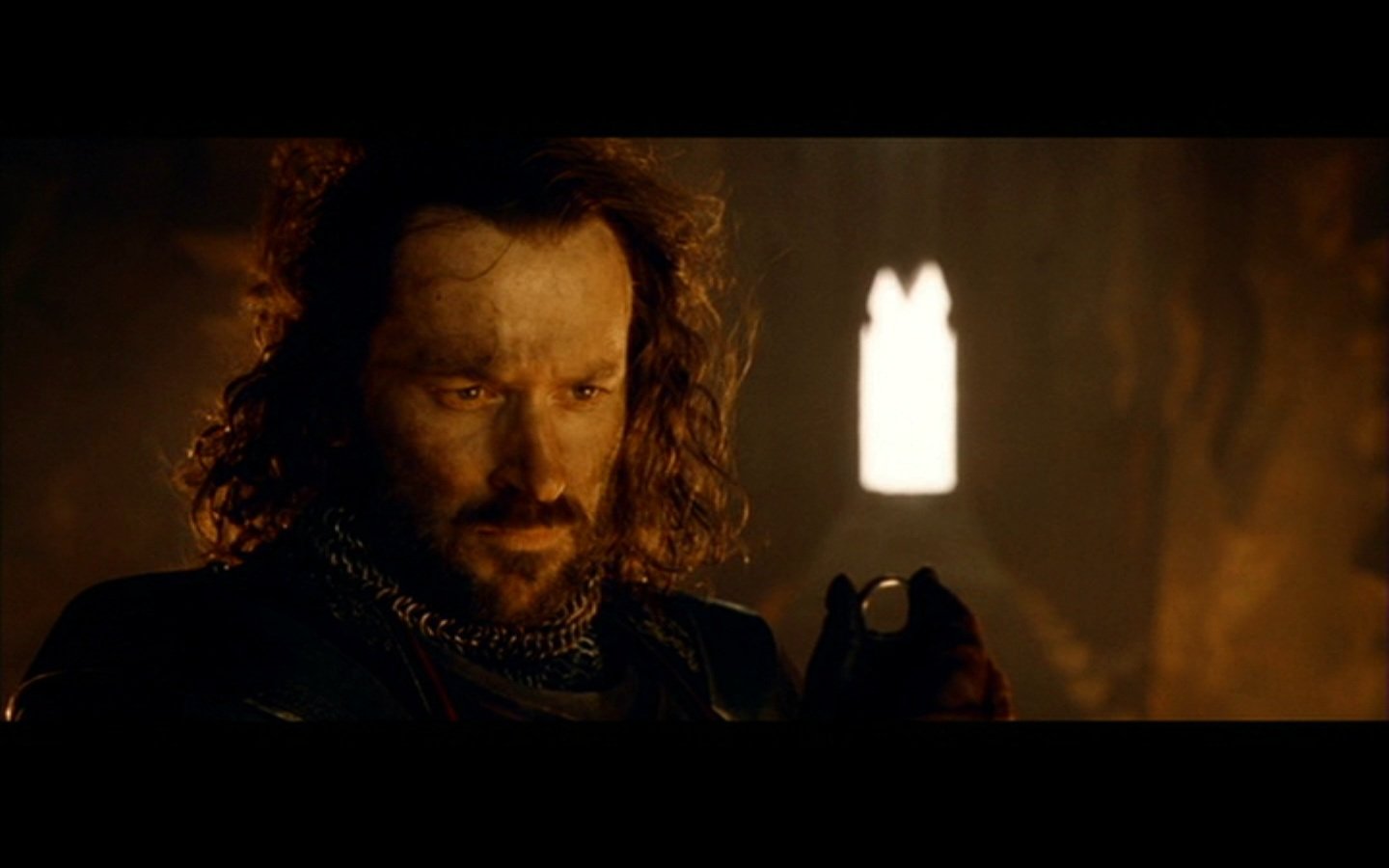
Isildur and The One Ring
Hrok then went to Hroar, and asked for the ring. Hroar replied, "I have given so much to get this ring that I will by no means part with it."

Hrok then asked to see it, saying he wanted to know if it was really "as much a treasure as it is claimed." Hroar readily showed it too him and Hrok threw it into the sea after saying, "I have never seen a comparable treasure, and the reason you esteem the ring so highly is obvious. The best solution, it seems to me, is that neither of us, or, for that matter, anyone else should enjoy it." He had no right to such an action. His claim on the ring was small enough, and Hroar had traded half the kingdom for it. Hroar chopped of Hrok's foot in response. After healing, Hrok assembled an army with which he defeated and killed Hroar. Helgi then defeated Hrok and instead of slaying him, broke all his limbs so that he was a cripple the rest of his life. And this was all between family! Many people searched the waters for the ring and Hroar's son, Agnar, finally found it after diving for it.

So, that's a summary of the ring episode. Although this ring was not imbued with the magical and evil properties that The One Ring possessed, it was coveted in much the same way, resulting in wars and the loss of limbs (Frodo lost his finger, Hrok, his foot). Hrok referred to it as "the great ring," giving it a title, much like, "The One Ring."  In The Lord of the Rings, it was suggested the the ring be thrown into the sea, but that idea was rejected because it could be found again eventually.

However, Hroar's ring could have been an arm ring and not a finger ring like The One Ring.
 
The Saga of Hrolf Kraki. Translated by Jesse L. Bylock. Published by Penguin Books, 1998.

Sunday, May 5, 2013

A thousand years ago feels like yesterday

I felt like they were my neighbors, my relations, my community, these Icelanders from a thousand years ago.

I think it was the style in which their sagas were written.

Many authors these days take an over-the-shoulder, inside-the-soul, point of view with their characters, telling you exactly what the character is thinking and feeling in every excruciating detail. I like that. However, the sagas were not written that way, they were written in a rather external fashion. Yet I felt close to the people.

They seemed real because the lens through which I saw them was as if I were a part of the community. I am told a bit of what they are feeling, I hear of their actions, I know who is best friends with who and how they are related. Just like in real life. In real life I don't know every thought, every pleasure, every pain that passes through my friends, let alone acquaintances that I see frequently.  And so the sagas, by being distant, seem real because I see a community functioning, like my home school co/op, like my extended family, like my Christian community. I see the major events that take place and I hear a little of the inside scoop through those more directly involved.

Additionally the descriptions of people are sometimes vivid, so it's like you can see them. I can see their face and external appearance (physique, clothing), but I can't see their mind. Like real life.

Interestingly, books written in first person or with a very over-the-shoulder view often  leave you guessing as to the person's looks.

They were so human, driven by their feelings of greed, anger, ambition, brokenheartedness and by what was acceptable in their culture.  The women were not meek sheep in the kitchen. A number had strong characters and were driving forces in the stories as they struggled for revenge. And they often manipulated/strong-armed their husbands into getting their way.

And so the sagas easily bridge the gap between then and now, despite culture and language barriers.

Thursday, April 4, 2013

Icelandic Sagas - Translation: What's Lost and Gained.

Somethings are just lost in translation, we all know that. If you can't read the original, somethings are found by reading translations by different authors.

I'm now reading The Laxdoela Saga, translated by A. Margaret Arent (copyright 1964).  Some of the people in this saga also appeared in The Story of Burnt Njal, however their names are spelled differently. Hauskuld/Hoskuld. Unna/Unn. Snorri Godi/Snorri the Priest. Tongue/Tunga. "Godi" is a title for a priest/chieftain so instead of calling him "Snorri the Priest," she called him "Snorri Godi." Additionally, instead of translating the name of his home to "Tongue," she left it as "Tunga."

So, by reading both translations, the notes, and learning a little history, I learned what his name really was (Snorri Godi) and what it meant to those who heard it in his day (Snorri the Priest). "Godi" (more authentically: goði) doesn't just mean "priest," you have to understand how it was used in the days of the sagas. According to Arent in her introduction, the priests of the old Norse religion had lots of power (to be a priest was to be a chieftain). She further explains that when Iceland became a republic, the goðar (plural of goði) automatically became members of parliament, the lawmakers.

Snorri was one of those men. If you read either name by itself, it doesn't mean a whole lot. One must dig into the notes in the book and the history or Iceland itself.

Time makes a difference in  translation. The sagas were written a long time ago and culture has changed considerably since then. The translators also come from different eras, affecting their translations. Sir George Webbe Dasent lived from 1817-1896 (translator of The Story of Burnt Njal, which was first published in 1861).  We now live in a different era with different customs. Sir Dasent used archaic language in his translation (probably even archaic for his time), including English words that are no longer used but approximated the Icelandic word better than any words we have now.

For example, Dasent used the words "boun" and "busked" while Arent used more current language: "made ready, fitted out."  Instead of saying "Easterling" she informs us the person is from Norway. Dasent used the word "daysmen" which refers to an arbitrator. This word appears in the King James Bible in Job 9:33. The King James Bible is from the 1600s, which is well before Dasent's time.

So, what we've got is a story from nearly a millennium ago, translated by a man who lived two hundred years ago (during the Victorian era) who used words atleast two hundred years older than himself (from Shakespeare's time), read by people of a vastly different era (us).

For more on the archaic words themselves:
Icelandic Sagas - A Cultural Glossary and Location Illuminator

Works Cited:
Arent, A. Margaret. The Laxdoela Saga. University of Washington Press, 1964
Dasent, Sir George Webbe. The Story of Burnt Njal. J. M. Dent and Sons LTD, 1960

Sunday, March 17, 2013

Happy St. Patrick's Day

Last year I wrote a little on the meaning of St. Patrick's Day:
Personal Reflections on St. Patrick's Day

This post will give you a glimpse of how, like Joseph, God can do the unthinkable and turn a bad situation to good. A young man who saves his enslavers and those who hate him. Joseph was sold into slavery by his jealous brothers and taken to Egypt. After he interpreted the dream of Pharaoh he was given a position of authority and saved the Egyptians from a seven years famine (by storing grain from the seven years of plenty preceding the famine), and also his brothers who came to Egypt to buy grain since their lands were experiencing the famine too. (Genesis 37, 39-47)

"Joseph said to his brothers, 'I am Joseph! Is my father still living?' But his brothers were not able to answer him, because they were terrified of at his presence....he said to them, 'I am your brother Joseph, the one you sold into Egypt! And now, do not be distressed and do not be angry with yourselves for selling me here, because it was to save lives that God sent me ahead of you.'" (Genesis 45:3-5, NIV)

St. Patrick was taken to Ireland as slave, after gaining his freedom and going home, he returned to Ireland to spread the gospel of salvation.

Imagine doing that. Who has wronged you? Imagine what it would look like for God to redeem that situation, and what he would have to work in your heart for you to do them a good turn. Now, start by praying about your own heart.


Saturday, March 2, 2013

Icelandic Sagas - A Cultural Glossary and Location Illuminator

Although the sagas are translated to English they may use words that are not as familiar to us. The translation I'm reading currently uses some lesser known vocabulary and archaic terms. Below is a list of some that I found in The Story of Burnt Njal, The Laxdoela Saga, and The Story of Rolf and the Viking Bow (although the latter is not a saga, it is written in that style and uses many of the same words and places.)

Icelandic place names tend to be descriptive of the place, and are often translated into English, which, although they make it easier for us to understand, does make it harder if you're trying to find a place on a map.

Glossary

The Althing/the Thing - Icelandic parliament/court system which began in 930 A.D.

Boun - to make or get ready. Or as an adverb: ready, prepared, destined. (http://www.thefreedictionary.com/Boun)

Busk - to make ready, prepare. A Scot's word from Old Norse būask.  (http://www.thefreedictionary.com/Busk)

Combe - a deep narrow valley, or a valley on the side of a hill. A British word. (http://www.merriam-webster.com/dictionary/combe)

Dale - a valley

Easterling - a person from Norway. (From notes in The Story of Burnt Njal)

Ell - a term of measurement. For the Icelanders at the time of the sagas it was 18 inches long. "The Viking ell was the measure from the elbow to the tip of the middle finger, about 18 inches. The Viking ell or primitive ell was used in Iceland up to the 1200s." (http://en.wikipedia.org/wiki/Ell)

Fell - a high barren field or moor. From Middle English, from Old Norse fell, fjall mountain. (http://www.merriam-webster.com/dictionary/fell)

Fey - 1. fated to die, having a premonition of death. 2. able to see the future, having an otherworldly demeanor, crazy. (http://www.merriam-webster.com/dictionary/fey?show=0&t=1363108715)

Firth - a long narrow inlet of the sea.  A Scots word, from Middle English furth from Old Norse fjördhr (The Free Dictionary.)  Notice how the Old Norse word is close to fjord, which also means a narrow inlet of the sea, but refers specifically to those that are a "long, narrow, deep inlet of the sea between steep slopes;" it comes from the same Old Norse word fjördhr . (The Free Dictionary. ) The Icelandic word for firth is  fjörđur (Dicts).

Vetch - a name that refers to a family of plants used for fodder or plant bed cover. Grows 1-4 feet tall. (http://www.merriam-webster.com/dictionary/vetch)

Westfirther - I think this means someone from the Westfjords. The Icelandic word for this location is Vestfirðir. The eth (the funny symbol) is pronounced like "th" in "the." So the word is roughly "vest-feer-theer" similar to "westfirther."  Also, (and I think this is the real reason) "er" can be added to a place name to make it into a people group name. Examples: Iceland, Icelander. Michigan, Michigander.  "Firth" is very close to the word "fjord" in origin, and somehow we got Westfirthers instead of Westfjorders. Perfectly plausible. 

Locations mentioned in these two works

Broadfirth - is Breiðifjörður.  It is a exactly what it's name means: A broad firth. It's the northernmost of the two largest bays on the western face of Iceland. Reykjavik is located on the southern one (Faxafloi).
See Wikipedia for more information. 

Hawkdale - is Haukadalur, and it is a name shared by three valleys.  One is in the Westfjords, one is in Snæfellsnes, and the third is a popular tourist destination, containing geysers, including the famous Geysir.
(Hawksdale locations listed on Wikipedia)

Hvammfirth - the southern inlet of Breiðifjörður (see map below).

Pentland firth - the strait between the Orkneys and Scotland (Wikipedia).

Snowfellsness - Snæfellsnes/snjófellsnes, the promontory dividing Breiðifjörður and Faxafloi.

Thingvellir - Icelandic: Þingvellir. The meeting place of the Althing. A valley with big rifts in it. See my post, Þingvellir - That Great Wonder of Iceland   for a description using photos to illustrate.

Westfjords - Vestfirðir. The large peninsula above Breiðifjörður. Maps available here: Westfjords, Wikipedia
Map of Iceland
Western Iceland

Resources:

I found the translation for Broadfirth and Snowfellness in The Saga Library, edited by William Morris and Eiríkr Magnússon 
This link will take you to "Broadfirth" in the Index, where you can then search for other names.

The Story of Burnt Njal, translated by Sir George Webbe Dasent. J.M. Dent & Sons LTD, London, England. Published 1911. Reprinted 1960.

~This post will be updated as I continue reading the sagas. I am also working on a map with major places labeled, including Thingvellir.~