Saturday, November 16, 2013

Sherlock Holmes (Book character) as an Intuitive Perceiver

Last night as I was reading The Complete Sherlock Holmes in the wee hours of the morning, I came across a rather revealing quote about Sherlock Holmes and his personality type. Across the internet I have seen Holmes labeled as either an INTP or an INTJ (personality types in the Myers-Briggs system). From my own small knowledge of the types, I agree with those who say he is an INTP, which stands for Introverted iNtutive Thinking Perceiving. I'm not going to go into a full analysis, but I just want to show how this quote fits with this conclusion.

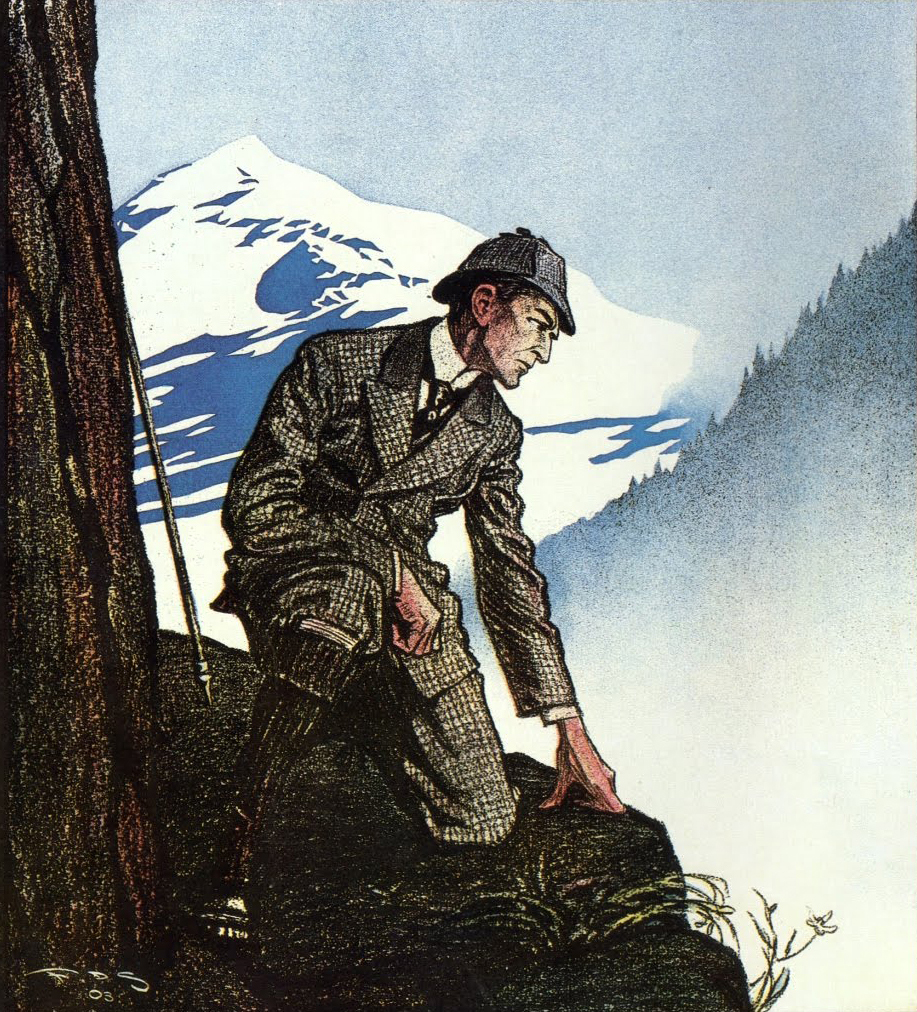
By Frederic Dorr Steele
Holmes said, "I have an instinct for such things, and yet sometimes it has played me false. It seemed a certainty when it first flashed across my mind in the cell at Winchester, but one drawback of an active mind is that one can always conceive alternate explanations which would make our scent a false one." (The Problem of Thor Bridge, page 1069)

This quote points to the fact that Holmes is intuitive (the N) in INTP. There are many references to his instinct and intuition throughout the stories and events that are evidence of it. For more on Holmes' intuition, see the links below. 

The fact that Holmes can "always conceive alternate explanations" to the one he already came up with shows that he is a P (perceiving). The official Myers-Briggs website describes the perceiving function thus: "in type language perceiving means 'preferring to take in information.'" The site states that the following statement is the sort of thing a perceiver might identify with, "Sometimes I stay open to new information so long I miss making decisions when they are needed" (The Myers & Briggs Foundation: Judging or Perceiving). Notice how similar this is to Holmes' own statement. He declares that his ability to come up with new explanations is a drawback of the active mind.

Quote from the book:
The Problem of Thor Bridge, in The Complete Sherlock Holmes, vol. II. By Sir Arthur Conan Doyle. Doubleday & Co, Inc. Garden City, New York. 1930.

For a description of the INTP personality type:
Typelogic INTP profile

For a fuller analysis of Sherlock Holmes' (of BBC's Sherlock) personality type, you might enjoy:
Thinker Intuitor Sensor Feeler: Sherlock's Myers-Briggs Type

Friday, November 15, 2013

The Heart is a Muscle


The heart is a muscle. Both the physical heart and the emotional one. Our feelings may really stem from a part of our brains, yet we say that feelings rise from the heart. Why? Because it pumps our blood which is a symbol of passions.

There is no life without the heart to drive the circulation of blood through the body.  There is no point to life without love. “And if I have the gift of prophecy, and know all mysteries and all knowledge; and if I have all faith, so as to remove mountains, but have not love, I am nothing. And if I bestow all my goods to feed the poor, and if I give my body to be burned, but have not love, it profiteth me nothing.” I Corinthians 13: 2-3.

The heart is a muscle.

A muscle that is overworked aches and knots up. Sometimes it’s a dull ache. When injured, torn, or stretched suddenly the pain is searing, shooting through you. So it is with the heart. When this muscle is used wrong, it aches, it burns, it feels like it is being ripped in half. Sometimes it feels like a heart-attack. 

Like a muscle, the heart needs time to heal from its injuries.

Like a muscle, it needs to be strengthened by slowly increasing what it can bear. Something happens, testing its strength, it lives on through despite the pain, but now it’s stronger than before. Something worse happens, again it hurts, but it lives on though. Something even worse happens and it is ready to be stretched to that limit. If this even worse thing had happened at the heart’s original strength, it would have been too much for it.  You would have died of a broken heart or become as hard as stone.

Saturday, November 9, 2013

The Meaning of "Grotesque"


I had always thought the word "grotesque" meant something gruesome, and/or misshapen in a strange and creepy way.

The word came up a number of times in the Sherlock Holmes stories by Sir Arthur Conan Doyle. However, the men in the stories used it to describe things that were just strange or un-ordinary, I began to wonder if the word had a different meaning back then.

In the book, Watson said, "I cannot see how such a message as this could inspire horror. It seems to me to be rather grotesque than otherwise" (The Gloria Scott, page 374). In this statement, it is clear that something "grotesque" is not necessarily horrific. He said that "grotesque" describes the message better than "horror" and therefore horror does not equate grotesque.

I wondered if these strange but, in no way gruesome events were enough to upset delicate Victorian sensitivities, but no, these events really did not have anything that smacked of immodesty and were generally not even gruesome. There were just that: "strange."

Fortunately, the book itself answered my question by asking it:

"'I suppose Watson, we must look upon you as a man of letters,' said [Holmes]. 'How do you define the word 'grotesque'?' 

'Strange—remarkable,' [Watson] suggested." (The Adventure of the Wisteria Lodge, page 869)


There we have it.

However, Holmes had begun to see another side to the word. The passage continues:

"'There is something more to it than that,' said [Holmes]; 'some underlying suggestion of the tragic and terrible. If you cast your mind back to some of those narratives with which you have afflicted a long-suffering public, you will recognize how often the grotesque has deepened into criminal. Think of that little affair of the red-headed men. That was grotesque enough at the outset, and yet it ended in a desperate attempt  at a robbery. Or, again, there was that most grotesque affair of the five orange pips, which led straight to a murderous conspiracy. The word puts me on the alert.'" (869)

While reading this passage, one must read "grotesque" as "strange" in keeping with the rest of the book, yet here we see that Holmes said that events that start as bizarre, often turn out to be criminal affairs. The word grotesque has begin to take on the darker connotations many people have today.

Holmes later said, "as I have had occasion to remark, there is but one step from the grotesque to the horrible" (888). So, still, the word does not mean horrible, and in my own definition I note a distinct difference between them due to nuance. However, I feel that now, in the current day usage, the word "grotesque" has stepped from "strange" to "horrible" in the sense that "grotesque" can describe things that inspire horror, it can indicate gruesomeness.

I asked my friends to define the word "grotesque" without the aid of the dictionary. Here are some of their responses: 

"I've always thought of it as frightening and unnatural."

"I always think of twisted stone statues..."

"I think in general it means gross but I generally associate it with something relating to gore or something unthinkable."

"I always think of something gross, but the 'esque' always makes me think of art, so I think of something that at first glance is gross but after taking a closer look is beautiful, or was meant to be so by someone for a certain audience." 

"Disfigured, ugly, gargoyle-like, disgusting, twisted from the normal form"

 To some "grotesque" is more along the lines of Watson's definition, while to others the definition involves some thing twisted or gross.

One important source we have not looked into yet is the dictionary: 

"Grotesque" as an adjective:
Farlex 
1.Characterized by ludicrous or incongruous distortion, as of appearance or manner.
2 Outlandish or bizarre, as in character or appearance. See Synonyms at fantastic.
3. Of, relating to, or being the grotesque style in art or a work executed in this style.

"Grotesque" as a noun:
a. a style of decorative art characterized by fanciful or fantastic human and animal forms often interwoven with foliage or similar figures that may distort the natural into absurdity, ugliness, or caricature.
So, I find several overlapping definitions of the word at play here.  These online dictionaries and Watson record the word as meaning "strange" and "bizarre" and this I suppose is the "correct" meaning.  The dictionaries also included twistedness in their definitions and a definition pertaining to art. In general usage these days it has a connotation of horrible and twisted. Some are aware of the art style too. To Holmes, the word meant "strange" with a nuance of "tragic and terrible" while indicating criminal activity.

~Update: In Anne of the Island, but L. M. Montgomery, we find this phrase:  "Must proposals be either grotesque or --horrible?"  Grotesque and horrible clearly have different meanings here, in accordance with the Sherlock Holmes stories. The copyright is 1915, definitely contemporary with Sir Doyle, although later than the publication of The Gloria Scott by over ten years.~

Sunday, October 20, 2013

The Details

Moss, Iceland

It is in the little things that I see God. In the tiny flowers, shiny acorns, lichen on rocks, and the multicolored sheen of a feather. When the timing and details work out. When He brings the right person along to comfort my lonely aching heart, or a stranger to get my vehicle out of a snowy rut, disentangle my gauchos from my bike chain (yes, that really did happen) or someone to walk me home in the dark. How could all these details that depend so much on the right timing or the right words at the right time have worked out just fine unless He was orchestrating them?

It's in these details that I see God's love and provision for me. It's also in the details that I learn of His existence.

Did God create the universe? Elementary! His fingerprints are all over creation. All evidence points to not only His existence, but His hand in crafting the universe and it's diversity.

On the molecular level, the intricacy of the details that have to work out just right for life to exist is astounding. There is no way they could have happened by chance.

If in my petty, day-to-day wishes, I don't get what I want or think I need, then I obviously didn't need them. He cares enough to teach me to be strong.

It's always been about the details for me. Small things are hugely important. It could be a beautiful day, and everything could be going my way, but if harmony was broken in some small way, it is as if a cavernous rift had opened.

Little things often upset me. The robe my mother gave me when I was a child was beautiful but it was itchy, and so was the long underwear. I cast them off, refusing to wear them ever again. I was a fussy baby: too hot, too cold, my clothes not soft enough. I fussed instead of slept unless my parents cradled me in their warm arms and I knew I was safe. How safe I find myself under the protection of my Heavenly Father!
When the details work out just so, it's like God is comfortingly laying his hand on my back, telling me that He is there, watching out for me. And who am I out of all the people in the world that He should care for me? Yet He is there, caring for all his children down to the minutiae of their lives, just as in mine.

Gullfoss, Iceland
As water flows over a cliff, it separates. The water descends in pieces, each sheet of water drops alone, yet together they sound the mighty roar of the cataract.  So may we all sound God's glory and might. Waterfalls speak to the mighty and terrifying power of God. Yet, they are made of tiny drops, and each drop is made of molecules, which are made of elements, which are made of protons, electrons, and neutrons, which, as some have begun to say, are made of something smaller still.

The details.The overwhelming, comforting, astonishing details! How I love them and how I love God for creating them and showing me His love through them.
Sunday, October 6, 2013

Sherlock Holmes...a fibre in the fabric of society

Whenever I look up a definition of a word or phrase from the Sherlock Holmes books, either the story is mentioned in the examples/article or the first results are for the story itself... I think these stories have permeated the fabric of our society.

Saturday, September 7, 2013

Drugs, Then and Now.

I love reading books written in the past that are set in present/recent past in relation to the author's life. It's so enlightening to be able to see what people thought about different topics, what they knew scientifically, and to see their social customs through their own eyes.

I just started reading The Sign of Four, by Sir Arthur Conan Doyle, and published in 1890 (Sherlock Holmes - Wikipedia). It begins with a dialogue between Holmes and Watson that sounds as if it could have taken place today. Well, not with the exact same words, but the argument seems essentially the same. 

By Sidney Paget
Watson is disturbed at seeing Holmes injecting himself and finally broached the subject with, "What is it today? Morphine or cocaine?"

Holmes replied that it was cocaine and asked if he would like to try some. Watson replied with a stout refusal, and they proceeded to debate the use of cocaine.

Let's dissect their arguments a little bit. Below each quote are my thoughts. I've highlighted the different parts of the argument with the same color as my thought about that statement. So, the second red sentence is my thought about the red sentence in the quote. The second purple sentence corresponds to the purple sentence in the quote. Etc.

Holmes said, "I suppose that its influence is physically a bad one. I find it, however, so transcendingly stimulating and clarifying to the mind that its secondary action is a matter of small moment."

He acknowledges that the drug has negative physical effects. But he uses it anyhow because of the feeling it gives him. This is typical. He claims that it helps him think. I've heard that one before too.  Certain drugs are said to give one an out of this world feeling (transcendence) and to be stimulating.

Watson answered with, "Your brain may, as you say, be roused and excited, but it is a pathological and morbid process, which involves increased tissue-change, and may at last leave a permanent weakness. you know too, what a black reaction comes upon you. Surely the game is hardly worth the candle. Why should you, for the mere passing pleasure, risk the loss of those great powers with which you have been endowed? Remember that I speak not only as one comrade to another, but as a medical man to one for whose constitution he is to some extent answerable."

He stresses the fact that cocaine has detrimental, long-lasting, permanent side-effects. He points out that it is not worth the risk, and makes his argument personal by warning that the cocaine could damage Holmes' intellect which is his greatest pride. Watson (like anyone making a good argument) validates his speech with relevant credentials. 

We really don't give people in the past enough credit for what they did know. In this case, that would be Sir Arthur since Watson and Holmes are his creations and not real people at all, but he, the author, had to know the pro and con arguments in order to write them into his book. I find it amazing that this argument, which is pertinent today, was actually basically the same then and now.

Wednesday, September 4, 2013

A Visit to the Library

The fourth floor of the campus library. Silence is the law. The only sounds are the turning of a few pages.

Yet I could hear the books screaming at me. As I walked by they flashed their golden words, like official badges, like name cards, like the skirts of flamenco dancers, trying to cause me to pause, pick them up and take them home. Like dogs at the humane society, row upon row, yapping, barking, baying, whining, pawing for someone to stop and pay attention.

I had wandered there for some time, mingling with the books like one does at a social gathering.  

This introduction was made to me, "If you have never met Sherlock Holmes, you have already wasted too much time. Take this slim volume away immediately to some sequestered safehouse and begin your involvement."* "Oh, fine!" I cried in a whisper, mentally throwing up my hands. I clapped the book onto my stack.

 From rows away I heard the Icelandic literature calling me, while golden letters on a binding caught my eye as I marched to answer the call.

I mentioned that this was a campus library, and that is the beauty of it. Shelves of classics and books about the authors. Books in French, books on language, oh what a glorious colloquy of the ancients! For now that I have my degree, I actually have time to read these books.

Reference:
*The quote is from the Foreward in A Study in Scarlet and The Sign of Four, by Sir Arthur Conan Doyle. Editor: Sandy Lesberg. Peebles Press International, New York:1975.