As I've said before, I'm an ISFJ.
This means that my fourth and least developed function is Extroverted Intuition. The websites I've read have said that as such, our intuition can steer us wrong. Joe Butt says, "ISFJs are easily undone by Extraverted iNtuition, their inferior function" (Humanmetrics.com: ISFJ).
Now, that's my weakest function. That's what I'm bad at. My intuition is a funny thing, and I'm only vaguely conscious of it. Sometimes I'm not sure if what I'm listening to is my extroverted intuition or my women's intuition, or something else entirely.
There are times when my intuition is spot on, and there are other times when I can't trust it. Is that all in my head? Do they actually not like me? I'll walk around with an uncomfortable feeling, it isn't right, how can we regain peace? Then I turn to prayer.
Sometimes I'll think of something to say in a situation and then I'll get a feeling: don't say that. If I do say it, sometimes I regret it, sometimes not.
One time though, a friend told me that he couldn't meet me as planned, his parent's wanted to talk to him about something. I could easily explain it away as not a big deal, but my gut wouldn't accept that. Whenever I thought about it, I began to shake. My legs trembled. I felt cold and my heart felt strange. The fear overwhelmed me, I could logically explain it away and make sense of it in my head and come up with some non-dire explanation. But I couldn't accept that. It turned out my intuition was correct. My friend admitted that something was wrong, and agreed to tell me in a few days. During those few days of anxious waiting, my brain pondered and I figured out what had happened ahead of time. I was calm when the blow fell. I felt almost nothing, my heart was a lump of dead flesh. Now, on Funky MBTI Fiction I read that the fourth and weakest function "often only turns up under extreme stress or anxiety." This was a case of extreme stress and anxiety and this issue that my intuition cued in on was not the only anxiety I was facing at the time. I remember hunching up in a boxed in corner of my bedroom sobbing on the phone to my best friend...
Another facet of having extroverted intuition as the fourth from your longest and strongest suite (to use a bridge term) is not always knowing what to say to people or being able to understand their meaning. ISFJs "aren't quite as good at reading others as their extroverted counterpart. The ISFJ needs external indicators to understand what is required from them and can sometimes get wrapped up in their own internal world and forget to check their Ne." (ESFJ vs. ISFJ)As a side note on this: it also really stinks when you realize your world in your head isn't real, and the characters in your story aren't quite so pure and noble as you thought they were.... This has happened to me, and it seems to have also happened to Dr. John Watson (aslo an ISFJ) in BBC's Sherlock,
When I'm in a conversation usually, feelings of warmth and support are there, but they stumble out of my mouth in awkward words, too deep, not deep enough, not quite what I meant to say or how I wanted it to sound. Or I keep quiet out of fear of saying the wrong thing. Later, my brain catches up to my heart and I think of a much better way to say it. (Guess why I like writing?)
I really don't understand my fourth function, I'm just trying to give some examples of what it's like to have extroverted intuition as your weakest function. Try performing brain surgery on yourself...it's like that...
Showing posts with label MBTI. Show all posts
Showing posts with label MBTI. Show all posts
Tuesday, September 30, 2014

Tuesday, July 15, 2014
The Hobbit and Huntingtower
The Hobbit was written by J.R.R Tolkien and published in 1937. The first two installments of the film trilogy by Peter Jackson were released in 2012 and 2013. Huntingtower was written by John Buchan and published in 1922.
The Hobbit (especially the film) and Huntingtower have a number of commonalities:
1. The main character from The Hobbit, Bilbo Baggins is 50 years old while the main character of Huntingtower, Dickson McCunn is 55.
2. Both Bilbo and Dickson are well to do, respectable people.
3. Both suddenly and unexpectedly set off on adventures.
4. Both had small companions in strange garb.
5. Dickson is fond of books and brings some with him, while books are also important to movie Bilbo who says, "I miss my books, I miss my armchair..." (etc.)
6. Dickson was a grocer until he retired, and in The Hobbit film one of the dwarves remarks of Bilbo, "He looks more like a grocer than a burglar."
7. Dickson is an ISFJ and Bilbo is said to be an ESFJ.
8. Bilbo (in the movie, but not in the book) and Dickson set off with walking sticks.
9. Dickson was setting forth on a walking holiday, and Bilbo liked walks, "I got as far as Frogmorton once," (The Hobbit: An Unexpected Journey).
10. Bilbo said, "It's a dangerous business, Frodo, going out your door. You step onto the road, and if you don't keep your feet there's no knowing where you might be swept off to," (The Lord of the Rings). This accurately describes the adventures of Dickson, he set out on a holiday and was quickly swept up into an unexpected adventure.
11. Dickson and Bilbo (film) had sandy colored hair.
The Hobbit (especially the film) and Huntingtower have a number of commonalities:
1. The main character from The Hobbit, Bilbo Baggins is 50 years old while the main character of Huntingtower, Dickson McCunn is 55.
2. Both Bilbo and Dickson are well to do, respectable people.
3. Both suddenly and unexpectedly set off on adventures.
4. Both had small companions in strange garb.
5. Dickson is fond of books and brings some with him, while books are also important to movie Bilbo who says, "I miss my books, I miss my armchair..." (etc.)
6. Dickson was a grocer until he retired, and in The Hobbit film one of the dwarves remarks of Bilbo, "He looks more like a grocer than a burglar."
7. Dickson is an ISFJ and Bilbo is said to be an ESFJ.
8. Bilbo (in the movie, but not in the book) and Dickson set off with walking sticks.
9. Dickson was setting forth on a walking holiday, and Bilbo liked walks, "I got as far as Frogmorton once," (The Hobbit: An Unexpected Journey).
10. Bilbo said, "It's a dangerous business, Frodo, going out your door. You step onto the road, and if you don't keep your feet there's no knowing where you might be swept off to," (The Lord of the Rings). This accurately describes the adventures of Dickson, he set out on a holiday and was quickly swept up into an unexpected adventure.
11. Dickson and Bilbo (film) had sandy colored hair.
 |
| Bilbo Baggins, played by Martin Freeman |
Dickson McCunn: ISFJ and Modest Hero
I recently listened to the LibriVox recording of Huntingtower, by John Buchan, published in 1922. I was on a long drive across the country and I admit I fell asleep a few times. I hope to actually read the book soon. As I listened, I almost instantly fell to analyzing the main character of this unusual tale, Dickson McCunn. It soon became apparent to me that he was an ISFJ.
I had him pinned down as an SJ, a Guardian, pretty quick. These are the people who are traditional and do what is expected of them and generally believe in upholding law and order. Dickson had lived a pretty normal life up until the book began. He had been a grocer until his retirement and he had done well in this profession and retired fairly wealthy. He described himself as "happily married for 30 years." He was also a responsible, providing type person. At the beginning, he gave some money to help some local urchins to go camping, and at the end, on seeing what fine boys they were he became their patron and decided to help them to great careers.
I had some trouble deciding if he was a Thinker or a Feeler. Then, Dickson was faced with a decision that drove the plot for the rest of the book. He had an initial gut reaction to get away from this odd, dangerous situation. Then he turned to thinking out his decision (Ti is the ISFJ's third function) and he busily worked out in his head why he no longer need take part in this adventure. He had it all logically thought out when he remembered the face of the girl in danger in his mind, and she had a peculiar expression that reminded him of his deceased daughter. (ISFJs have strong memories for details like expression. Portrait of an ISFJ).This clinched it for him, he was going back to help her. That is a perfect example of how an ISFJ makes decisions based on Fe, their secondary function, while first engaging their Ti, their tertiary function. I have use the same process myself, figuring it all out logically (using Ti), making excuses for myself and my initial gut reaction, and then when it comes down to it, doing what my feelings tell me is right (Fe). My feelings consume me for a moment and refuse to let me do anything other than but what they feel is right.
Dickson's next actions were classic ISFJ/ESFJ. He returned, but not without proper preparations. He bought a gun and brought food and thoughtful gifts back to his beleaguered companions. He not only provided, but did so in a thoughtful way that sought to meet the others' personal needs for comfort, not just generic needs for food.
Dickson is definitely and Introverted Sensor. He was very self-aware and analyzed himself constantly throughout the story. He wanted to come through this adventure without regrets or shame, knowing that he had done his bit, his duty (an SJ driving force), and had been brave. From my own experience and from what I've read, ISFJs are tied to the past, we think of life as a story, so while in the present, we want to make sure that we will be able to look back at our own story, our own past, without having to be stung by our consciences for doing the wrong thing or being a coward.
So, we come to the final question, how do we know that he is an Introvert and not an Extrovert? Well, he set off alone on a walking holiday. Key word: ALONE. He didn't need other people to have a good time, he had his books and himself. But, that in itself isn't much to go on. So, additionally, The ESFJ functions, in order of strength are Fe, Si, Ne, and Ti, while the ISFJ functions are Si, Fe, Ti, Ne. If Dickson were an ESFJ, we'd see him use his intuition more. Funky MBTI Fiction says that, "ESFJs are very good at reading people." Dickson has very few flashes of intuition and isn't particularly gifted at reading people correctly. Joe Butt wrote, "ISFJs are easily undone by Extroverted iNtuition, their inferior function." Instead, Dickson is more of a Ti user. For more on the differences between ESFJs and ISFJs and the significance of these functional differences please read Funky MBTI Fiction's post, see link above.
There are a plethora of little instances that point to the fact that Dickson is an ISFJ, perhaps when I have an opportunity to get my hands on a paper copy of the book I will delve into a more exhaustive analysis.
One more little thing: one of the reasons I really enjoyed this story was because it lent itself so well to analysis and as an ISFJ, myself, I could really relate to Dickson's decision making process, his romanticism spurred by the books he'd read, his shock at hearing someone lie, his shy, quiet manner of giving gifts, and his desire to do his duty and be a hero in what is thrown his way even if he's not THE hero of the story.
I had him pinned down as an SJ, a Guardian, pretty quick. These are the people who are traditional and do what is expected of them and generally believe in upholding law and order. Dickson had lived a pretty normal life up until the book began. He had been a grocer until his retirement and he had done well in this profession and retired fairly wealthy. He described himself as "happily married for 30 years." He was also a responsible, providing type person. At the beginning, he gave some money to help some local urchins to go camping, and at the end, on seeing what fine boys they were he became their patron and decided to help them to great careers.
I had some trouble deciding if he was a Thinker or a Feeler. Then, Dickson was faced with a decision that drove the plot for the rest of the book. He had an initial gut reaction to get away from this odd, dangerous situation. Then he turned to thinking out his decision (Ti is the ISFJ's third function) and he busily worked out in his head why he no longer need take part in this adventure. He had it all logically thought out when he remembered the face of the girl in danger in his mind, and she had a peculiar expression that reminded him of his deceased daughter. (ISFJs have strong memories for details like expression. Portrait of an ISFJ).This clinched it for him, he was going back to help her. That is a perfect example of how an ISFJ makes decisions based on Fe, their secondary function, while first engaging their Ti, their tertiary function. I have use the same process myself, figuring it all out logically (using Ti), making excuses for myself and my initial gut reaction, and then when it comes down to it, doing what my feelings tell me is right (Fe). My feelings consume me for a moment and refuse to let me do anything other than but what they feel is right.
Dickson's next actions were classic ISFJ/ESFJ. He returned, but not without proper preparations. He bought a gun and brought food and thoughtful gifts back to his beleaguered companions. He not only provided, but did so in a thoughtful way that sought to meet the others' personal needs for comfort, not just generic needs for food.
Dickson is definitely and Introverted Sensor. He was very self-aware and analyzed himself constantly throughout the story. He wanted to come through this adventure without regrets or shame, knowing that he had done his bit, his duty (an SJ driving force), and had been brave. From my own experience and from what I've read, ISFJs are tied to the past, we think of life as a story, so while in the present, we want to make sure that we will be able to look back at our own story, our own past, without having to be stung by our consciences for doing the wrong thing or being a coward.
So, we come to the final question, how do we know that he is an Introvert and not an Extrovert? Well, he set off alone on a walking holiday. Key word: ALONE. He didn't need other people to have a good time, he had his books and himself. But, that in itself isn't much to go on. So, additionally, The ESFJ functions, in order of strength are Fe, Si, Ne, and Ti, while the ISFJ functions are Si, Fe, Ti, Ne. If Dickson were an ESFJ, we'd see him use his intuition more. Funky MBTI Fiction says that, "ESFJs are very good at reading people." Dickson has very few flashes of intuition and isn't particularly gifted at reading people correctly. Joe Butt wrote, "ISFJs are easily undone by Extroverted iNtuition, their inferior function." Instead, Dickson is more of a Ti user. For more on the differences between ESFJs and ISFJs and the significance of these functional differences please read Funky MBTI Fiction's post, see link above.
There are a plethora of little instances that point to the fact that Dickson is an ISFJ, perhaps when I have an opportunity to get my hands on a paper copy of the book I will delve into a more exhaustive analysis.
One more little thing: one of the reasons I really enjoyed this story was because it lent itself so well to analysis and as an ISFJ, myself, I could really relate to Dickson's decision making process, his romanticism spurred by the books he'd read, his shock at hearing someone lie, his shy, quiet manner of giving gifts, and his desire to do his duty and be a hero in what is thrown his way even if he's not THE hero of the story.
Tuesday, May 27, 2014
Confessions of an ISFJ

Confessions of an ISFJ:
1. I have no idea how to handle unforeseen social situations.
I think this is because I am a Sensor and I rely on my past experiences to guide my behavior. In a situation I have never experienced before I don't have the data of previous similar experiences needed to construct protocol. This causes me to him-haw or just gape stupidly while my brain wildly tries to figure out what to do.
2. I give myself a little talk before going to a social event, creating occasion-specific rules for myself. "You will not mention____. You will not push yourself forward. You will be quiet and not interrupt. The less you say, the less stupid things you'll say and regret later." Or, "You will exude quiet confidence, you will stand up for yourself and what's right." After any social event, I need time alone to analyze what just happened and create more rules for myself. (After typing this, I found this related quote on Funky MBTI Fiction which said ISFJs and ESFJs will "reevaluate their behavior, relationships, work experiences, and lifestyle to determine if it needs improvement.")
3. I once I wrote ten pages of sheer description of a painting for an assignment when only five where required. Some were a little daunted by this assignment but I wasn't much because I was glad I didn't have to draw a conclusion or defend a theory. Child ISFjs might not be capable of summary, but instead feel the need to include ALL details (funny personal story). For more on ISFJ writing tendencies (almost all true for me) : http://andreajwenger.com/2010/03/06/isfj-writing-personality/
4. I like to go to the store as opposed to shopping by catalogue or online. I like to actually see and physically touch the items I'm thinking of buying. I think this could be a Sensor trait.
5. I've discovered that violent emotions will shut an INTP and an INTJ down. It will NOT create sympathy, they'll just leave the room as fast as possible and possibly think less of you. (Personal experience)
6. When I'm at an event I pick one person as my special buddy to stick to. Sometimes we part for a little while to chat with different people or play different games but I will come back to them and check-up on them or go and "stick to them" when I feel out of place elsewhere. They're my anchor for that event.
7. Don't forget my birthday. Doing so says, "I don't love you." We don't want to ask people to do anything special for us, but forgetting our birthday hits upon deeply rooted convictions about love we're unaware of ourselves. If you do something for one of us ISFJs on our birthday, we will think of you with more warmth than we already did. (I'm guessing this principle is translatable to other special occasions instead of birthday, an ISFJ may have special inviolable traditions or ideas of how something should be celebrated.)
8. Sometimes my feelings take over. I will figure out what I think I should do and then when I'm confronted with the actual situation, I follow my heart anyhow. This is not for areas of major moral dilemma, just small things. For example, being placed on one team but switching to the other so as to be on the same team as your significant other.
9. I use emotion to communicate what I want to say even if I can't get the right words out. If I'm irritated, everybody knows. It's not so much in what I say, but in how I say it, or how I move, or huff, or glare.
10. I feel very honored when someone confides in me and comes to me for emotional support, advice, or protection.
11. Sometimes I look forward to danger or distress with anticipation because I like to protect people. So, if there's a weird guy annoying a friend and they ask me to help them, I am thrilled. I'll walk with that friend, I'll invent honest ways to break-up a conversation between him and her, whatever. So, if you're in trouble and I can help, I really enjoy helping or defending you, even though it's unfortunate you're in a tough spot. I find myself day-dreaming scenarios of potential problems and how I can be a hero in them. (This also prepares me for problems when they arise, since I don't think on my feet very well...?)
12. I seem shy and timid but then suddenly I'll let my wild side show which shocks people. I even tone it down so as to freak people out less. According to Dave's video (link below too) this is caused by the ISFJ's secondary function: Extroverted Feeling (Fe): "This is why the ESFJ and ISFJ have the gold star for being the most crazy, bi-polar.....by day they're in a traditional job and they're very good at it and then at home all that extroverted feeling is allowed to come out."
13. Change just really freaks me out. When first confronted with a novel idea, my response is "NO." Five minutes later, I'll already be warmer to it than I was. I just need some time to think a new idea through and become used to it. If it's a request for help, this scenario may be reversed.
14. Defender mode. I scare myself sometimes....I growled at a soccer ball once while playing defense. I actually growled at it instinctively. Another time we were playing with larps and I was defending an imaginary king. A friend noticed that once my opponents got past me and attacked the king I would switch from just warding them of but not fulling engaging in combat to fighting madly like a berserk maniac to save and avenge my king (who didn't even exist). If I've got someone to protect something just wells up inside and suddenly I'm not that timid and shy little person, suddenly "I've got the eye of the tiger, a fighter, dancing through the fire, I am a champion, and you're gonna hear me roar. (Katy Perry, Roar)."
15. I wear comfortable, protective footwear so I'm ready for anything. Some studies suggest ISFJs tend to wear practical, comfortable shoes.
In Conclusion I'd like to say that just because another ISFJ does something doesn't make it right! These are not excuses for fits of rage or following your heart. If you are an ISFJ, I hope this helps you understand yourself better/gives you something to relate too. With some of these, I don't know that they're particularly ISFJ traits, but rather they are ways the ISFJ functions are exhibited in me in conjunction with my upbringing and my own function percentages/balance. Therefore, some ISFJs will relate and some probably won't but that doesn't make you any less an ISFJ.
If you're reading this and you are not an ISFJ, I hope this helps you understand your ISFJ better.
These are things that I've noticed about myself and seem to fit with what I've learned about ISFJs on these websites:
ISFJ Profile on TypeLogic by Marina Margaret Heiss and Joe Butt.
Portrait of an ISFJ at PersonalityPage
Sensor Feeler Thinker Intuitor on Sherlock Character Analysis tumblr. This one helped me see how the functions play out in an ISFJ.
ISFJ vs. ISFP by DaveSuperPowers, video on youtube This one says ISFJs can be crazy.
Type Contrast: ESFJ vs ISFJ on Funky MBTI Fiction
Thursday, May 15, 2014
Confusion, Counselors, Cats, and Comfort: An anecdote on MBTI types and emotion.
Continuing in my mini-series on personality types, here's another little snapshot of personalities playing out in my family. Enjoy!
I was sitting at the table talking to my mom about my emotional state.
My mom, an INFJ--this type is also known as The Counselor-- was listening, offering advice, and probing my heart.
As an ISFJ, "often unable to either hide or articulate any distress they may be feeling" (Joe Butt, TypeLogic), I sighed, "I don't even know what I feel." Numbness throbbed in my chest, partially obscuring my sadness and anger which was also strangely mixed with a dash of hope and excitement.
Now, both my dad and I love cats, and it's a bond that we have. On seeing I was sad, he reappeared with one of our cats which he wordlessly handed to me. It was like he was saying, "I can't fix your emotional problem, but have a cat. Cats are comforting."
I couldn't help chuckling as I hugged our gray cat. I had found the INTP solution to emotional distress: Apply cat directly to problem.
This thought caused further mirth as I pictured sticking my cat onto certain people's faces.
From my experience, INTPs are not comfortable with emotions in others, they don't know how to delve into them and explore them out. I think emotions distress them, they want to fix them and turn off negative emotions in others if they're not too overwhelming. The volatile and violent expression of emotions, like screaming in rage, will turn the INTP off, he'll just leave the room. Since mine were quietly expressed in this instance he was willing to try and comfort me.
 ~I read this to my dad before posting and he laughed.~
I was sitting at the table talking to my mom about my emotional state.
My mom, an INFJ--this type is also known as The Counselor-- was listening, offering advice, and probing my heart.
As an ISFJ, "often unable to either hide or articulate any distress they may be feeling" (Joe Butt, TypeLogic), I sighed, "I don't even know what I feel." Numbness throbbed in my chest, partially obscuring my sadness and anger which was also strangely mixed with a dash of hope and excitement.
Now, both my dad and I love cats, and it's a bond that we have. On seeing I was sad, he reappeared with one of our cats which he wordlessly handed to me. It was like he was saying, "I can't fix your emotional problem, but have a cat. Cats are comforting."
I couldn't help chuckling as I hugged our gray cat. I had found the INTP solution to emotional distress: Apply cat directly to problem.
This thought caused further mirth as I pictured sticking my cat onto certain people's faces.
From my experience, INTPs are not comfortable with emotions in others, they don't know how to delve into them and explore them out. I think emotions distress them, they want to fix them and turn off negative emotions in others if they're not too overwhelming. The volatile and violent expression of emotions, like screaming in rage, will turn the INTP off, he'll just leave the room. Since mine were quietly expressed in this instance he was willing to try and comfort me.
Tuesday, April 29, 2014
Pens and Personality : A Polaroid from the Past
Did you know that a simple pen can give great insight into personalities? My mother discovered this one day.
Our mom home-schooled us and one day she had us all at the kitchen table for a writing assignment. She gave us each a brand new pen while explaining the assignment. Suddenly, our personalities came to life before her eyes through the different actions we chose to take with our pens.
I began to ask for more specifics about the assignment. I'm the first-born, a conscientious Melancholy and duty-fulfiller ISFJ. I wanted to know exactly what was expected of me and I wanted to do it right. The pen was just a pen to me at that moment.
Our resident performer, the baby of the family and a Sanguine, stood up on his chair --not an unusual occurrence in those days-- and began waving his pen about like a baton, grandly and loudly telling us what he was going to do. He's an ENFJ, but back then it was just obvious that he was an extroverted Sanguine and acted more like an ESFP.
My mother then looked over at the quiet INTJ, the middle-child and a Phlegmatic. He had taken his pen apart and the pieces were neatly laid out in front of him. From many little incidents, this one included, it was obvious to us that he was the "engineering type."
Please note: I don't know how The Humoral Personality System relates to Myers-Briggs. From my own experience, I wouldn't say all INTJs are phlegmatics nor are middle-children all Phlegmatics either. The same can be said with all the other personality types expressed, especially in connection to birth order. Not all ISFJs are necessarily Melancholy, but I suspect that Melancholy is either the prime or secondary type in their personality since Introverted Sensing is an ISFJ's primary function.
Our mom home-schooled us and one day she had us all at the kitchen table for a writing assignment. She gave us each a brand new pen while explaining the assignment. Suddenly, our personalities came to life before her eyes through the different actions we chose to take with our pens.
I began to ask for more specifics about the assignment. I'm the first-born, a conscientious Melancholy and duty-fulfiller ISFJ. I wanted to know exactly what was expected of me and I wanted to do it right. The pen was just a pen to me at that moment.
Our resident performer, the baby of the family and a Sanguine, stood up on his chair --not an unusual occurrence in those days-- and began waving his pen about like a baton, grandly and loudly telling us what he was going to do. He's an ENFJ, but back then it was just obvious that he was an extroverted Sanguine and acted more like an ESFP.
My mother then looked over at the quiet INTJ, the middle-child and a Phlegmatic. He had taken his pen apart and the pieces were neatly laid out in front of him. From many little incidents, this one included, it was obvious to us that he was the "engineering type."
 |
| Photo Credit: Edana A. |
Tuesday, April 22, 2014
A real life example of Sensing vs Intuition
I'm not at all an expert on Myers-Briggs, but I've been reading, studying and exploring this personality system and there are times when I can see it playing out in my life. We didn't learn about Myers-Briggs until these last few years but looking back I have some fond family memories of our distinct personality types being clearly exhibited. I'm an ISFJ (Introverted Sensing Feeling Judging) and one of my brothers is an INTJ (Introverted Intuition Thinking Judging). Therefore, I'm a sensor (S) and he is intuitive (N).
The Myers Briggs website defines the differences between Sensing and Intuition by asking these questions: "Do you pay more attention to information that comes in through your five senses (Sensing), or do you pay more attention to the patterns and possibilities that you see in the information you receive (Intuition)?"
Sensors identify with these statements: "Paying attention to physical reality, what I see, hear, touch, taste, and smell. I’m concerned with what is actual, present, current, and real. I notice facts and I remember details that are important to me."
Those who rely on intuition identify with these statements: "Paying the most attention to impressions or the meaning and patterns of the information I get....I remember events more as an impression of what it was like than as actual facts or details of what happened."
Here is one anecdote that demonstrates the difference between a Sensor and an Intuitive:
When we were young, my mom read Bible stories to us from a children's bible. After the story she had us each recount what we could remember. I usually did quite well, (granted I had the advantage of being two years older than my INTJ brother and five years older than the ENFJ one, however they had their own abilities).
I remembered almost all the events and details in the story, even down to specific words. One time, after listening to a shorter story, I began to retell it word for word. Of course I didn't make it all the way to the end like this, but I got most of it word for word with a little help, then my mom read it again and had me try again since I was so close and I got it pretty much spot on. We were all shocked and amazed, myself included.
My INTJ brother had trouble remembering the details. His detail retention was probably about 50% of mine. My mom started to switch up the exercise and asked us to summarize the stories. He was able to summarize a story into a few succinct sentences. I couldn't summarize for the life of me. I was unable to grasp the central thread of the story, the bare bones plot. My best attempt was arbitrarily leaving out details and side-stories which I hated to do. But he found the point of the stories and could extract the major plot-line from amongst the details.
Here's a picture I created to demonstrate. The Sensor sees lots of little details that comprise the big picture. The Intuitive person sees the big picture of which the little pieces are a part of. These are all pictures I took in Iceland at Úlfarsfell.

The Myers Briggs website defines the differences between Sensing and Intuition by asking these questions: "Do you pay more attention to information that comes in through your five senses (Sensing), or do you pay more attention to the patterns and possibilities that you see in the information you receive (Intuition)?"
Sensors identify with these statements: "Paying attention to physical reality, what I see, hear, touch, taste, and smell. I’m concerned with what is actual, present, current, and real. I notice facts and I remember details that are important to me."
Those who rely on intuition identify with these statements: "Paying the most attention to impressions or the meaning and patterns of the information I get....I remember events more as an impression of what it was like than as actual facts or details of what happened."
Here is one anecdote that demonstrates the difference between a Sensor and an Intuitive:
When we were young, my mom read Bible stories to us from a children's bible. After the story she had us each recount what we could remember. I usually did quite well, (granted I had the advantage of being two years older than my INTJ brother and five years older than the ENFJ one, however they had their own abilities).
I remembered almost all the events and details in the story, even down to specific words. One time, after listening to a shorter story, I began to retell it word for word. Of course I didn't make it all the way to the end like this, but I got most of it word for word with a little help, then my mom read it again and had me try again since I was so close and I got it pretty much spot on. We were all shocked and amazed, myself included.
My INTJ brother had trouble remembering the details. His detail retention was probably about 50% of mine. My mom started to switch up the exercise and asked us to summarize the stories. He was able to summarize a story into a few succinct sentences. I couldn't summarize for the life of me. I was unable to grasp the central thread of the story, the bare bones plot. My best attempt was arbitrarily leaving out details and side-stories which I hated to do. But he found the point of the stories and could extract the major plot-line from amongst the details.
Here's a picture I created to demonstrate. The Sensor sees lots of little details that comprise the big picture. The Intuitive person sees the big picture of which the little pieces are a part of. These are all pictures I took in Iceland at Úlfarsfell.
Tuesday, March 4, 2014
Dr. Watson an Expressive ISFJ
In the Sherlock Holmes canon, there are many incidents that support the generally accepted idea that Dr. John H. Watson is an ISFJ.
ISFJ stands for Introverted Sensing Feeling Judging, and is a personality type in the Myers Briggs system of personality analysis.
ISFJs are known as "The Protectors" and "The Defenders." Watson felt the need to protect his friend, insisting on accompanying Holmes when he was being pursued by Moriarty (The Final Problem, 734). He also felt protective of Miss Mary Morstan. When Thaddeus Sholto suddenly and offhandedly revealed that her father was dead, Watson wrote, "I could have struck the man across the face, so hot was I at this callous and offhand reference to so delicate a matter." Not long later they found themselves holding hands, "I have marvelled at it since, but at the time it seemed the most natural thing that I should go out to her so, and, as she has often told me, there was in her also the instinct to turn to me for comfort and protection" (The Sign of Four). In this quote, it is clear that he instinctively wanted to be supportive to her, and that she saw him as a good emotional support and protector.
Heiss wrote that
ISFJ's will provide practical support at a moment's notice to their
close friends. This is seen a number of times throughout the canon. In The Final Problem, Watson left on very short notice with Holmes in order to protect and assist
him. He arose early to go on adventures with
Holmes and undertook assignments from Holmes that involved leaving his
own business behind. Additionally, he retrieved a different friend from
an opium den and the man was grateful for this rescue (The Man With the Twisted Lip). Watson definitely exhibits this ISFJ trait.
ISFJs are Sensors as opposed to Intuitives. Andrea Wenger wrote, "They’re more interested in sensory data than in the patterns perceived by the unconscious mind." Watson saw and noticed details but he could not connect them correctly in the grand way the intuitive Holmes did. Now, that being said, ISFJs do have some intuition which may misguide them (Heiss) as perhaps it did Watson.
Watson possessed an inability to hide his true feelings well. Joe Butt wrote that ISFJs are "are often unable to either hide or articulate any distress they may be feeling." One example was when Holmes deceived Watson instead of taking him into his schemes because he knew Watson wouldn't be as convincing if he didn't believe in it. In The Dying Detective. Holmes said to Watson, "among your many talents dissimulation finds no place, and that if you had shared my secret you would never have been able to impress Smith with the urgent necessity of his presence, which was the vital point of the whole scheme." (Conversely: because he did believe Holmes was dieing, he succeeded in convincing the villain to come). In The Sign of Four, he pretended to be happy although his heart "was heavy within" him and it was evident: "I think I must have been rather over-acting my delight, and that she detected a hollow ring in my congratulations."
Now, in response to the latter half of Joe Butt's statement, Watson was able to articulate his feelings just fine, and I think this is because we see his feelings through his writings. Writing gives one the chance to analyze one's emotions and pick the right words to describe them. In Portrait of an ISFJ, we read, "more so than other types, ISFJs are extremely aware of their own internal feelings, as well as other people's feelings" which they may refrain from expressing. From personal experience both these statements are true in the right context. ISFJs just hide their feelings poorly.
On a similar note, and although not technically an ISFJ trait, Watson had an expressive face. In The Adventure of the Cardboard Box, Holmes was able to basically read Watson's mind because, well, it was written across his face:
“You remember,” said he, “that some little time ago when I read you the passage in one of Poe’s sketches in which a close reasoner follows the unspoken thoughts of his companion, you were inclined to treat the matter as a mere tour-de-force of the author. On my remarking that I was constantly in the habit of doing the same thing you expressed incredulity.”
“Oh, no!”
“Perhaps not with your tongue, my dear Watson, but certainly with your eyebrows."
Their conversation continued and Watson argued:
"But I have been seated quietly in my chair, and what clues can I have given you?”
“You do yourself an injustice. The features are given to man as the means by which he shall express his emotions, and yours are faithful servants.”
“Do you mean to say that you read my train of thoughts from my features?”
“Your features and especially your eyes.” Holmes continued with an analysis of Watson's expressions and movements which were the foot-prints that led him through the path of Watson's mind.
And this is one reason why Martin Freeman is an excellent Watson:
What a veritable palette of expression!
Further Exploration:
His writing style also indicates that he is an ISFJ. For more on that see:
Dr. Watson's Writing Style and Personality Type
I really enjoyed this post about Dr. John Watson from BBC's Sherlock. It approaches character analysis by looking at personality functions. I learned a lot about Myers Briggs through her series and the further exploration that it prompted:
http://sherlockcharacteranalysis.tumblr.com/post/29827385452/sensor-feeler-thinker-intuitor-johns-myers-briggs
Bibliography:
Doyle, Sir Arthur Conan, edited by Leslie J. Klinger, intro by John Le Carré. The New Annotated Sherlock Holmes, vol 1 & 2. W. W. Norton & Company. New York: 2005.
Heiss, Marina Margaret and Joe Butt. ISFJ Profile, on TypeLogic.
http://www.typelogic.com/isfj.html
Wenger, Andrea. The ISFJ Writing Personality: Tangible Warmth.
http://andreajwenger.com/2010/03/06/isfj-writing-personality/
ISFJ stands for Introverted Sensing Feeling Judging, and is a personality type in the Myers Briggs system of personality analysis.
ISFJs are known as "The Protectors" and "The Defenders." Watson felt the need to protect his friend, insisting on accompanying Holmes when he was being pursued by Moriarty (The Final Problem, 734). He also felt protective of Miss Mary Morstan. When Thaddeus Sholto suddenly and offhandedly revealed that her father was dead, Watson wrote, "I could have struck the man across the face, so hot was I at this callous and offhand reference to so delicate a matter." Not long later they found themselves holding hands, "I have marvelled at it since, but at the time it seemed the most natural thing that I should go out to her so, and, as she has often told me, there was in her also the instinct to turn to me for comfort and protection" (The Sign of Four). In this quote, it is clear that he instinctively wanted to be supportive to her, and that she saw him as a good emotional support and protector.
 |
| Dr. Watson |
On a related note, this type feels a need to serve. "ISFJs are characterized above all by their desire to serve others, their 'need to be needed.' In extreme cases, this need is so strong that standard give-and-take relationships are deeply unsatisfying to them" (Heiss). Watson once referred to Holmes as his master, which implies that he was the servant or pupil. He, himself, stated that he served Holmeswith these words: "my years of
humble but single-minded service" (The Adventure of the Three Garridebs).
While he would have liked to be more appreciated this need to serve is perhaps
why he continued to serve Holmes despite the fact that he felt unappreciated.
It seems that Watson would have liked a normal give-and-take friendship, but
because he was an ISFJ he put up with one that was not and on learning that
Holmes really did value his friendship and service after his apparent
indifference, it was enough for him: "All my years of humble but
single-minded service culminated in that moment of revelation" (The Adventure
of the Three Garridebs). "ISFJs are
loyal to the end," Joe Butt.
Typical ISFJ, Watson feels
unappreciated, "I have often been piqued by his indifference to my
admiration and to the attempts I had made to give publicity to his
methods" (The Hound of the Baskervilles).
Heiss wrote, "ISFJs are often unappreciated....they are often
unwilling to toot their own horns about their accomplishments because they feel
that although they deserve more credit than they're getting, it's somehow wrong
to want any sort of reward for doing work." Watson doesn't express the
feeling that it is wrong to want recognition, but he does feel unappreciated
and that he deserves more gratitude from Holmes.
Watson possessed an inability to hide his true feelings well. Joe Butt wrote that ISFJs are "are often unable to either hide or articulate any distress they may be feeling." One example was when Holmes deceived Watson instead of taking him into his schemes because he knew Watson wouldn't be as convincing if he didn't believe in it. In The Dying Detective. Holmes said to Watson, "among your many talents dissimulation finds no place, and that if you had shared my secret you would never have been able to impress Smith with the urgent necessity of his presence, which was the vital point of the whole scheme." (Conversely: because he did believe Holmes was dieing, he succeeded in convincing the villain to come). In The Sign of Four, he pretended to be happy although his heart "was heavy within" him and it was evident: "I think I must have been rather over-acting my delight, and that she detected a hollow ring in my congratulations."
Now, in response to the latter half of Joe Butt's statement, Watson was able to articulate his feelings just fine, and I think this is because we see his feelings through his writings. Writing gives one the chance to analyze one's emotions and pick the right words to describe them. In Portrait of an ISFJ, we read, "more so than other types, ISFJs are extremely aware of their own internal feelings, as well as other people's feelings" which they may refrain from expressing. From personal experience both these statements are true in the right context. ISFJs just hide their feelings poorly.
On a similar note, and although not technically an ISFJ trait, Watson had an expressive face. In The Adventure of the Cardboard Box, Holmes was able to basically read Watson's mind because, well, it was written across his face:
“You remember,” said he, “that some little time ago when I read you the passage in one of Poe’s sketches in which a close reasoner follows the unspoken thoughts of his companion, you were inclined to treat the matter as a mere tour-de-force of the author. On my remarking that I was constantly in the habit of doing the same thing you expressed incredulity.”
“Oh, no!”
“Perhaps not with your tongue, my dear Watson, but certainly with your eyebrows."
Their conversation continued and Watson argued:
"But I have been seated quietly in my chair, and what clues can I have given you?”
“You do yourself an injustice. The features are given to man as the means by which he shall express his emotions, and yours are faithful servants.”
“Do you mean to say that you read my train of thoughts from my features?”
“Your features and especially your eyes.” Holmes continued with an analysis of Watson's expressions and movements which were the foot-prints that led him through the path of Watson's mind.
And this is one reason why Martin Freeman is an excellent Watson:
 |
| Watson from BBC Sherlock |
Further Exploration:
His writing style also indicates that he is an ISFJ. For more on that see:
Dr. Watson's Writing Style and Personality Type
I really enjoyed this post about Dr. John Watson from BBC's Sherlock. It approaches character analysis by looking at personality functions. I learned a lot about Myers Briggs through her series and the further exploration that it prompted:
http://sherlockcharacteranalysis.tumblr.com/post/29827385452/sensor-feeler-thinker-intuitor-johns-myers-briggs
Bibliography:
Doyle, Sir Arthur Conan, edited by Leslie J. Klinger, intro by John Le Carré. The New Annotated Sherlock Holmes, vol 1 & 2. W. W. Norton & Company. New York: 2005.
Heiss, Marina Margaret and Joe Butt. ISFJ Profile, on TypeLogic.
http://www.typelogic.com/isfj.html
Wenger, Andrea. The ISFJ Writing Personality: Tangible Warmth.
http://andreajwenger.com/2010/03/06/isfj-writing-personality/
Portrait of an ISFJ
Friday, January 31, 2014
Dr. Watson's Writing Style and Personality Type
Dr. John H. Watson is generally accepted as an ISFJ. His writing style certainly supports this idea. Watson writes clearly, succinctly, and yet with warmth.
John Le Carré wrote in the Introduction to The New Annoted Sherlock Holmes, "Dr. Watson doesn't write to you, he talks to you, with Edwardian courtesy, across a glowing fire. His voice has no barriers or affectations. It is clear, energetic, and decent." Andrea Wenger labeled the ISFJ writing style as "Tangible Warmth." She wrote, "ISFJs focus on facts, which they often convey with warmth.." Although Holmes complains that Watson doesn't stick to the facts enough,* the stories stay focused on the mystery at hand and are told in a straight-forward fashion. He just diverges a little bit to give us a better glimpse of the characters and their lives-- one source of warmth. This warmth, or rather personability, is found in the feelings of the characters, such as their excitement, fear, love, and ideals.
Warmth is also found in Watson's descriptions. Even if he is describing something dreary, it still has warmth because the description contains a perception of the subject and how it is interpreted by an imaginative human mind. It's like that scientific principle which says the temperature scale doesn't measure hot versus cold, but is rather a scale of heat. There isn't really such a thing as cold, but just a difference in warmth. It was explained to me somewhat like this: two objects that we perceive as cold, one being -10 degrees Fahrenheit and the other -20 degrees Fahrenheit (cold to human touch) actually contain heat, for if they didn't there could be no energy transfer and the warmth from the -10 object wouldn't travel to the other and raise it's temperature to -15 degrees.
One example of Watson's descriptive warmth in speaking and writing is this exchange where his "SF" effusion is met with "NT" facts:
"'The Haven is the name of Mr. Josiah Amberley's house,' I explained. 'I think it would interest you, Holmes. It is like some penurious patrician who has sunk into the company of his inferiors. You know that particular quarter, the monotonous brick streets, the weary suburban highways. Right in the middle of them, a little island of ancient culture and comfort, lies this old home, surrounded by a high sun-baked wall mottled with lichens and topped with moss, the sort of wall--'
'Cut out the poetry, Watson,' said Holmes severely. 'I note that it was a high brick wall.' (The Adventure of the Retired Colour Man)
The description pulls you in. He personifies the house. He is bounteous with adjectives and in a painter-like fashion, he daubs moss and lichen onto the wall. Not only does he display warmth in this passage but also other characteristics in keeping with the ISFJ style, for Wenger writes, "They may also excel at sensory detail, drawing the reader in."
ISFJs "Enjoy reading and writing about history or biography, but are less likely to gravitate toward business or technical writing" (Wenger). Watson writes about events, he recounts stories that have happened, which is, more or less, history. Holmes referred to him as his "biographer" on at least one occasion. Watson does not write the dry technical pieces Holmes would wish.*
Wenger also informs us that ISFJs "often write about topics they care about, although they may not let their own beliefs shine through. They prefer to present the facts, which they may do in great detail, then let readers make up their own mind." We know that Watson finds the cases very interesting, his wife says as much. However, Watson doesn't make judgments on Holmes' handling of a case although he expresses his disapproval of his drug use and excessive untidiness.
"Tangible Warmth" (Wenger) is certainly an appropriate description for Dr. Watson's writing style. The facts told in vivid detail renders it tangible. Warmth emanates from the humanness of his descriptions, the emotions expressed, and the interactions between people that you come to know through his eyes.
~Please take a look at Andrea Wenger's article, The ISFJ Writing Personality: Tangible Warmth. I was delighted with it. You may also enjoy reading her other articles. ~
Note:
*In The Sign of Four, Holmes said, "Detection is, or ought to be, an exact science, and should be treated in the same cold and unemotional manner. You have attempted to tinge it with romanticism, which produces much the same effect as if you worked a love-story or an elopement into the fifth proposition of Euclid."
Bibliography:
Doyle, Sir Arthur Conan, edited by Leslie J. Klinger, intro by John Le Carré. The New Annotated Sherlock Holmes, vol 1 & 2. W. W. Norton & Company. New York: 2005.
Wenger, Andrea. The ISFJ Writing Personality: Tangible Warmth.
http://andreajwenger.com/2010/03/06/isfj-writing-personality/
John Le Carré wrote in the Introduction to The New Annoted Sherlock Holmes, "Dr. Watson doesn't write to you, he talks to you, with Edwardian courtesy, across a glowing fire. His voice has no barriers or affectations. It is clear, energetic, and decent." Andrea Wenger labeled the ISFJ writing style as "Tangible Warmth." She wrote, "ISFJs focus on facts, which they often convey with warmth.." Although Holmes complains that Watson doesn't stick to the facts enough,* the stories stay focused on the mystery at hand and are told in a straight-forward fashion. He just diverges a little bit to give us a better glimpse of the characters and their lives-- one source of warmth. This warmth, or rather personability, is found in the feelings of the characters, such as their excitement, fear, love, and ideals.
Warmth is also found in Watson's descriptions. Even if he is describing something dreary, it still has warmth because the description contains a perception of the subject and how it is interpreted by an imaginative human mind. It's like that scientific principle which says the temperature scale doesn't measure hot versus cold, but is rather a scale of heat. There isn't really such a thing as cold, but just a difference in warmth. It was explained to me somewhat like this: two objects that we perceive as cold, one being -10 degrees Fahrenheit and the other -20 degrees Fahrenheit (cold to human touch) actually contain heat, for if they didn't there could be no energy transfer and the warmth from the -10 object wouldn't travel to the other and raise it's temperature to -15 degrees.
One example of Watson's descriptive warmth in speaking and writing is this exchange where his "SF" effusion is met with "NT" facts:
"'The Haven is the name of Mr. Josiah Amberley's house,' I explained. 'I think it would interest you, Holmes. It is like some penurious patrician who has sunk into the company of his inferiors. You know that particular quarter, the monotonous brick streets, the weary suburban highways. Right in the middle of them, a little island of ancient culture and comfort, lies this old home, surrounded by a high sun-baked wall mottled with lichens and topped with moss, the sort of wall--'
'Cut out the poetry, Watson,' said Holmes severely. 'I note that it was a high brick wall.' (The Adventure of the Retired Colour Man)
The description pulls you in. He personifies the house. He is bounteous with adjectives and in a painter-like fashion, he daubs moss and lichen onto the wall. Not only does he display warmth in this passage but also other characteristics in keeping with the ISFJ style, for Wenger writes, "They may also excel at sensory detail, drawing the reader in."
Furthermore, in Portrait of an ISFJ, we are told,
"ISFJs have a rich inner world that is not usually obvious to observers.
They constantly take in information about people and situations that is
personally important to them, and store it away. This tremendous store of
information is usually startlingly accurate, because the ISFJ has an
exceptional memory about things that are important to their value systems. It
would not be uncommon for the ISFJ to remember a particular facial expression
or conversation in precise detail years after the event occurred, if the
situation made an impression on the ISFJ. " This is evident in Watson's
writing. He often wrote the stories years after they occurred (with the help of
his notes) and yet the people have life and color, and the descriptions are
explicit.
 |
| By Sidney Paget, The Strand Magazine, October 1891 |
Wenger also informs us that ISFJs "often write about topics they care about, although they may not let their own beliefs shine through. They prefer to present the facts, which they may do in great detail, then let readers make up their own mind." We know that Watson finds the cases very interesting, his wife says as much. However, Watson doesn't make judgments on Holmes' handling of a case although he expresses his disapproval of his drug use and excessive untidiness.
"Tangible Warmth" (Wenger) is certainly an appropriate description for Dr. Watson's writing style. The facts told in vivid detail renders it tangible. Warmth emanates from the humanness of his descriptions, the emotions expressed, and the interactions between people that you come to know through his eyes.
~Please take a look at Andrea Wenger's article, The ISFJ Writing Personality: Tangible Warmth. I was delighted with it. You may also enjoy reading her other articles. ~
Note:
*In The Sign of Four, Holmes said, "Detection is, or ought to be, an exact science, and should be treated in the same cold and unemotional manner. You have attempted to tinge it with romanticism, which produces much the same effect as if you worked a love-story or an elopement into the fifth proposition of Euclid."
Bibliography:
Doyle, Sir Arthur Conan, edited by Leslie J. Klinger, intro by John Le Carré. The New Annotated Sherlock Holmes, vol 1 & 2. W. W. Norton & Company. New York: 2005.
Wenger, Andrea. The ISFJ Writing Personality: Tangible Warmth.
http://andreajwenger.com/2010/03/06/isfj-writing-personality/
Portrait of an ISFJ
Saturday, November 16, 2013
Sherlock Holmes (Book character) as an Intuitive Perceiver
Last night as I was reading The Complete Sherlock Holmes in the wee hours of the morning, I came across a rather revealing quote about Sherlock Holmes and his personality type. Across the internet I have seen Holmes labeled as either an INTP or an INTJ (personality types in the Myers-Briggs system). From my own small knowledge of the types, I agree with those who say he is an INTP, which stands for Introverted iNtutive Thinking Perceiving. I'm not going to go into a full analysis, but I just want to show how this quote fits with this conclusion.
Holmes said, "I have an instinct for such things, and yet sometimes it has played me false. It seemed a certainty when it first flashed across my mind in the cell at Winchester, but one drawback of an active mind is that one can always conceive alternate explanations which would make our scent a false one." (The Problem of Thor Bridge, page 1069)
This quote points to the fact that Holmes is intuitive (the N) in INTP. There are many references to his instinct and intuition throughout the stories and events that are evidence of it. For more on Holmes' intuition, see the links below.
The fact that Holmes can "always conceive alternate explanations" to the one he already came up with shows that he is a P (perceiving). The official Myers-Briggs website describes the perceiving function thus: "in type language perceiving means 'preferring to take in information.'" The site states that the following statement is the sort of thing a perceiver might identify with, "Sometimes I stay open to new information so long I miss making decisions when they are needed" (The Myers & Briggs Foundation: Judging or Perceiving). Notice how similar this is to Holmes' own statement. He declares that his ability to come up with new explanations is a drawback of the active mind.
Quote from the book:
The Problem of Thor Bridge, in The Complete Sherlock Holmes, vol. II. By Sir Arthur Conan Doyle. Doubleday & Co, Inc. Garden City, New York. 1930.
For a description of the INTP personality type:
Typelogic INTP profile
For a fuller analysis of Sherlock Holmes' (of BBC's Sherlock) personality type, you might enjoy:
Thinker Intuitor Sensor Feeler: Sherlock's Myers-Briggs Type
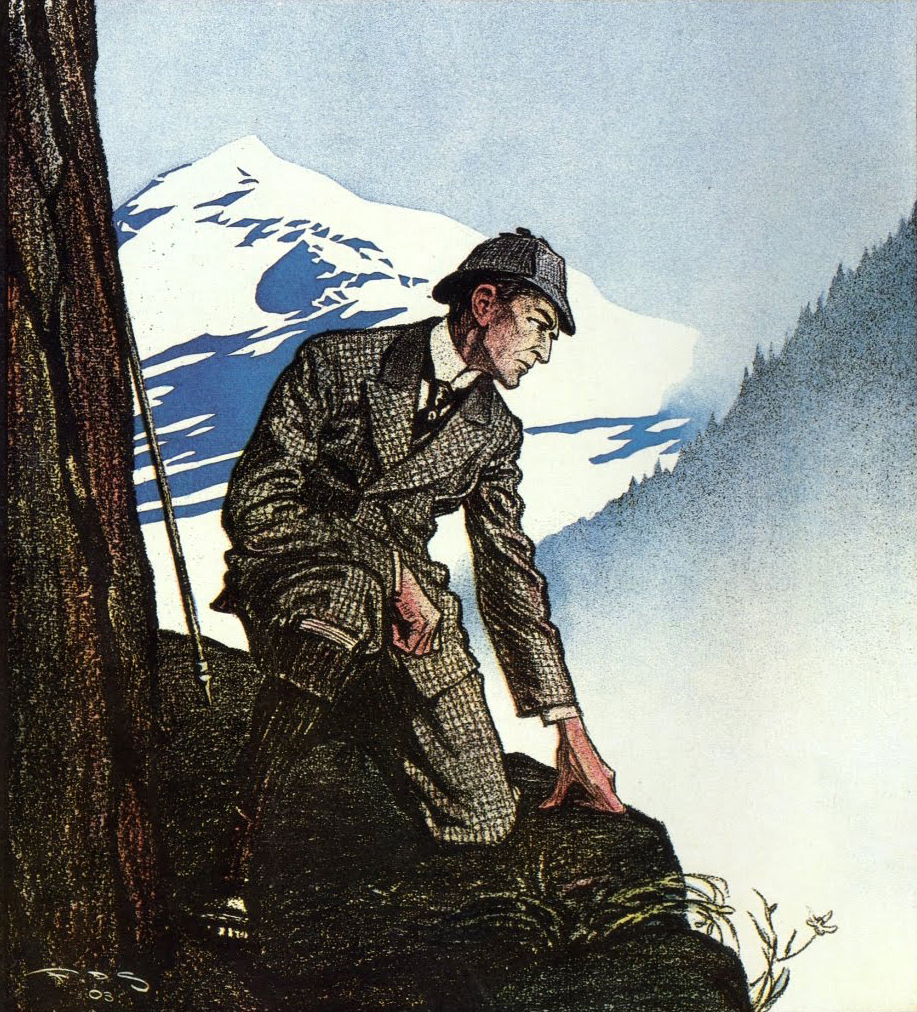 |
| By Frederic Dorr Steele |
This quote points to the fact that Holmes is intuitive (the N) in INTP. There are many references to his instinct and intuition throughout the stories and events that are evidence of it. For more on Holmes' intuition, see the links below.
The fact that Holmes can "always conceive alternate explanations" to the one he already came up with shows that he is a P (perceiving). The official Myers-Briggs website describes the perceiving function thus: "in type language perceiving means 'preferring to take in information.'" The site states that the following statement is the sort of thing a perceiver might identify with, "Sometimes I stay open to new information so long I miss making decisions when they are needed" (The Myers & Briggs Foundation: Judging or Perceiving). Notice how similar this is to Holmes' own statement. He declares that his ability to come up with new explanations is a drawback of the active mind.
Quote from the book:
The Problem of Thor Bridge, in The Complete Sherlock Holmes, vol. II. By Sir Arthur Conan Doyle. Doubleday & Co, Inc. Garden City, New York. 1930.
For a description of the INTP personality type:
Typelogic INTP profile
For a fuller analysis of Sherlock Holmes' (of BBC's Sherlock) personality type, you might enjoy:
Thinker Intuitor Sensor Feeler: Sherlock's Myers-Briggs Type
Subscribe to:
Posts (Atom)