Showing posts with label battle. Show all posts

Monday, May 13, 2013

A Passion for Rings

In The Saga of King Hrolf Kraki there is a ring that is coveted greatly. The passion for this ring and the terms in which it is spoken of is similar to The One Ring from The Lord of the Rings, by J. R. R. Tolkien.

The story of this ring begins thus: "A ring owned by King Helgi was a widely famed treasure. Both brothers wanted it, and so too did their sister Signy."

King Hroar offered to give his brother, King Helgi, his share of the kingdom in exchange for the ring, saying, "I want the ring, the one that is the best treasure in your possession and that both of us would like to own." Basically, Hroar saw this ring as worth half a kingdom.

Helgi agreed to this deal, "after such a speech, nothing else is fitting but that you should have the ring."

However, that is not the end of the episode. Hrok, with the encouragement of his mother Signy, also decided he wanted the ring. He demanded that King Helgi (his uncle) give him a third of the kingdom or "the great ring." Helgi informed him that Hroar had the ring and that his claims were arrogant.
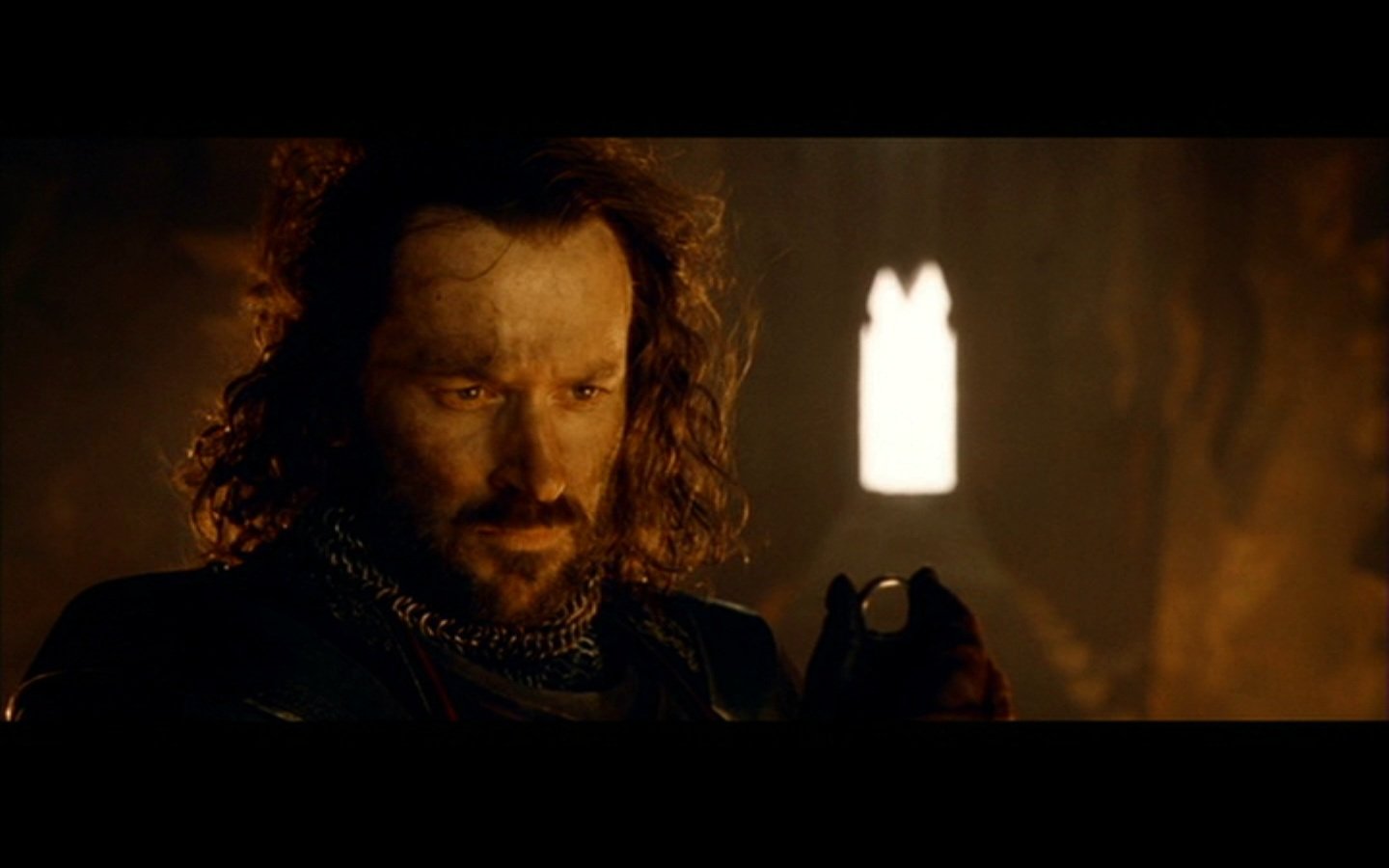
Isildur and The One Ring
Hrok then went to Hroar, and asked for the ring. Hroar replied, "I have given so much to get this ring that I will by no means part with it."

Hrok then asked to see it, saying he wanted to know if it was really "as much a treasure as it is claimed." Hroar readily showed it too him and Hrok threw it into the sea after saying, "I have never seen a comparable treasure, and the reason you esteem the ring so highly is obvious. The best solution, it seems to me, is that neither of us, or, for that matter, anyone else should enjoy it." He had no right to such an action. His claim on the ring was small enough, and Hroar had traded half the kingdom for it. Hroar chopped of Hrok's foot in response. After healing, Hrok assembled an army with which he defeated and killed Hroar. Helgi then defeated Hrok and instead of slaying him, broke all his limbs so that he was a cripple the rest of his life. And this was all between family! Many people searched the waters for the ring and Hroar's son, Agnar, finally found it after diving for it.

So, that's a summary of the ring episode. Although this ring was not imbued with the magical and evil properties that The One Ring possessed, it was coveted in much the same way, resulting in wars and the loss of limbs (Frodo lost his finger, Hrok, his foot). Hrok referred to it as "the great ring," giving it a title, much like, "The One Ring."  In The Lord of the Rings, it was suggested the the ring be thrown into the sea, but that idea was rejected because it could be found again eventually.

However, Hroar's ring could have been an arm ring and not a finger ring like The One Ring.
 
The Saga of Hrolf Kraki. Translated by Jesse L. Bylock. Published by Penguin Books, 1998.

Tuesday, December 4, 2012

Richard III and Scar

If Richard III was an animated film character, he would be Scar.

Now, I don't know what the real Richard III was like. Here, I'm just talking about Richard III from Shakespeare's play by the same name.

Scar is a character in the Disney animated feature, The Lion King.

List of similarities:
1. Want the throne.
2. Want the death of their nephews and arrange for their deaths to take place. Richard succeeds; Scar fails.
3. Crafty, silver tongued. Scar weaves a web of lies around Simba. Richard III convinces a woman who whose husband's death he caused to marry him. And that is just one specific example for each...
4. Richard III was a hunchback and walked with a limp. Scar is a runt, he's scrawny and can't even grow a full mane while his brother the king is large, strong, beautiful, and brawny. Scar says, "Well as far as brains go, I've got the lion's share, but when it comes to brute strength, I'm afraid I'm at the shallow end of the gene pool."
5. Both are defeated in the end after a battle.

Simba and Uncle Scar

Tuesday, July 10, 2012

Brave - a Mother and Daughter Movie / a Film about Family

Bagpipes, clans, kilts, haggis, highlander cattle, a Clydesdale horse (named Angus),"stubborn," fighting between the clans, highland games in which is featured the caber toss, tug-o-war, and Scottish dancing. These are all elements of Scottish culture that were woven into the Disney-Pixar film, Brave.

However, beneath the exterior is a tale that touches on the relationship between many mothers and daughters of just about any nation. The family is one that mirrors many across America. At any rate, I can certainly see mine. It's the mother who runs the family. She is an intelligent perfectionist and visionary who "knows" how everything must be done and what everyone should pursue in their lives.  Fortunately for me, my mother is better at listening than Merida's.  Like Elinor, my mother tries to keep everyone "civilized" when the rest (father included) are goofing off at the dinner table and trying to get her to let us have desserts!  Dad gets himself a big bowl of ice cream and my brothers say, "Dad did it, so why can't we?"

The father, Fergus, is big and strong, loves his family and is a great protector. However, he is lacking in leadership and courage in dealing with family affairs. He didn't know how to handle the betrothal of his daughter. He didn't know how to tell her that suitors were coming and that she was about to be betrothed to one of them and he didn't know what to say to the clans when they arrived. His favorite past-times are fighting and storytelling. He doesn't know how to lead unless it is into a battle. There are many fathers who are good at doing their job to sustain their families but don't know how to approach relationships their daughters have with men.

The mother, Elinor, is the one who ran things, she knew what to say and had expectations for everyone. When her husband got involved in a brawl (and was having a grand ole time) she just gave him a look and he knew she was disappointed. So then, he started making sheepish excuses and then simply said, "I'm sorry."  


Merida, the daughter, doesn't like being ruled over by her mother. It's typical, the daughter doesn't want to be the perfect lady her mother tries to get her to be. Merida wants to run free, have adventures, explore nature, ride, and practice arms!

The triplet brothers are funny little things. They are loved by all in the family despite their pranks. 

Both the mother and daughter had to learn lessons.  This is one of the best things about the film. Many films undermine parental authority, but this one shows both as making mistakes.  It also shows how hasty, desperate actions can lead to events no one wants. How horrible would you feel if your mother turned into a bear and may remain a bear forever because of your actions, accidental as they may be? 

Brave is a great film because it makes you think.

They say, "you never know what you got til it's gone."

Let's not let that happen in our lives. We can do this by learning from Merida and her family.

I am happy to say that the film has a happy ending! Merida and Elinor have a healed relationship. A brighter future is in store for Merida, her family, and the lads from the other clans!

All pictures are downloads made available by Disney on their website: http://disney.go.com/brave/index.html#/downloads/standard/

Monday, May 7, 2012

"Big as a house, gray as a mouse," and very loud!

The Song of Roland is an old French epic poem in which the knights of Charlemagne battle Saracen forces.
The leading knight, Roland, has a horn that they refer to as an "olifant."

Olifant
 "Olifant" is the Old French word for "elephant." In fact, the present day English word is derived from the French (The American Heritage Dictionary). What is an elephants tusk? Ivory. Roland's horn was probably made of ivory.

In The Lord of the Rings, by J. R. R. Tolkien, there are some large elephant-like creatures called, "Oliphaunts."  (The title of this post comes from a poem about Oliphaunts in the book.)

Boromir also had an important horn.  It is mentioned in his first appearance in the book, "on a baldric he wore a great horn tipped in silver that now was laid upon his knees." He blew it as he defended Merry and Pippin from the Orcs, calling his companions: "Then suddenly with a deep-throated call a great horn blew, and the blasts of it smote the hills and echoed in the hollows, rising in a mighty shout above the roaring of the falls."  As Aragorn raced towards the scene, the horn sounded "desperately" and then ceased abruptly. He arrived too late: the Orcs had already run off with the hobbits. Aragorn found Boromir sitting against a tree, dieing. His horn, symbolic of his life, lay broken at his side. "But Aragorn saw that he was pierced with many black-feathered arrows; his sword was still in his hand, but it was broken near the hilt; his horn cloven in two was at his side. Many Orcs lay slain, piled all around him and at his feet."

As Roland fought the attacking Saracens, his friend Olivier told him to blow the horn and call for the help of Charlemagne's army.  Roland refused, and as a result the entire rear guard was wiped out, including himself and Olivier. However, before the battle was completely over, Roland blew the horn long and loud and called the army back after there was no more hope of survival. Before they arrived, Roland blew his horn again, but much weaker this time and Charlemagne knew that Roland was scarcely alive. Before he died, the warrior placed his sword and horn beneath him lest they fall into enemy hands. Charlemagne and his knights found the battlefield covered in bodies.