Showing posts with label book. Show all posts

Tuesday, October 21, 2014

North and South - Mr. Thornton.

The BBC miniseries, North and South, exhibits some of the best casting I have ever seen. I am now reading the book on which it is based, bearing the same name, and written by Elizabeth Gaskill.

All the main characters fit very well with their descriptions from the book, Today I'm just going to focus on the remarkable similarities between the Mr. Thornton of the book, and Mr. Thornton as played by Richard Armitage.

The book describes Mr. Thornton thus,
"Now, in Mr. Thornton's face the straight brows fell low over the deep-set earnest eyes, which, without being unpleasantly sharp, seemed intent enough to penetrate into the very heart and core of what he was looking at. The lines in the face were few but firm, as if they were carved in marble, and lay principally about the lips, which were slightly compressed over a set of teeth so faultless and beautiful as to give the effect of sudden sunlight when the rare bright smile, coming in an instant and shining out of the eyes, changed the whole look from the severe and resolved expression of a man ready to do and dare everything, to the keen honest enjoyment of the moment, which is seldom shown so fearlessly and instantaneously except in children." (North and South, chapter 10)

In the movie, not only does Richard Armitage fit this description, but the way he played the character fits as well. His eyes were piercing, he looked severe, and at that moment when he smiled in the movie near the end, it was like the sun burst forth suddenly from behind clouds and it seemed as if he was entirely wrapped up in that moment.

Here is a set of pictures to illustrate this description and demonstrate how they coincide:

"The straight brows fell low over the deep-set earnest eyes...seemed intent enough to penetrate...The lines in the face were few but firm, as if they were carved in marble and lay principally about the lips...the severe and resolved expression of a man ready to do and dare everything."


"...when the rare bright smile, coming in an instant and shining out of the eyes, changed the whole look from the severe and resolved expression of a man ready to do and dare everything, to the keen honest enjoyment of the moment, which is seldom shown so fearlessly and instantaneously except in children."

One difference is that his teeth are hardly seen when he smiles, while in the book it seems they are visible when he smiles, although much of the smile comes from his eyes: "a set of teeth so faultless and beautiful as to give the effect of sudden sunlight when the rare bright smile, coming in an instant and shining out of the eyes."

All the same, I am amazed at how well he fits the description in the book in look and manner. 

Thursday, May 22, 2014

Recipe for an Afternoon Well Spent

You will need:

~Yourself
~A bike
~A helmet
~A favorite locale that you haven't entirely explored...
~A water-bottle or two.
~A good book
~Your favorite satchel with some things like a little cash, a camera, etc.
~Some vague idea of where to go.
~Remember that God is with you.

Directions:

Start by putting on your helmet, and remember that it is your helm of war as you go off on a quest for adventure!
Next, get on your bike and head off down the road.
Admire the scenery as you go and the feel of the wind on your face. From this point, it doesn't really matter what you do, just go far and get away. If you see a road and wonder where it leads, follow it. Savor the dappled light filtering through the trees, and the cool that comes when you enter a forest lane. When the sun beats down upon you all alone on open road, reflect on how small you are. Praise God for the beautiful things you see, a flower, a shimmering lake, whatever it is that touches your heart with wonder. Thank Him for the beautiful moments you experience, the feeling of sunlight and shade, the breeze as you crest a hill.
After rambling for a few hours, perhaps stop at a store and get a treat, but don't stop for long, continue on and find a nice place to sit. After stretching, enjoy your treat and delve into your book out in the fresh air.


Finally, return home happy.


I recently started following a blogger, Marissa, at  http://marissabaker.wordpress.com/ Among the many things she writes about, she posts weekly recipes, and it kind of inspired me to write a recipe of my own...
Hope this was fun!  

Thursday, March 20, 2014

J.R.R. Tolkien's Translation of Beowulf To Be Published

I just read the news: J.R.R. Tolkien's translation of Beowulf  is set to be published on May 22 (The Guardian).

As a Beowulf and Tolkien fan, this is very exciting. How will it differ from other translations? What phrases like gold and jewels strung together will be set forth to shine in the sun like ancient treasures newly discovered from some grim coffer where they have lain hidden? What will it reveal about the influence of Beowulf on Middle-Earth?

However my anticipation was stung a little with the thought,"if it hasn't been published until now, then maybe J. R. R. Tolkien never wanted it to be published?" Similar thoughts by others are reported in The Guardian's article "J. R. R. Tolkien translation of Beowulf to be published after 90 year wait."

And now we wait.

~Update~

Read the latest on TheOneRing.Net:
The official word on the publication of Tolkien's Beowulf Translation

This article includes details about the book and includes a picture of the cover. The dragon on it looks like one that Tolkien drew.

Tuesday, March 4, 2014

Dr. Watson an Expressive ISFJ

In the Sherlock Holmes canon, there are many incidents that support the generally accepted idea that Dr. John H. Watson is an ISFJ.

ISFJ stands for Introverted Sensing Feeling Judging, and is a personality type in the Myers Briggs system of personality analysis.

ISFJs are known as "The Protectors" and "The Defenders." Watson felt the need to protect his friend, insisting on accompanying Holmes when he was being pursued by Moriarty (The Final Problem, 734). He also felt protective of Miss Mary Morstan. When Thaddeus Sholto suddenly and offhandedly revealed that her father was dead, Watson wrote, "I could have struck the man across the face, so hot was I at this callous and offhand reference to so delicate a matter." Not long later they found themselves holding hands, "I have marvelled at it since, but at the time it seemed the most natural thing that I should go out to her so, and, as she has often told me, there was in her also the instinct to turn to me for comfort and protection" (The Sign of Four). In this quote, it is clear that he instinctively wanted to be supportive to her, and that she saw him as a good emotional support and protector.

Dr. Watson
Heiss wrote that ISFJ's will provide practical support at a moment's notice to their close friends. This is seen a number of times throughout the canon. In The Final Problem, Watson left on very short notice with Holmes in order to protect and assist him. He arose early to go on adventures with Holmes and undertook assignments from Holmes that involved leaving his own business behind. Additionally, he retrieved a different friend from an opium den and the man was grateful for this rescue (The Man With the Twisted Lip). Watson definitely exhibits this ISFJ trait. 

On a related note, this type feels a need to serve. "ISFJs are characterized above all by their desire to serve others, their 'need to be needed.' In extreme cases, this need is so strong that standard give-and-take relationships are deeply unsatisfying to them" (Heiss). Watson once referred to Holmes as his master, which implies that he was the servant or pupil. He, himself, stated that he served Holmeswith these words: "my years of humble but single-minded service" (The Adventure of the Three Garridebs). While he would have liked to be more appreciated this need to serve is perhaps why he continued to serve Holmes despite the fact that he felt unappreciated. It seems that Watson would have liked a normal give-and-take friendship, but because he was an ISFJ he put up with one that was not and on learning that Holmes really did value his friendship and service after his apparent indifference, it was enough for him: "All my years of humble but single-minded service culminated in that moment of revelation" (The Adventure of the Three Garridebs).  "ISFJs are loyal to the end," Joe Butt.

Typical ISFJ, Watson feels unappreciated, "I have often been piqued by his indifference to my admiration and to the attempts I had made to give publicity to his methods" (The Hound of the Baskervilles).  Heiss wrote, "ISFJs are often unappreciated....they are often unwilling to toot their own horns about their accomplishments because they feel that although they deserve more credit than they're getting, it's somehow wrong to want any sort of reward for doing work." Watson doesn't express the feeling that it is wrong to want recognition, but he does feel unappreciated and that he deserves more gratitude from Holmes.

ISFJs are Sensors as opposed to Intuitives. Andrea Wenger wrote, "They’re more interested in sensory data than in the patterns perceived by the unconscious mind." Watson saw and noticed details but he could not connect them correctly in the grand way the intuitive Holmes did. Now, that being said, ISFJs do have some intuition which may misguide them (Heiss) as perhaps it did Watson.

Watson possessed an inability to hide his true feelings well. Joe Butt wrote that ISFJs are "are often unable to either hide or articulate any distress they may be feeling." One example was when Holmes deceived Watson instead of taking him into his schemes because he knew Watson wouldn't be as convincing if he didn't believe in it.  In The Dying Detective. Holmes said to Watson, "among your many talents dissimulation finds no place, and that if you had shared my secret you would never have been able to impress Smith with the urgent necessity of his presence, which was the vital point of the whole scheme." (Conversely: because he did believe Holmes was dieing, he succeeded in convincing the villain to come). In The Sign of Four, he pretended to be happy although his heart "was heavy within" him and it was evident: "I think I must have been rather over-acting my delight, and that she detected a hollow ring in my congratulations."

Now, in response to the latter half of Joe Butt's statement, Watson was able to articulate his feelings just fine, and I think this is because we see his feelings through his writings. Writing gives one the chance to analyze one's emotions and pick the right words to describe them. In Portrait of an ISFJ, we read, "more so than other types, ISFJs are extremely aware of their own internal feelings, as well as other people's feelings" which they may refrain from expressing. From personal experience both these statements are true in the right context. ISFJs just hide their feelings poorly. 

On a similar note, and although not technically an ISFJ trait, Watson had an expressive face. In The Adventure of the Cardboard Box, Holmes was able to basically read Watson's mind because, well, it was written across his face:
“You remember,” said he, “that some little time ago when I read you the passage in one of Poe’s sketches in which a close reasoner follows the unspoken thoughts of his companion, you were inclined to treat the matter as a mere tour-de-force of the author. On my remarking that I was constantly in the habit of doing the same thing you expressed incredulity.”
“Oh, no!”
“Perhaps not with your tongue, my dear Watson, but certainly with your eyebrows."
Their conversation continued and Watson argued:
"But I have been seated quietly in my chair, and what clues can I have given you?”
“You do yourself an injustice. The features are given to man as the means by which he shall express his emotions, and yours are faithful servants.”
“Do you mean to say that you read my train of thoughts from my features?”
“Your features and especially your eyes.” Holmes continued with an analysis of Watson's expressions and movements which were the foot-prints that led him through the path of Watson's mind.

And this is one reason why Martin Freeman is an excellent Watson:

Watson from BBC Sherlock
What a veritable palette of expression!

Further Exploration:

His writing style also indicates that he is an ISFJ. For more on that see:
Dr. Watson's Writing Style and Personality Type

I really enjoyed this post about Dr. John Watson from BBC's Sherlock. It approaches character analysis by looking at personality functions. I learned a lot about Myers Briggs through her series and the further exploration that it prompted:
http://sherlockcharacteranalysis.tumblr.com/post/29827385452/sensor-feeler-thinker-intuitor-johns-myers-briggs

Bibliography:

Doyle, Sir Arthur Conan, edited by Leslie J. Klinger, intro by John Le Carré. The New Annotated Sherlock Holmes, vol 1 & 2. W. W. Norton & Company. New York: 2005.

Heiss, Marina Margaret and Joe Butt. ISFJ Profile, on TypeLogic.
http://www.typelogic.com/isfj.html

Wenger, Andrea. The ISFJ Writing Personality: Tangible Warmth.
http://andreajwenger.com/2010/03/06/isfj-writing-personality/

Portrait of an ISFJ

Saturday, December 28, 2013

If, then

I recently read The Lost Special and The Man with the Watches, by Sir Arthur Conan Doyle. Phillip A. Schreffler makes the claim (in the "Afterword") that the character who writes to the newspapers with a possible solution is none other than Sherlock Holmes, even though his name is never mentioned. In the story, he is referred to as "an amateur reasoner of some celebrity at that date." And the first line of the letter contains one of Holmes' most famous axioms, in addition to the words "elementary principle." After reading the canon, it seems to me that he favors the word "elementary." He is also an INTP, and this type likes logic and theories, which involves applying principles.

Well, if the unnamed fellow is indeed Mr. Holmes, then I do believe Professor Moriarty, or one of those under him, is undeniably in The Lost Special. The events took place in 1980, before the death of the professor. The principle perpetrator engaged the aid of an agent he described as "one of the acutest brains in England....it would be unjust to claim all the credit for myself."

The perpetrator also wrote of his agent: "he had command of a band of workers who were trustworthy and intelligent. The idea was his, and my own judgement was only required in the details."

Finally, he said, "I have already spoken of my English agent--who is a man with a considerable future before him, unless some complaint of the throat carries him off before his time."

The crime itself was rather spectacular. They made a train disappear without a trace.  The finesse and successful completion of the crime further points to Moriarty being behind it somewhere.  

And I really should try and find what the Sherlockian scholars have to say about it...

Bibliography

Sir Arthur Conan Doyle, The Further Adventures of Sherlock Holmes. The Reader's Digest Association, Inc. Pleasantville, N. Y. : 1993

Joe Butt, INTP Profile. http://www.typelogic.com/intp.html

For more about the personality type of S. H. see:
http://loreandlit.blogspot.com/2013/11/sherlock-holmes-book-character-as.html

Saturday, November 16, 2013

Sherlock Holmes (Book character) as an Intuitive Perceiver

Last night as I was reading The Complete Sherlock Holmes in the wee hours of the morning, I came across a rather revealing quote about Sherlock Holmes and his personality type. Across the internet I have seen Holmes labeled as either an INTP or an INTJ (personality types in the Myers-Briggs system). From my own small knowledge of the types, I agree with those who say he is an INTP, which stands for Introverted iNtutive Thinking Perceiving. I'm not going to go into a full analysis, but I just want to show how this quote fits with this conclusion.

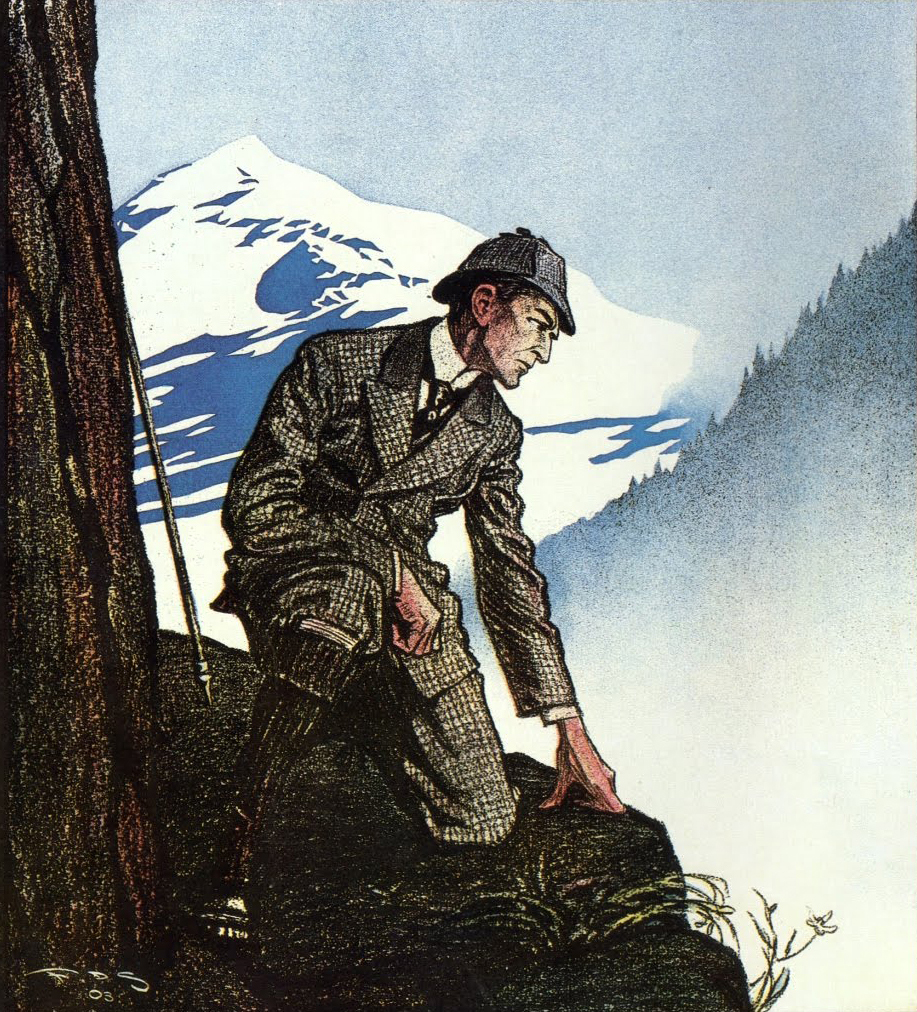
By Frederic Dorr Steele
Holmes said, "I have an instinct for such things, and yet sometimes it has played me false. It seemed a certainty when it first flashed across my mind in the cell at Winchester, but one drawback of an active mind is that one can always conceive alternate explanations which would make our scent a false one." (The Problem of Thor Bridge, page 1069)

This quote points to the fact that Holmes is intuitive (the N) in INTP. There are many references to his instinct and intuition throughout the stories and events that are evidence of it. For more on Holmes' intuition, see the links below. 

The fact that Holmes can "always conceive alternate explanations" to the one he already came up with shows that he is a P (perceiving). The official Myers-Briggs website describes the perceiving function thus: "in type language perceiving means 'preferring to take in information.'" The site states that the following statement is the sort of thing a perceiver might identify with, "Sometimes I stay open to new information so long I miss making decisions when they are needed" (The Myers & Briggs Foundation: Judging or Perceiving). Notice how similar this is to Holmes' own statement. He declares that his ability to come up with new explanations is a drawback of the active mind.

Quote from the book:
The Problem of Thor Bridge, in The Complete Sherlock Holmes, vol. II. By Sir Arthur Conan Doyle. Doubleday & Co, Inc. Garden City, New York. 1930.

For a description of the INTP personality type:
Typelogic INTP profile

For a fuller analysis of Sherlock Holmes' (of BBC's Sherlock) personality type, you might enjoy:
Thinker Intuitor Sensor Feeler: Sherlock's Myers-Briggs Type

Monday, December 17, 2012

The Hobbit. A long-expected movie.

It's here! It is finally here! Saturday afternoon I saw The Hobbit with some friends.

Over all, I like it very much.

*Spoiler Alert. Don't continue reading if you haven't seen the movie yet.* 

There were a few things I did not like, like the troll sneezing all over Bilbo. Yuck.

Radagast was hardly what I pictured, plus he's not even in the book, The Hobbit. He is in the book, The Lord of the Rings, and he doesn't have a sleigh pulled by rabbits as far as I know. Bird poop on the side of his face: gross and not needed. The part where he out runs the wolves with his rabbit sleigh is just kinda silly.

The film portrayal of The Goblin King left me disappointed, the things he said, and the voice he used were so very un-goblinlike. It didn't fit with his grotesque appearance. The voice would be better matched to a greedy business tycoon in a suit.  

The beginning was neat because it ties right into The Lord of the Rings, the film. The Hobbit (film) opens with Bilbo and Frodo on the morning of Bilbo's big party. We see Frodo run off to meet Gandalf on his way into town, and we know what will follow in The Lord of Rings: "You're late." "A wizard is never late, Frodo Baggins, nor is he early. He arrives precisely when he means too." Remember? If we stopped The Hobbit there, and put on The Lord of the Rings, well, it would flow seamlessly.

I really am glad they kept so many of the opening lines and dialogue from the book.

The song about the dishes, as much as I could catch, was right from the book.

His button's popped off when he escaped from the cave! Yay!

Gandalf said to Bilbo (loose paraphrase): "Courage is not killing people, but deciding who to let live."
Sure enough, along comes the Gollum scene. Although they changed Bilbo's escape from the cave a little, they emphasized the point that Bilbo lets Gollum live when he could have killed him. They made it very clear. Bilbo sees the pain and lostness in Gollum's eyes when he was about to slay him and makes the decision not to kill Gollum. This scene then fits in very well with this dialogue from The Lord of the Rings (film):
 Frodo, "It's a pity Bilbo didn't kill him while he had the chance." 
Gandalf replies, "Pity? It was pity that staid Bilbo's hand. There are many that die who deserve life, and many who live that deserve death. Can you give it to them Frodo? Do not be to eager to deal out death and judgment."

While this dialogue is not in the books, these scenes work well in the movies and add a powerful lesson in the midst of scenes of heroes slaying enemies (where fighting is glorified). Don't get me wrong, I enjoy the battle scenes, I'm glad though, that this point is made so that we all remember that strength and courage is not defined by the number of heads one has chopped off.

Another Lord of the Rings tie-in: Gandalf said to Bilbo, "Your home is behind you, the world ahead." These lines are almost straight from Pippin's Song. "Home is behind, the world ahead." In the book, Pippin does not sing for Denethor, but many of the other songs the hobbits sing were written by Bilbo. So, this is a strange sort of book/movie mixed-up tie-in. It's like Bilbo later wrote Pippin's Song after his adventure, but you wouldn't know that unless you read the books.

"I'm going on an adventure!"
I also love the moment when Bilbo is running down the path and a hobbit asks him were he is going. "I'm going on an adventure!" he cries with the contract flapping in his raised hand.

Twice, Thorin used a large piece of tree trunk (small log) as a shield. My brother pointed out that could be how he got his name: Thorin Oakenshield. Interesting, it's not in the books, but it's interesting that they made the movie detailed enough that even his name has a back story.

A surmise about the next installment: that big rock the eagles drop them off at looks like a bear. I think that must be the Carrock of Beorn. Which implies they skipped the night at the eagle eyries (not a big deal) and just had them dropped off at the Carrock immediately.

Monday, December 3, 2012

A Dwarf and a Gaul

Well, I'm not the first to notice that Bombur, as portrayed in the soon to be released film, The Hobbit, looks like Obelix from the Asterix comics.

But, this blog is all about comparison, so I feel I've got to include it!

Now, the book, The Hobbit, does not go into much detail about Bombur's appearance, except to say that he is the fattest of the thirteen dwarves. One assumes he has a beard because he is a dwarf.
The film removes his beard and gives him a ginormous mustache and sideburns that are braided together. Basically he has hair everywhere BUT his chin.

Obelix is Asterix's sidekick in the French comic book series about the days of the Roman conquest of Gaul. He fell into a cauldron of magic potion as a baby and is endued with superhuman strength because of it. He runs a menhir delivery service and quarries stone in order to make menhirs. I believe he is the sole proprietor and employee, unless he includes Dogmatix. He loves to eat, his favorite food being wild boar which he and Asterix hunt in the forest. He also enjoys beating up Romans and fighting in general. Not the brightest match in the box, but still a loyal friend to Asterix.


Asterix, Obelix, & Dogmatix


Here is a list of similarities between the characters:
1. Both have large rounded noses
2. Similar vacant yet contented expressions
3. Both have the same double chin
4. Body shape
5. Red hair
6. Have mustaches
7. Hairstyles that incorporate braids
8. Round ears that stick out of their hair  

Links to the official sites:
The Hobbit
Asterix

Tuesday, November 27, 2012

Les Misérables

I'd like to start by saying that this post has nothing to do with the Les Misérables film that is coming out in December. I've never even seen the musical Les Misérables. But, where there is smoke there is fire...

Volumes 1&2
So, I undertook to read the original unabridged version in French. Wow, books these days are so different from back then. If someone went on for pages and pages about social darkness and then went back to the story, and then did it again....well, the book probably wouldn't get published without major amputations. But that was then, and this is now. So, the story that was adapted into one of the most popular musical dramas made it to press. Look to the past, learn for the future.

Anyhow, the thing that struck me most about the book is the fact that the title is very fitting. I wish I had kept a tally of how many times the word "misérable" was used.

Basically there are three types of miserable people in this book:

The miserably poor
The emotionally wretched
The wretchedly both

The French word "misérable" is full of meanings. First of all, it is a noun and an adjective like the English word "miserable." One would think it means "miserable" straight-up and simple. But, it actually translates better as "wretched" (adj) or "wretch" (n).  It can also mean "slummy" and "poverty stricken." The French word "misérable" translates to "miserable" when one is talking of a miserable place or situation but not a miserable person.

Sources:
http://dictionary.reverso.net/french-english/miserable
http://dictionary.reverso.net/english-french/miserable 


Friday, November 23, 2012

The Hobbit

Who's excited for the film The Hobbit? I am, for sure, and I know many others are! Ever since he directed The Lord of the Rings, fans have been hoping that Peter Jackson would undertake The Hobbit.

Not only is Peter Jackson one of the directors, but Sir Ian McKellen, Hugo Weaving, Cate Blanchett, Andy Serkis, Ian Holm (as an older Bilbo), Elijah Wood, Orlando Bloom, and Christopher Lee all playing the same roles as they did in The Lord of the Rings. Wonderful news!

Bilbo, from The Hobbit
However, from the production videos and trailers I've seen, the film seems to diverge quite a bit from the book. Galadriel does not even appear in The Hobbit. All the wizard action (Involving Radagast the Brown and Saruman the White) happens simultaneously as the action of the story, but is off-set so to speak: Tolkien never takes us there. We don't see the defeat of the Necromancer, we just hear about it. 

Secondly, I never would have pictured the village of Dale as an Italian/southern France village. It's cute though.

Thirdly, they added to the dwarves' characters. Ok, fine. Sounds entertaining. 

Fourthly, they got the beards wrong for the most part. In the film some of them don't really have beards, they have glorified mustaches. However, they are dwarves, therefore they ought to have full beards. Thorin Oakenshield from the book would be ashamed to go about with as little a beard as they gave him in the movie.
Kili
Aragorn

Fili and Kili, being younger, can certainly have smaller beards (in my opinion), but I think they should be longer and fuller than men generally wear theirs. Kili and Thorin in the movie look rather like Rangers or Men of Gondor.  In this photo, Kili looks like he could be a brother to Aragorn.
Here are pictures for comparison's sake.


Full, long beards are part of what make dwarves, dwarves (see The Blog That Time Forgot if you don't believe me). In the book, The Hobbit, Dwalin at least was able to tuck his beard in his belt: "It was a dwarf with a blue beard tucked into a golden belt" (page 7). Once, when Thorin was very angry, he said to Gandalf, "May your beard wither." Thorin was furious, showing that this is one of the worst things he could possibly wish upon another. The state of one's beard was a matter of pride. To loose one's beard would be like losing one's "man-card,"  or in this case, one's "dwarf-card."

The Blog that Time Forgot 
This blog goes into a detailed textual analysis of the dwarves' beards in the book. You can skip down to the section about beards. Basically his argument agrees with my observations from the book: dwarves should have beards and that beards are a source of pride.

In a production (behind-the-scenes) video one of the people on set suggests that maybe Fili and Kili can't grow beards yet. The above blog mentions this, and in addition to that blogger's analysis, I'd like to point out that Fili and Kili, most certainly did have beards in the book, "It was two dwarves, both with blue hoods, silver belts, and yellow beards" (page 8).

Sources:
The Hobbit, by J.R.R. Tolkien. Ballantine Books, published 1965.
The Hobbit (Official Site)
The Lord of the Rings (Official Site)
All photos come from the downloads sections.