Showing posts with label quotes. Show all posts

Tuesday, April 15, 2014

Inscrutable: Women and Sherlock Holmes

What did Sherlock Holmes think of women? There are a number of what appear to be incongruous reports in the canon, yet they're not entirely irreconcilable.  On some occasions he expressed approval of women, while Watson reported that he had an "aversion to women."  Here's a look at what I was able to untangle:

A Victorian Woman
Holmes really did respect women's intuition. On one occasion he remarked, "I value a woman's instinct in such matters" (The Adventure of the Lion's Mane, 1088)  On another, he praised Mary Morstan for retaining a piece of paper because she had an inkling that it might be important later, "You are certainly a model client. You have the correct intuition"  (The Sign of Four). The most astounding, and strongest statement of his belief in a woman's intuition/instinct is found in these words he said to Mrs. Neville St. Clair, "I have seen too much not to know that the impression of a woman may be more valuable than the conclusion of an analytical reasoner" (The Man with the Twisted Lip).

While Holmes values a woman's instinct and intuition, he has no intention of  letting romance and marriage enter his life because he doesn't see emotion and reason as being compatible: "But love is an emotional thing, and whatever is emotional is opposed to that true cold reason which I place above all things. I should never marry myself, lest I bias my judgment"  (The Sign of Four).

Holmes said of Mary, "I think she is one of the most charming young ladies I ever met and might have been most useful in such work as we have been doing. She had a decided genius that way, witness the way in which she preserved that Agra plan from all the other papers of her father"  (The Sign of Four). The key word is "might have." She and Watson were in love, and therefore their reasoning was impaired according to Holmes, and she could no longer be of much use.

Yet, while this phrase communicates his disapproval of their marriage, it also expresses an appreciation for her faculties and that he thinks she possessed potential for being of assistance in crime solving. It is hard to reconcile this with Watson's report that Holmes had an "aversion to women" (The Greek Interpreter). In this situation it seems he is not averse to Mary, just to averse to her marriage to Watson since it will cloud their reasoning. So perhaps, his "aversion to women" was in a general sense: womankind as a whole, or specifically in regards to romance: he decided not to marry and so pulled back from women generally. It seems that while he was able to appreciate a woman's merits he never pursued a friendship with one beyond what was needed to solve a case.

Additionally, "Holmes had, when he liked, a peculiarly ingratiating way with women, and...he very readily established terms of confidence with them" (The Adventure of the Golden Pince-nez).  Holmes could easily befriend women when he found it expedient, yet I don't recall any mention of his having a close or prolonged friendship with a woman in the canon and he certainly had no intention of falling in love.

From Harper's Bazaar, May 14, 1898
Perhaps part of his "aversion to women" stems from the fact that he finds the reasoning behind their actions hard to predict, "And you must have observed, Watson, how she manouvered to have the light at her back. She did not wish us to read her expression...And yet the motives of women are inscrutable. You remember the woman at Margate whom I suspected for the same reason. No powder on her nose--that proved to be the correct solution. How can you build on such quicksand? Their most trivial action may mean volumes, or their most extraordinary conduct may depend upon a hairpin or a curling tongs" (The Adventure of the Second Stain). This sentiment renders Holmes quite human and quite a man! He expresses the age old man vs. woman struggle for comprehension of the other, although based on his decision not to marry, his interest in this subject is entirely a professional one. --And, once again, he's an "automaton" as Watson called him in The Sign of Four.

Many people like to toy with the idea of a romance between Holmes and Irene Adler. Holmes was not in love with Irene Adler. "It was not that he felt any emotion akin to love for Irene Adler" (A Scandal in Bohemia).

It's interesting to note that many of the women Holmes encountered throughout his adventures were brave, spirited, independent, emotional, and loyal. Most of them weren't silly, although sometimes over-run by passions.

Therefore, from the canon, it seems that while he is decidedly against romantic attachments, he is generally kind to women and values woman's instincts. 

Note:

The Sherlock Holmes stories were written by Sir Arthur Conan Doyle. There are many different editions and publications of these stories, and they are sometimes presented in part or as an entirety.

The first image is from Karen's Whimsy. Her website features collections of nicely sorted public domain images for free use.

The second is from Wikipedia. Due to its date, the image is no longer under copyright.

Friday, January 31, 2014

Dr. Watson's Writing Style and Personality Type

Dr. John H. Watson is generally accepted as an  ISFJ. His writing style certainly supports this idea. Watson writes clearly, succinctly, and yet with warmth.

John Le Carré wrote in the Introduction to The New Annoted Sherlock Holmes, "Dr. Watson doesn't write to you, he talks to you, with Edwardian courtesy, across a glowing fire. His voice has no barriers or affectations. It is clear, energetic, and decent."  Andrea Wenger labeled the ISFJ writing style as "Tangible Warmth." She wrote, "ISFJs focus on facts, which they often convey with warmth.." Although Holmes complains that Watson doesn't stick to the facts enough,* the stories stay focused on the mystery at hand and are told in a straight-forward fashion. He just diverges a little bit to give us a better glimpse of the characters and their lives-- one source of warmth. This warmth, or rather personability, is found in the feelings of the characters, such as their excitement, fear, love, and ideals.  

Warmth is also found in Watson's descriptions. Even if he is describing something dreary, it still has warmth because the description contains a perception of the subject and how it is interpreted by an imaginative human mind. It's like that scientific principle which says the temperature scale doesn't measure hot versus cold, but is rather a scale of heat. There isn't really such a thing as cold, but just a difference in warmth. It was explained to me somewhat like this: two objects that we perceive as cold, one being -10 degrees Fahrenheit and the other -20 degrees Fahrenheit  (cold to human touch) actually contain heat, for if they didn't there could be no energy transfer and the warmth from the -10 object wouldn't travel to the other and raise it's temperature to -15 degrees.

One example of Watson's descriptive warmth in speaking and writing is this exchange where his "SF" effusion is met with "NT" facts:

"'The Haven is the name of Mr. Josiah Amberley's house,' I explained. 'I think it would interest you, Holmes. It is like some penurious patrician who has sunk into the company of his inferiors. You know that particular quarter, the monotonous brick streets, the weary suburban highways. Right in the middle of them, a little island of ancient culture and comfort, lies this old home, surrounded by a high sun-baked wall mottled with lichens and topped with moss, the sort of wall--'
'Cut out the poetry, Watson,' said Holmes severely. 'I note that it was a high brick wall.' (The Adventure of the Retired Colour Man)

The description pulls you in. He personifies the house. He is bounteous with adjectives and in a painter-like fashion, he daubs moss and lichen onto the wall. Not only does he display warmth in this passage but also other characteristics in keeping with the ISFJ style, for Wenger writes, "They may also excel at sensory detail, drawing the reader in."

Furthermore, in Portrait of an ISFJ, we are told, "ISFJs have a rich inner world that is not usually obvious to observers. They constantly take in information about people and situations that is personally important to them, and store it away. This tremendous store of information is usually startlingly accurate, because the ISFJ has an exceptional memory about things that are important to their value systems. It would not be uncommon for the ISFJ to remember a particular facial expression or conversation in precise detail years after the event occurred, if the situation made an impression on the ISFJ. " This is evident in Watson's writing. He often wrote the stories years after they occurred (with the help of his notes) and yet the people have life and color, and the descriptions are explicit.

By Sidney Paget, The Strand Magazine, October 1891
ISFJs "Enjoy reading and writing about history or biography, but are less likely to gravitate toward business or technical writing" (Wenger). Watson writes about events, he recounts stories that have happened, which is, more or less, history. Holmes referred to him as his "biographer" on at least one occasion. Watson does not write the dry technical pieces Holmes would wish.*

Wenger also informs us that ISFJs "often write about topics they care about, although they may not let their own beliefs shine through. They prefer to present the facts, which they may do in great detail, then let readers make up their own mind."  We know that Watson finds the cases very interesting, his wife says as much. However, Watson doesn't make judgments on Holmes' handling of a case although he expresses his disapproval of his drug use and excessive untidiness.

"Tangible Warmth" (Wenger) is certainly an appropriate description for Dr. Watson's writing style. The facts told in vivid detail renders it tangible. Warmth emanates from the humanness of his descriptions, the emotions expressed, and the interactions between people that you come to know through his eyes.

~Please take a look at Andrea Wenger's article,  The ISFJ Writing Personality: Tangible Warmth. I was delighted with it. You may also enjoy reading her other articles. ~

Note:
*In The Sign of Four, Holmes said, "Detection is, or ought to be, an exact science, and should be treated in the same cold and unemotional manner. You have attempted to tinge it with romanticism, which produces much the same effect as if you worked a love-story or an elopement into the fifth proposition of Euclid."


Bibliography:

Doyle, Sir Arthur Conan, edited by Leslie J. Klinger, intro by John Le Carré. The New Annotated Sherlock Holmes, vol 1 & 2. W. W. Norton & Company. New York: 2005.

Wenger, Andrea. The ISFJ Writing Personality: Tangible Warmth.
http://andreajwenger.com/2010/03/06/isfj-writing-personality/


Portrait of an ISFJ
 

Saturday, January 18, 2014

Dr. Watson Quotes

~A compilation of my favorite quotes by or about Dr. Watson.~

One of my favorite moments from the Sherlock Holmes canon is when Watson carries his point of accompanying Holmes despite the danger he ran. In The Final Problem, Holmes advises Watson to return to England while he endeavors to elude Professor Moriarty, who now seeks his life, alone.

Watson wrote, "It was hardly an appeal to be successful with one who was an old campaigner as well as an old friend. We sat in the Strasburg salle-à-manger arguing the question for half an hour, but the same night we had resumed out journey and were well on our way to Geneva." (The Final Problem, page 734)

This quote not only shows Watson's tenacious loyalty and bravery, but also his strong will, for he won the argument and they continued the journey together.

 When Watson recognizes Holmes after he thought Holmes was dead for some years: "I rose to my feet, stared at him for some seconds in utter amazement, and then it appears that I must have fainted for the first and last time in my life." (The Adventure of the Empty House, 789)

By Sidney Paget
Watson's quip: "I don't admit that a fresh illustration is an explanation." He had requested Holmes to explain how he came a conclusion and Holmes began to explain by starting with an example. Holmes replied to Watson's quip, "Bravo Watson! A very dignified and logical remonstrance." (The Disappearance of Lady Carfax, 1363)

Some of my favorite quotes about or to Watson, spoken by Holmes:

"There is no prospect of danger, or I should not dream of stirring without you." (The Adventure of the Norwood Builder, 843)

"And a singularly consistent investigation you have made, my dear Watson....I cannot at the moment recall any possible blunder which you have omitted." (The Disappearance of Lady Carfax, 1371). Oh, poor Watson, it seems a bit undeserved too. 

"The ideas of my friend Watson, though limited are exceedingly pertinacious."  (The Adventure of the Blanched Soldier, page 1483)

"I am getting into your involved habit of telling a story backward."  (The Problem of Thor Bridge, page 1605) 

'"Cut out the poetry, Watson," said Holmes severely. "I note that it was a high brick wall."' After Watson gives a soulful description of a wall. (The Adventure of the Retired Colourman, 1734)

"Good Old Watson! You are the one fixed point in a changing age." (His Last Bow, 1433)

Source:
The New Annotated Sherlock Holmes, vol. 1 & 2, by Sir Arthur Conan Doyle. Edited by Leslie S. Klinger. W. W. Norton & Company. New York: 2005.

Saturday, November 16, 2013

Sherlock Holmes (Book character) as an Intuitive Perceiver

Last night as I was reading The Complete Sherlock Holmes in the wee hours of the morning, I came across a rather revealing quote about Sherlock Holmes and his personality type. Across the internet I have seen Holmes labeled as either an INTP or an INTJ (personality types in the Myers-Briggs system). From my own small knowledge of the types, I agree with those who say he is an INTP, which stands for Introverted iNtutive Thinking Perceiving. I'm not going to go into a full analysis, but I just want to show how this quote fits with this conclusion.

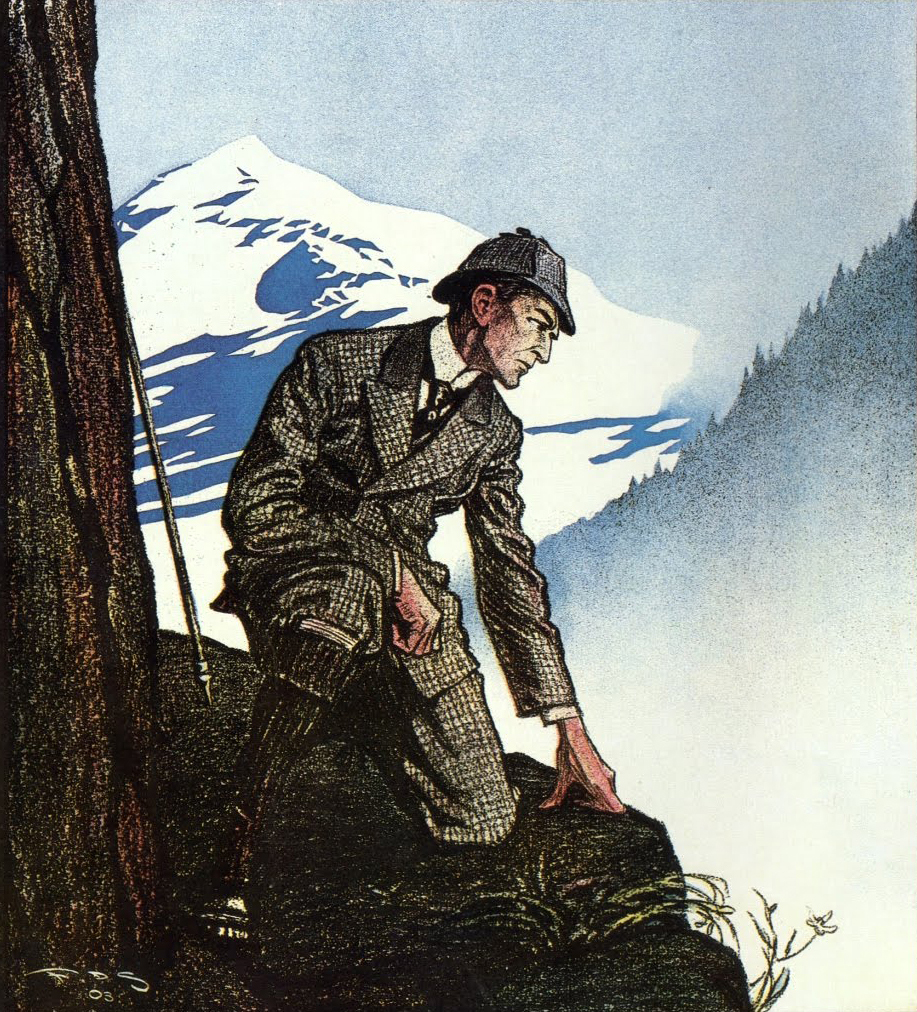
By Frederic Dorr Steele
Holmes said, "I have an instinct for such things, and yet sometimes it has played me false. It seemed a certainty when it first flashed across my mind in the cell at Winchester, but one drawback of an active mind is that one can always conceive alternate explanations which would make our scent a false one." (The Problem of Thor Bridge, page 1069)

This quote points to the fact that Holmes is intuitive (the N) in INTP. There are many references to his instinct and intuition throughout the stories and events that are evidence of it. For more on Holmes' intuition, see the links below. 

The fact that Holmes can "always conceive alternate explanations" to the one he already came up with shows that he is a P (perceiving). The official Myers-Briggs website describes the perceiving function thus: "in type language perceiving means 'preferring to take in information.'" The site states that the following statement is the sort of thing a perceiver might identify with, "Sometimes I stay open to new information so long I miss making decisions when they are needed" (The Myers & Briggs Foundation: Judging or Perceiving). Notice how similar this is to Holmes' own statement. He declares that his ability to come up with new explanations is a drawback of the active mind.

Quote from the book:
The Problem of Thor Bridge, in The Complete Sherlock Holmes, vol. II. By Sir Arthur Conan Doyle. Doubleday & Co, Inc. Garden City, New York. 1930.

For a description of the INTP personality type:
Typelogic INTP profile

For a fuller analysis of Sherlock Holmes' (of BBC's Sherlock) personality type, you might enjoy:
Thinker Intuitor Sensor Feeler: Sherlock's Myers-Briggs Type

Monday, December 17, 2012

The Hobbit. A long-expected movie.

It's here! It is finally here! Saturday afternoon I saw The Hobbit with some friends.

Over all, I like it very much.

*Spoiler Alert. Don't continue reading if you haven't seen the movie yet.* 

There were a few things I did not like, like the troll sneezing all over Bilbo. Yuck.

Radagast was hardly what I pictured, plus he's not even in the book, The Hobbit. He is in the book, The Lord of the Rings, and he doesn't have a sleigh pulled by rabbits as far as I know. Bird poop on the side of his face: gross and not needed. The part where he out runs the wolves with his rabbit sleigh is just kinda silly.

The film portrayal of The Goblin King left me disappointed, the things he said, and the voice he used were so very un-goblinlike. It didn't fit with his grotesque appearance. The voice would be better matched to a greedy business tycoon in a suit.  

The beginning was neat because it ties right into The Lord of the Rings, the film. The Hobbit (film) opens with Bilbo and Frodo on the morning of Bilbo's big party. We see Frodo run off to meet Gandalf on his way into town, and we know what will follow in The Lord of Rings: "You're late." "A wizard is never late, Frodo Baggins, nor is he early. He arrives precisely when he means too." Remember? If we stopped The Hobbit there, and put on The Lord of the Rings, well, it would flow seamlessly.

I really am glad they kept so many of the opening lines and dialogue from the book.

The song about the dishes, as much as I could catch, was right from the book.

His button's popped off when he escaped from the cave! Yay!

Gandalf said to Bilbo (loose paraphrase): "Courage is not killing people, but deciding who to let live."
Sure enough, along comes the Gollum scene. Although they changed Bilbo's escape from the cave a little, they emphasized the point that Bilbo lets Gollum live when he could have killed him. They made it very clear. Bilbo sees the pain and lostness in Gollum's eyes when he was about to slay him and makes the decision not to kill Gollum. This scene then fits in very well with this dialogue from The Lord of the Rings (film):
 Frodo, "It's a pity Bilbo didn't kill him while he had the chance." 
Gandalf replies, "Pity? It was pity that staid Bilbo's hand. There are many that die who deserve life, and many who live that deserve death. Can you give it to them Frodo? Do not be to eager to deal out death and judgment."

While this dialogue is not in the books, these scenes work well in the movies and add a powerful lesson in the midst of scenes of heroes slaying enemies (where fighting is glorified). Don't get me wrong, I enjoy the battle scenes, I'm glad though, that this point is made so that we all remember that strength and courage is not defined by the number of heads one has chopped off.

Another Lord of the Rings tie-in: Gandalf said to Bilbo, "Your home is behind you, the world ahead." These lines are almost straight from Pippin's Song. "Home is behind, the world ahead." In the book, Pippin does not sing for Denethor, but many of the other songs the hobbits sing were written by Bilbo. So, this is a strange sort of book/movie mixed-up tie-in. It's like Bilbo later wrote Pippin's Song after his adventure, but you wouldn't know that unless you read the books.

"I'm going on an adventure!"
I also love the moment when Bilbo is running down the path and a hobbit asks him were he is going. "I'm going on an adventure!" he cries with the contract flapping in his raised hand.

Twice, Thorin used a large piece of tree trunk (small log) as a shield. My brother pointed out that could be how he got his name: Thorin Oakenshield. Interesting, it's not in the books, but it's interesting that they made the movie detailed enough that even his name has a back story.

A surmise about the next installment: that big rock the eagles drop them off at looks like a bear. I think that must be the Carrock of Beorn. Which implies they skipped the night at the eagle eyries (not a big deal) and just had them dropped off at the Carrock immediately.