Showing posts with label J.R.R. Tolkien. Show all posts

Tuesday, July 15, 2014

The Hobbit and Huntingtower

The Hobbit was written by J.R.R Tolkien and published in 1937. The first two installments of the film trilogy by Peter Jackson were released in 2012 and 2013.  Huntingtower was written by John Buchan and published in 1922.

The Hobbit (especially the film) and Huntingtower have a number of commonalities:

1. The main character from The Hobbit, Bilbo Baggins is 50 years old while the main character of Huntingtower, Dickson McCunn is 55.

2. Both Bilbo and Dickson are well to do, respectable people.

3. Both suddenly and unexpectedly set off on adventures.

4. Both had small companions in strange garb.

5. Dickson is fond of books and brings some with him, while books are also important to movie Bilbo who says, "I miss my books, I miss my armchair..." (etc.)

6. Dickson was a grocer until he retired, and in The Hobbit film one of the dwarves remarks of Bilbo, "He looks more like a grocer than a burglar."

7. Dickson is an ISFJ and Bilbo is said to be an ESFJ.

8. Bilbo (in the movie, but not in the book) and Dickson set off with walking sticks.

9. Dickson was setting forth on a walking holiday, and Bilbo liked walks, "I got as far as Frogmorton once," (The Hobbit: An Unexpected Journey).

10. Bilbo said, "It's a dangerous business, Frodo, going out your door. You step onto the road, and if you don't keep your feet there's no knowing where you might be swept off to," (The Lord of the Rings). This accurately describes the adventures of Dickson, he set out on a holiday and was quickly swept up into an unexpected adventure.

11. Dickson and Bilbo (film) had sandy colored hair.

Bilbo Baggins, played by Martin Freeman


Thursday, March 20, 2014

J.R.R. Tolkien's Translation of Beowulf To Be Published

I just read the news: J.R.R. Tolkien's translation of Beowulf  is set to be published on May 22 (The Guardian).

As a Beowulf and Tolkien fan, this is very exciting. How will it differ from other translations? What phrases like gold and jewels strung together will be set forth to shine in the sun like ancient treasures newly discovered from some grim coffer where they have lain hidden? What will it reveal about the influence of Beowulf on Middle-Earth?

However my anticipation was stung a little with the thought,"if it hasn't been published until now, then maybe J. R. R. Tolkien never wanted it to be published?" Similar thoughts by others are reported in The Guardian's article "J. R. R. Tolkien translation of Beowulf to be published after 90 year wait."

And now we wait.

~Update~

Read the latest on TheOneRing.Net:
The official word on the publication of Tolkien's Beowulf Translation

This article includes details about the book and includes a picture of the cover. The dragon on it looks like one that Tolkien drew.

Wednesday, May 29, 2013

Roverandom

It's a tale you don't hear about too often, but it is a good one.

Written by J.R.R. Tolkien, it's the story of a little dog named Rover and the adventures he has after being turned into a toy by a wizard.

An easy read, if you like other books by Tolkien and fairy tales, I recommend you give it a go. The places and creatures he describes are very imaginative and it contains some lovely ideas. For example: a seagull that flies to the moon with messages for the wizard who lives there with a little white flying dog.
I don't want to say too much because it's lovelier if you read it for yourself.

The edition at my house even has illustrations by Tolkien himself!

I find his depictions of mermaids interesting because one of them married a wizard and they moved to the land. He mentions mermaid tails with aversion. He remarks on her "deplorable" tail. Having a fish tail would certainly be shocking for humans to see, but he seems to disdain them for some reason in the midst of all the unusual things that are going on. Is he just projecting the views of the two-legged people's society (from the story) into his narration, or is it something else?  

Monday, May 13, 2013

A Passion for Rings

In The Saga of King Hrolf Kraki there is a ring that is coveted greatly. The passion for this ring and the terms in which it is spoken of is similar to The One Ring from The Lord of the Rings, by J. R. R. Tolkien.

The story of this ring begins thus: "A ring owned by King Helgi was a widely famed treasure. Both brothers wanted it, and so too did their sister Signy."

King Hroar offered to give his brother, King Helgi, his share of the kingdom in exchange for the ring, saying, "I want the ring, the one that is the best treasure in your possession and that both of us would like to own." Basically, Hroar saw this ring as worth half a kingdom.

Helgi agreed to this deal, "after such a speech, nothing else is fitting but that you should have the ring."

However, that is not the end of the episode. Hrok, with the encouragement of his mother Signy, also decided he wanted the ring. He demanded that King Helgi (his uncle) give him a third of the kingdom or "the great ring." Helgi informed him that Hroar had the ring and that his claims were arrogant.

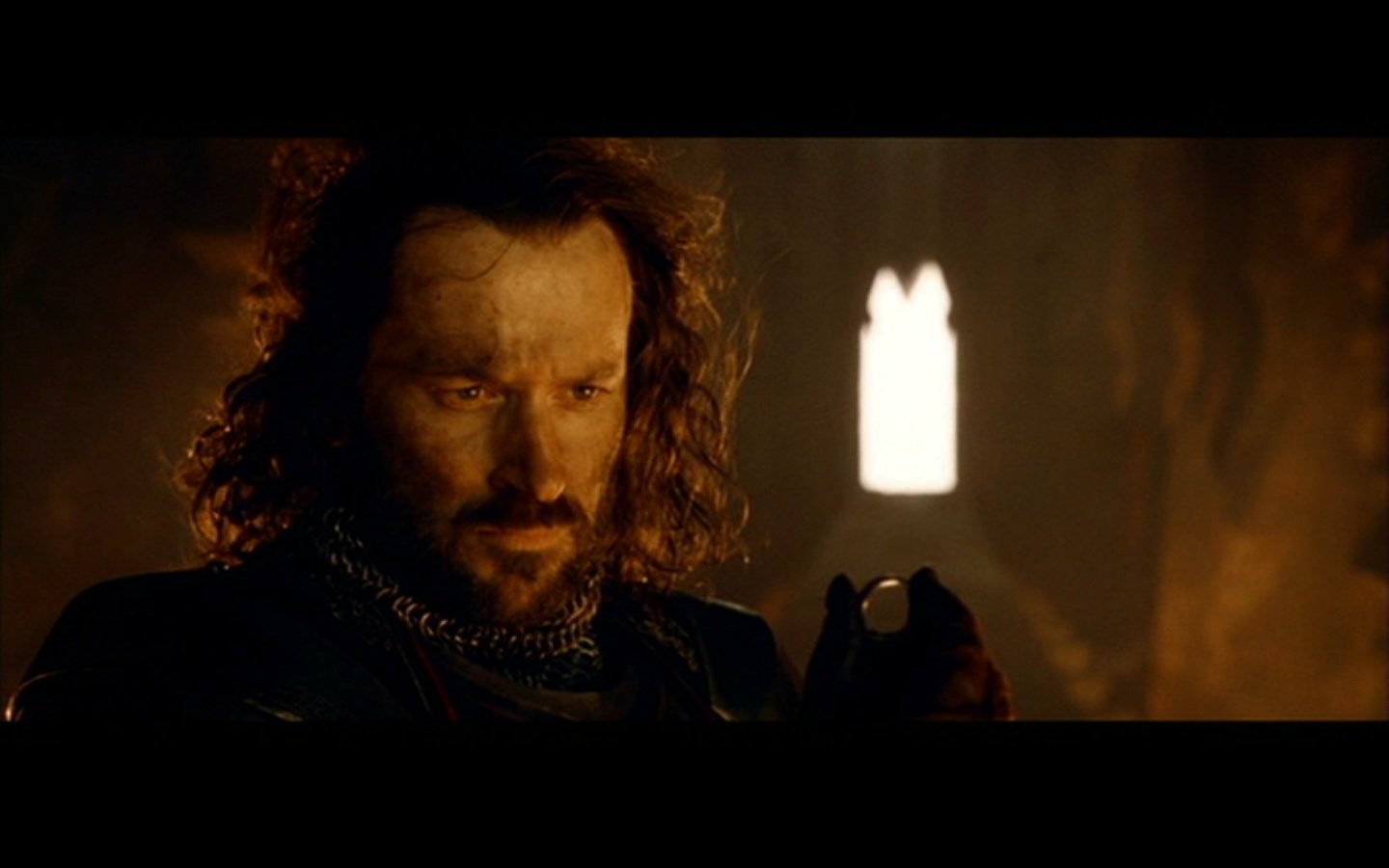
Isildur and The One Ring
Hrok then went to Hroar, and asked for the ring. Hroar replied, "I have given so much to get this ring that I will by no means part with it."

Hrok then asked to see it, saying he wanted to know if it was really "as much a treasure as it is claimed." Hroar readily showed it too him and Hrok threw it into the sea after saying, "I have never seen a comparable treasure, and the reason you esteem the ring so highly is obvious. The best solution, it seems to me, is that neither of us, or, for that matter, anyone else should enjoy it." He had no right to such an action. His claim on the ring was small enough, and Hroar had traded half the kingdom for it. Hroar chopped of Hrok's foot in response. After healing, Hrok assembled an army with which he defeated and killed Hroar. Helgi then defeated Hrok and instead of slaying him, broke all his limbs so that he was a cripple the rest of his life. And this was all between family! Many people searched the waters for the ring and Hroar's son, Agnar, finally found it after diving for it.

So, that's a summary of the ring episode. Although this ring was not imbued with the magical and evil properties that The One Ring possessed, it was coveted in much the same way, resulting in wars and the loss of limbs (Frodo lost his finger, Hrok, his foot). Hrok referred to it as "the great ring," giving it a title, much like, "The One Ring."  In The Lord of the Rings, it was suggested the the ring be thrown into the sea, but that idea was rejected because it could be found again eventually.

However, Hroar's ring could have been an arm ring and not a finger ring like The One Ring.
 
The Saga of Hrolf Kraki. Translated by Jesse L. Bylock. Published by Penguin Books, 1998.

Wednesday, February 20, 2013

Iceland and Middle-Earth

I recently started reading The Story of Burnt Njal, an Icelandic saga translated by Sir George Webbe Dasent. I'm not even half-way through and I found several points of comparison between this tale, Beowulf, and The Lord of the Rings.

 Here is one quote I found particularly striking: "How the Lord of rings bereft thee." The notes say that "Lord of rings" is a "periphrasis for a chief"  (The Story of Burnt Njal).  As an interesting side note: the man of whom this speaks was also called a "gold-bestower" like something from Beowulf.  Additionally, Beowulf speaks of  good lords as those who give gifts to their followers, namely rings among gifts of gold and armor. There is a huge emphasis on rings as gifts in Beowulf.

The phrase "crack of doom" appears in The Story of Burnt Njal. In a viking's interpretation of a dream, he said, "But when ye heard a great din, then ye must have been shown the crack of doom, and ye shall all die speedily."  In the Lord of the Rings, "the cracks of doom" is the name of the place in Mount Doom (a volcano) were the ring must be cast to destroy it.

Some names from The Story of Burnt Njal and The Story of Rolf and the Viking Bow bear similarities to those of the dwarves of Middle-Earth (a land created by Tolkien).

The name "Thrain" is found in The Story of Burnt Njal and The Hobbit.
"Thorarin" from the saga is similar to "Thorin" from The Hobbit.

In The Story of Rolf and the Viking Bow one finds the names "Frodi, Gisli, Snorri, Kari, and Flosi." These names end in "i" and "ri" like these dwarves in the Hobbit: Dori, Nori, and Ori. Also "Frodo" is like to "Frodi."  However, Tolkien was not imitating these specific names for the dwarves' names stem from The Poetic Edda. Christopher Tolkien wrote, "It is at any rate well-known that he derived the names of the dwarves in The Hobbit  from the first of the poems in the Edda, the Völuspá. 'the prophecy of Sibyl' " (Christopher Tolkien, Forward, in The Legend of Sigurd and Gudrún).

I saw the word "Gimli" on a building in Iceland, and it is also the name of a dwarf in The Lord of the Rings.

"Easterling" in The Story of Burnt Njal refers to a person from Norway. This term is used of a people group in Middle-Earth.

"The Mark" is a location in Iceland and Middle-Earth. The phrase: "The men of the mark" appears in both.

One must note that The Story of Burnt Njal, as I am reading it, is a translation. There are probably other acceptable ways to translate some of these terms I mentioned above; these are not the original Icelandic.

For example: several place names include "holt" in The Story of Burnt Njal and at least once in Middle-Earth (Dimholt)."Holt" is just a word for "wood" or "wooded hill" and is an English word, not Icelandic, it's just interesting that Dasent and Tolkien used it. Dasent could have said "XXXXwood" instead of "XXXXholt" but he didn't do that. 

Anyhow, it's quite exciting to stumble across these similarities between the tales!

For more comparisons between Iceland and Middle-Earth see:
The Icelandic horse and its home
Volcanoes, Geysers, and Trolls, oh my!

Monday, December 24, 2012

Merry Christmas! ~Lore and Literature Style~

Here is a selection of Christmas greetings in several interesting languages, group loosely by family or similarities.

Heughliche Winachten un 'n moi Nijaar ~Low Saxon~ Merry Christmas and a Happy New Year
Compare to German: Fröhliche Weihnachten

Glæd Geol ~Old English ~Merry Christmas
Glædelig jul ~Danish~ Merry Christmas
Gleðileg jól ~Icelandic~ Merry Christmas
Gleðilig jól ~Faroese~ Merry Christmas


 A Blythe Yule an a Guid Hogmanay/Merry Christmas an a Guid Hogmanay ~Scots English~Merry Christmas and Happy New Year

Nollaig shona duit ~ Irish~ Merry Christmas to you
Nollaig Chridheil dhuibh ~Scottish Gaelic~ Merry Christmas
Nadolig llawen ~Welsh~ Merry Christmas
Nadelik Lowen ~Cornish~ Merry Christmas
Nedeleg laouen ~Breton~ Merry Christmas

Alassë a Hristomerendë ~Quenya (Elvish)~ Joyous Feast of Christ
Mereth Veren e-Doled Eruion ~Sindarin (Elvish)~ Joyous Feast of the Coming of the Son of God.
Quenya and Sindarin are both elvish langauges created by J.R.R. Tolkien.

Friday, November 23, 2012

The Hobbit

Who's excited for the film The Hobbit? I am, for sure, and I know many others are! Ever since he directed The Lord of the Rings, fans have been hoping that Peter Jackson would undertake The Hobbit.

Not only is Peter Jackson one of the directors, but Sir Ian McKellen, Hugo Weaving, Cate Blanchett, Andy Serkis, Ian Holm (as an older Bilbo), Elijah Wood, Orlando Bloom, and Christopher Lee all playing the same roles as they did in The Lord of the Rings. Wonderful news!

Bilbo, from The Hobbit
However, from the production videos and trailers I've seen, the film seems to diverge quite a bit from the book. Galadriel does not even appear in The Hobbit. All the wizard action (Involving Radagast the Brown and Saruman the White) happens simultaneously as the action of the story, but is off-set so to speak: Tolkien never takes us there. We don't see the defeat of the Necromancer, we just hear about it. 

Secondly, I never would have pictured the village of Dale as an Italian/southern France village. It's cute though.

Thirdly, they added to the dwarves' characters. Ok, fine. Sounds entertaining. 

Fourthly, they got the beards wrong for the most part. In the film some of them don't really have beards, they have glorified mustaches. However, they are dwarves, therefore they ought to have full beards. Thorin Oakenshield from the book would be ashamed to go about with as little a beard as they gave him in the movie.
Kili
Aragorn

Fili and Kili, being younger, can certainly have smaller beards (in my opinion), but I think they should be longer and fuller than men generally wear theirs. Kili and Thorin in the movie look rather like Rangers or Men of Gondor.  In this photo, Kili looks like he could be a brother to Aragorn.
Here are pictures for comparison's sake.


Full, long beards are part of what make dwarves, dwarves (see The Blog That Time Forgot if you don't believe me). In the book, The Hobbit, Dwalin at least was able to tuck his beard in his belt: "It was a dwarf with a blue beard tucked into a golden belt" (page 7). Once, when Thorin was very angry, he said to Gandalf, "May your beard wither." Thorin was furious, showing that this is one of the worst things he could possibly wish upon another. The state of one's beard was a matter of pride. To loose one's beard would be like losing one's "man-card,"  or in this case, one's "dwarf-card."

The Blog that Time Forgot 
This blog goes into a detailed textual analysis of the dwarves' beards in the book. You can skip down to the section about beards. Basically his argument agrees with my observations from the book: dwarves should have beards and that beards are a source of pride.

In a production (behind-the-scenes) video one of the people on set suggests that maybe Fili and Kili can't grow beards yet. The above blog mentions this, and in addition to that blogger's analysis, I'd like to point out that Fili and Kili, most certainly did have beards in the book, "It was two dwarves, both with blue hoods, silver belts, and yellow beards" (page 8).

Sources:
The Hobbit, by J.R.R. Tolkien. Ballantine Books, published 1965.
The Hobbit (Official Site)
The Lord of the Rings (Official Site)
All photos come from the downloads sections.

Friday, September 7, 2012

Legends - a retelling of history

"Look to the past, learn for the future." This was our motto in American Girl's Club.

 "Legends are lessons. They ring with truth." -Queen Elinor, in Brave (a Pixar-Disney film)

"'Haflings!' laughed the Rider that stood beside Eomer. 'Haflings! But they are only a little people in old songs and children's tales out of the North. Do we walk in legends or on the green earth in the daylight?'
'A man may do both,' said Aragorn. 'For not we but those who come after will make the legends of our time.'" - J.R.R. Tolkien, The Two Towers

Based on fact, legends reflect reality as it was, and sometimes as it is.

Learn from legends or else "History repeats itself." 

Friday, June 1, 2012

The Road goes ever on and on without me

Photo Credit: Edana A.

"The Road goes ever on and on
 Down from the door where it began.
Now far ahead the road has gone,
and I must follow if I can,
 Pursuing it with eager feet,
Until it joins some larger way
 Where many paths and errands meet.
And whither then? I cannot say."
~ from The Lord of the Rings, by J.R.R. Tolkien

Photo Credit: Edana A.
Sometimes I want to just take a road and follow it all the way from it's source to it's end, wherever that may be, and just see what happens to it. Does it grow larger or smaller, what places does it pass through, does it meander through the woods and little towns, does it pass through big towns or open country? Where does it go?

Sometimes my heart cries out in restless desperation because I cannot follow all roads (usually when I am sight-seeing and exploring), I cannot go around every corner. On and on, the road and the land go, and I always wonder, "what's around the bend, what's over the next hill, the next stone?"

Just as in the poem, the road goes on ahead without me, and I chase it with my small feet, but then I meet a fork, or some side path, or I have to go back for I have neither time nor energy to keep going.

Bilbo spoke of being "swept" of his feet, and he told Frodo, "It's a dangerous business, Frodo, going out your door. You step into the Road and if you don't keep your feet, there is no knowing where you might be swept off to.  Do you realize that this is the very path that goes through Mirkwood, and if you let it, it might take you to the Lonely Mountain or even further to worse places?"

Sometimes you leave the house and you don't know what will happen in the course of the day or were you will go, you may have a destination, but that may change, or other destinations are added, or a wrong turn will bring you to sights and places you didn't expect to go. It's like life.  

Like little hobbits, we live out our humdrum lives, but maybe we will be called to a higher purpose and go to lands we never dreamed of.
Photo Credit: Edana A.