I recently listened to the LibriVox recording of Huntingtower, by John Buchan, published in 1922. I was on a long drive across the country and I admit I fell asleep a few times. I hope to actually read the book soon. As I listened, I almost instantly fell to analyzing the main character of this unusual tale, Dickson McCunn. It soon became apparent to me that he was an ISFJ.
I had him pinned down as an SJ, a Guardian, pretty quick. These are the people who are traditional and do what is expected of them and generally believe in upholding law and order. Dickson had lived a pretty normal life up until the book began. He had been a grocer until his retirement and he had done well in this profession and retired fairly wealthy. He described himself as "happily married for 30 years." He was also a responsible, providing type person. At the beginning, he gave some money to help some local urchins to go camping, and at the end, on seeing what fine boys they were he became their patron and decided to help them to great careers.
I had some trouble deciding if he was a Thinker or a Feeler. Then, Dickson was faced with a decision that drove the plot for the rest of the book. He had an initial gut reaction to get away from this odd, dangerous situation. Then he turned to thinking out his decision (Ti is the ISFJ's third function) and he busily worked out in his head why he no longer need take part in this adventure. He had it all logically thought out when he remembered the face of the girl in danger in his mind, and she had a peculiar expression that reminded him of his deceased daughter. (ISFJs have strong memories for details like expression. Portrait of an ISFJ).This clinched it for him, he was going back to help her. That is a perfect example of how an ISFJ makes decisions based on Fe, their secondary function, while first engaging their Ti, their tertiary function. I have use the same process myself, figuring it all out logically (using Ti), making excuses for myself and my initial gut reaction, and then when it comes down to it, doing what my feelings tell me is right (Fe). My feelings consume me for a moment and refuse to let me do anything other than but what they feel is right.
Dickson's next actions were classic ISFJ/ESFJ. He returned, but not without proper preparations. He bought a gun and brought food and thoughtful gifts back to his beleaguered companions. He not only provided, but did so in a thoughtful way that sought to meet the others' personal needs for comfort, not just generic needs for food.
Dickson is definitely and Introverted Sensor. He was very self-aware and analyzed himself constantly throughout the story. He wanted to come through this adventure without regrets or shame, knowing that he had done his bit, his duty (an SJ driving force), and had been brave. From my own experience and from what I've read, ISFJs are tied to the past, we think of life as a story, so while in the present, we want to make sure that we will be able to look back at our own story, our own past, without having to be stung by our consciences for doing the wrong thing or being a coward.
So, we come to the final question, how do we know that he is an Introvert and not an Extrovert? Well, he set off alone on a walking holiday. Key word: ALONE. He didn't need other people to have a good time, he had his books and himself. But, that in itself isn't much to go on. So, additionally, The ESFJ functions, in order of strength are Fe, Si, Ne, and Ti, while the ISFJ functions are Si, Fe, Ti, Ne. If Dickson were an ESFJ, we'd see him use his intuition more. Funky MBTI Fiction says that, "ESFJs are very good at reading people." Dickson has very few flashes of intuition and isn't particularly gifted at reading people correctly. Joe Butt wrote, "ISFJs are easily undone by Extroverted iNtuition, their inferior function." Instead, Dickson is more of a Ti user. For more on the differences between ESFJs and ISFJs and the significance of these functional differences please read Funky MBTI Fiction's post, see link above.
There are a plethora of little instances that point to the fact that Dickson is an ISFJ, perhaps when I have an opportunity to get my hands on a paper copy of the book I will delve into a more exhaustive analysis.
One more little thing: one of the reasons I really enjoyed this story was because it lent itself so well to analysis and as an ISFJ, myself, I could really relate to Dickson's decision making process, his romanticism spurred by the books he'd read, his shock at hearing someone lie, his shy, quiet manner of giving gifts, and his desire to do his duty and be a hero in what is thrown his way even if he's not THE hero of the story.
Showing posts with label analysis. Show all posts
Showing posts with label analysis. Show all posts
Tuesday, July 15, 2014

Tuesday, March 4, 2014
Dr. Watson an Expressive ISFJ
In the Sherlock Holmes canon, there are many incidents that support the generally accepted idea that Dr. John H. Watson is an ISFJ.
ISFJ stands for Introverted Sensing Feeling Judging, and is a personality type in the Myers Briggs system of personality analysis.
ISFJs are known as "The Protectors" and "The Defenders." Watson felt the need to protect his friend, insisting on accompanying Holmes when he was being pursued by Moriarty (The Final Problem, 734). He also felt protective of Miss Mary Morstan. When Thaddeus Sholto suddenly and offhandedly revealed that her father was dead, Watson wrote, "I could have struck the man across the face, so hot was I at this callous and offhand reference to so delicate a matter." Not long later they found themselves holding hands, "I have marvelled at it since, but at the time it seemed the most natural thing that I should go out to her so, and, as she has often told me, there was in her also the instinct to turn to me for comfort and protection" (The Sign of Four). In this quote, it is clear that he instinctively wanted to be supportive to her, and that she saw him as a good emotional support and protector.
Heiss wrote that
ISFJ's will provide practical support at a moment's notice to their
close friends. This is seen a number of times throughout the canon. In The Final Problem, Watson left on very short notice with Holmes in order to protect and assist
him. He arose early to go on adventures with
Holmes and undertook assignments from Holmes that involved leaving his
own business behind. Additionally, he retrieved a different friend from
an opium den and the man was grateful for this rescue (The Man With the Twisted Lip). Watson definitely exhibits this ISFJ trait.
ISFJs are Sensors as opposed to Intuitives. Andrea Wenger wrote, "They’re more interested in sensory data than in the patterns perceived by the unconscious mind." Watson saw and noticed details but he could not connect them correctly in the grand way the intuitive Holmes did. Now, that being said, ISFJs do have some intuition which may misguide them (Heiss) as perhaps it did Watson.
Watson possessed an inability to hide his true feelings well. Joe Butt wrote that ISFJs are "are often unable to either hide or articulate any distress they may be feeling." One example was when Holmes deceived Watson instead of taking him into his schemes because he knew Watson wouldn't be as convincing if he didn't believe in it. In The Dying Detective. Holmes said to Watson, "among your many talents dissimulation finds no place, and that if you had shared my secret you would never have been able to impress Smith with the urgent necessity of his presence, which was the vital point of the whole scheme." (Conversely: because he did believe Holmes was dieing, he succeeded in convincing the villain to come). In The Sign of Four, he pretended to be happy although his heart "was heavy within" him and it was evident: "I think I must have been rather over-acting my delight, and that she detected a hollow ring in my congratulations."
Now, in response to the latter half of Joe Butt's statement, Watson was able to articulate his feelings just fine, and I think this is because we see his feelings through his writings. Writing gives one the chance to analyze one's emotions and pick the right words to describe them. In Portrait of an ISFJ, we read, "more so than other types, ISFJs are extremely aware of their own internal feelings, as well as other people's feelings" which they may refrain from expressing. From personal experience both these statements are true in the right context. ISFJs just hide their feelings poorly.
On a similar note, and although not technically an ISFJ trait, Watson had an expressive face. In The Adventure of the Cardboard Box, Holmes was able to basically read Watson's mind because, well, it was written across his face:
“You remember,” said he, “that some little time ago when I read you the passage in one of Poe’s sketches in which a close reasoner follows the unspoken thoughts of his companion, you were inclined to treat the matter as a mere tour-de-force of the author. On my remarking that I was constantly in the habit of doing the same thing you expressed incredulity.”
“Oh, no!”
“Perhaps not with your tongue, my dear Watson, but certainly with your eyebrows."
Their conversation continued and Watson argued:
"But I have been seated quietly in my chair, and what clues can I have given you?”
“You do yourself an injustice. The features are given to man as the means by which he shall express his emotions, and yours are faithful servants.”
“Do you mean to say that you read my train of thoughts from my features?”
“Your features and especially your eyes.” Holmes continued with an analysis of Watson's expressions and movements which were the foot-prints that led him through the path of Watson's mind.
And this is one reason why Martin Freeman is an excellent Watson:
What a veritable palette of expression!
Further Exploration:
His writing style also indicates that he is an ISFJ. For more on that see:
Dr. Watson's Writing Style and Personality Type
I really enjoyed this post about Dr. John Watson from BBC's Sherlock. It approaches character analysis by looking at personality functions. I learned a lot about Myers Briggs through her series and the further exploration that it prompted:
http://sherlockcharacteranalysis.tumblr.com/post/29827385452/sensor-feeler-thinker-intuitor-johns-myers-briggs
Bibliography:
Doyle, Sir Arthur Conan, edited by Leslie J. Klinger, intro by John Le Carré. The New Annotated Sherlock Holmes, vol 1 & 2. W. W. Norton & Company. New York: 2005.
Heiss, Marina Margaret and Joe Butt. ISFJ Profile, on TypeLogic.
http://www.typelogic.com/isfj.html
Wenger, Andrea. The ISFJ Writing Personality: Tangible Warmth.
http://andreajwenger.com/2010/03/06/isfj-writing-personality/
ISFJ stands for Introverted Sensing Feeling Judging, and is a personality type in the Myers Briggs system of personality analysis.
ISFJs are known as "The Protectors" and "The Defenders." Watson felt the need to protect his friend, insisting on accompanying Holmes when he was being pursued by Moriarty (The Final Problem, 734). He also felt protective of Miss Mary Morstan. When Thaddeus Sholto suddenly and offhandedly revealed that her father was dead, Watson wrote, "I could have struck the man across the face, so hot was I at this callous and offhand reference to so delicate a matter." Not long later they found themselves holding hands, "I have marvelled at it since, but at the time it seemed the most natural thing that I should go out to her so, and, as she has often told me, there was in her also the instinct to turn to me for comfort and protection" (The Sign of Four). In this quote, it is clear that he instinctively wanted to be supportive to her, and that she saw him as a good emotional support and protector.
 |
| Dr. Watson |
On a related note, this type feels a need to serve. "ISFJs are characterized above all by their desire to serve others, their 'need to be needed.' In extreme cases, this need is so strong that standard give-and-take relationships are deeply unsatisfying to them" (Heiss). Watson once referred to Holmes as his master, which implies that he was the servant or pupil. He, himself, stated that he served Holmeswith these words: "my years of
humble but single-minded service" (The Adventure of the Three Garridebs).
While he would have liked to be more appreciated this need to serve is perhaps
why he continued to serve Holmes despite the fact that he felt unappreciated.
It seems that Watson would have liked a normal give-and-take friendship, but
because he was an ISFJ he put up with one that was not and on learning that
Holmes really did value his friendship and service after his apparent
indifference, it was enough for him: "All my years of humble but
single-minded service culminated in that moment of revelation" (The Adventure
of the Three Garridebs). "ISFJs are
loyal to the end," Joe Butt.
Typical ISFJ, Watson feels
unappreciated, "I have often been piqued by his indifference to my
admiration and to the attempts I had made to give publicity to his
methods" (The Hound of the Baskervilles).
Heiss wrote, "ISFJs are often unappreciated....they are often
unwilling to toot their own horns about their accomplishments because they feel
that although they deserve more credit than they're getting, it's somehow wrong
to want any sort of reward for doing work." Watson doesn't express the
feeling that it is wrong to want recognition, but he does feel unappreciated
and that he deserves more gratitude from Holmes.
Watson possessed an inability to hide his true feelings well. Joe Butt wrote that ISFJs are "are often unable to either hide or articulate any distress they may be feeling." One example was when Holmes deceived Watson instead of taking him into his schemes because he knew Watson wouldn't be as convincing if he didn't believe in it. In The Dying Detective. Holmes said to Watson, "among your many talents dissimulation finds no place, and that if you had shared my secret you would never have been able to impress Smith with the urgent necessity of his presence, which was the vital point of the whole scheme." (Conversely: because he did believe Holmes was dieing, he succeeded in convincing the villain to come). In The Sign of Four, he pretended to be happy although his heart "was heavy within" him and it was evident: "I think I must have been rather over-acting my delight, and that she detected a hollow ring in my congratulations."
Now, in response to the latter half of Joe Butt's statement, Watson was able to articulate his feelings just fine, and I think this is because we see his feelings through his writings. Writing gives one the chance to analyze one's emotions and pick the right words to describe them. In Portrait of an ISFJ, we read, "more so than other types, ISFJs are extremely aware of their own internal feelings, as well as other people's feelings" which they may refrain from expressing. From personal experience both these statements are true in the right context. ISFJs just hide their feelings poorly.
On a similar note, and although not technically an ISFJ trait, Watson had an expressive face. In The Adventure of the Cardboard Box, Holmes was able to basically read Watson's mind because, well, it was written across his face:
“You remember,” said he, “that some little time ago when I read you the passage in one of Poe’s sketches in which a close reasoner follows the unspoken thoughts of his companion, you were inclined to treat the matter as a mere tour-de-force of the author. On my remarking that I was constantly in the habit of doing the same thing you expressed incredulity.”
“Oh, no!”
“Perhaps not with your tongue, my dear Watson, but certainly with your eyebrows."
Their conversation continued and Watson argued:
"But I have been seated quietly in my chair, and what clues can I have given you?”
“You do yourself an injustice. The features are given to man as the means by which he shall express his emotions, and yours are faithful servants.”
“Do you mean to say that you read my train of thoughts from my features?”
“Your features and especially your eyes.” Holmes continued with an analysis of Watson's expressions and movements which were the foot-prints that led him through the path of Watson's mind.
And this is one reason why Martin Freeman is an excellent Watson:
 |
| Watson from BBC Sherlock |
Further Exploration:
His writing style also indicates that he is an ISFJ. For more on that see:
Dr. Watson's Writing Style and Personality Type
I really enjoyed this post about Dr. John Watson from BBC's Sherlock. It approaches character analysis by looking at personality functions. I learned a lot about Myers Briggs through her series and the further exploration that it prompted:
http://sherlockcharacteranalysis.tumblr.com/post/29827385452/sensor-feeler-thinker-intuitor-johns-myers-briggs
Bibliography:
Doyle, Sir Arthur Conan, edited by Leslie J. Klinger, intro by John Le Carré. The New Annotated Sherlock Holmes, vol 1 & 2. W. W. Norton & Company. New York: 2005.
Heiss, Marina Margaret and Joe Butt. ISFJ Profile, on TypeLogic.
http://www.typelogic.com/isfj.html
Wenger, Andrea. The ISFJ Writing Personality: Tangible Warmth.
http://andreajwenger.com/2010/03/06/isfj-writing-personality/
Portrait of an ISFJ
Friday, January 31, 2014
Dr. Watson's Writing Style and Personality Type
Dr. John H. Watson is generally accepted as an ISFJ. His writing style certainly supports this idea. Watson writes clearly, succinctly, and yet with warmth.
John Le Carré wrote in the Introduction to The New Annoted Sherlock Holmes, "Dr. Watson doesn't write to you, he talks to you, with Edwardian courtesy, across a glowing fire. His voice has no barriers or affectations. It is clear, energetic, and decent." Andrea Wenger labeled the ISFJ writing style as "Tangible Warmth." She wrote, "ISFJs focus on facts, which they often convey with warmth.." Although Holmes complains that Watson doesn't stick to the facts enough,* the stories stay focused on the mystery at hand and are told in a straight-forward fashion. He just diverges a little bit to give us a better glimpse of the characters and their lives-- one source of warmth. This warmth, or rather personability, is found in the feelings of the characters, such as their excitement, fear, love, and ideals.
Warmth is also found in Watson's descriptions. Even if he is describing something dreary, it still has warmth because the description contains a perception of the subject and how it is interpreted by an imaginative human mind. It's like that scientific principle which says the temperature scale doesn't measure hot versus cold, but is rather a scale of heat. There isn't really such a thing as cold, but just a difference in warmth. It was explained to me somewhat like this: two objects that we perceive as cold, one being -10 degrees Fahrenheit and the other -20 degrees Fahrenheit (cold to human touch) actually contain heat, for if they didn't there could be no energy transfer and the warmth from the -10 object wouldn't travel to the other and raise it's temperature to -15 degrees.
One example of Watson's descriptive warmth in speaking and writing is this exchange where his "SF" effusion is met with "NT" facts:
"'The Haven is the name of Mr. Josiah Amberley's house,' I explained. 'I think it would interest you, Holmes. It is like some penurious patrician who has sunk into the company of his inferiors. You know that particular quarter, the monotonous brick streets, the weary suburban highways. Right in the middle of them, a little island of ancient culture and comfort, lies this old home, surrounded by a high sun-baked wall mottled with lichens and topped with moss, the sort of wall--'
'Cut out the poetry, Watson,' said Holmes severely. 'I note that it was a high brick wall.' (The Adventure of the Retired Colour Man)
The description pulls you in. He personifies the house. He is bounteous with adjectives and in a painter-like fashion, he daubs moss and lichen onto the wall. Not only does he display warmth in this passage but also other characteristics in keeping with the ISFJ style, for Wenger writes, "They may also excel at sensory detail, drawing the reader in."
ISFJs "Enjoy reading and writing about history or biography, but are less likely to gravitate toward business or technical writing" (Wenger). Watson writes about events, he recounts stories that have happened, which is, more or less, history. Holmes referred to him as his "biographer" on at least one occasion. Watson does not write the dry technical pieces Holmes would wish.*
Wenger also informs us that ISFJs "often write about topics they care about, although they may not let their own beliefs shine through. They prefer to present the facts, which they may do in great detail, then let readers make up their own mind." We know that Watson finds the cases very interesting, his wife says as much. However, Watson doesn't make judgments on Holmes' handling of a case although he expresses his disapproval of his drug use and excessive untidiness.
"Tangible Warmth" (Wenger) is certainly an appropriate description for Dr. Watson's writing style. The facts told in vivid detail renders it tangible. Warmth emanates from the humanness of his descriptions, the emotions expressed, and the interactions between people that you come to know through his eyes.
~Please take a look at Andrea Wenger's article, The ISFJ Writing Personality: Tangible Warmth. I was delighted with it. You may also enjoy reading her other articles. ~
Note:
*In The Sign of Four, Holmes said, "Detection is, or ought to be, an exact science, and should be treated in the same cold and unemotional manner. You have attempted to tinge it with romanticism, which produces much the same effect as if you worked a love-story or an elopement into the fifth proposition of Euclid."
Bibliography:
Doyle, Sir Arthur Conan, edited by Leslie J. Klinger, intro by John Le Carré. The New Annotated Sherlock Holmes, vol 1 & 2. W. W. Norton & Company. New York: 2005.
Wenger, Andrea. The ISFJ Writing Personality: Tangible Warmth.
http://andreajwenger.com/2010/03/06/isfj-writing-personality/
John Le Carré wrote in the Introduction to The New Annoted Sherlock Holmes, "Dr. Watson doesn't write to you, he talks to you, with Edwardian courtesy, across a glowing fire. His voice has no barriers or affectations. It is clear, energetic, and decent." Andrea Wenger labeled the ISFJ writing style as "Tangible Warmth." She wrote, "ISFJs focus on facts, which they often convey with warmth.." Although Holmes complains that Watson doesn't stick to the facts enough,* the stories stay focused on the mystery at hand and are told in a straight-forward fashion. He just diverges a little bit to give us a better glimpse of the characters and their lives-- one source of warmth. This warmth, or rather personability, is found in the feelings of the characters, such as their excitement, fear, love, and ideals.
Warmth is also found in Watson's descriptions. Even if he is describing something dreary, it still has warmth because the description contains a perception of the subject and how it is interpreted by an imaginative human mind. It's like that scientific principle which says the temperature scale doesn't measure hot versus cold, but is rather a scale of heat. There isn't really such a thing as cold, but just a difference in warmth. It was explained to me somewhat like this: two objects that we perceive as cold, one being -10 degrees Fahrenheit and the other -20 degrees Fahrenheit (cold to human touch) actually contain heat, for if they didn't there could be no energy transfer and the warmth from the -10 object wouldn't travel to the other and raise it's temperature to -15 degrees.
One example of Watson's descriptive warmth in speaking and writing is this exchange where his "SF" effusion is met with "NT" facts:
"'The Haven is the name of Mr. Josiah Amberley's house,' I explained. 'I think it would interest you, Holmes. It is like some penurious patrician who has sunk into the company of his inferiors. You know that particular quarter, the monotonous brick streets, the weary suburban highways. Right in the middle of them, a little island of ancient culture and comfort, lies this old home, surrounded by a high sun-baked wall mottled with lichens and topped with moss, the sort of wall--'
'Cut out the poetry, Watson,' said Holmes severely. 'I note that it was a high brick wall.' (The Adventure of the Retired Colour Man)
The description pulls you in. He personifies the house. He is bounteous with adjectives and in a painter-like fashion, he daubs moss and lichen onto the wall. Not only does he display warmth in this passage but also other characteristics in keeping with the ISFJ style, for Wenger writes, "They may also excel at sensory detail, drawing the reader in."
Furthermore, in Portrait of an ISFJ, we are told,
"ISFJs have a rich inner world that is not usually obvious to observers.
They constantly take in information about people and situations that is
personally important to them, and store it away. This tremendous store of
information is usually startlingly accurate, because the ISFJ has an
exceptional memory about things that are important to their value systems. It
would not be uncommon for the ISFJ to remember a particular facial expression
or conversation in precise detail years after the event occurred, if the
situation made an impression on the ISFJ. " This is evident in Watson's
writing. He often wrote the stories years after they occurred (with the help of
his notes) and yet the people have life and color, and the descriptions are
explicit.
 |
| By Sidney Paget, The Strand Magazine, October 1891 |
Wenger also informs us that ISFJs "often write about topics they care about, although they may not let their own beliefs shine through. They prefer to present the facts, which they may do in great detail, then let readers make up their own mind." We know that Watson finds the cases very interesting, his wife says as much. However, Watson doesn't make judgments on Holmes' handling of a case although he expresses his disapproval of his drug use and excessive untidiness.
"Tangible Warmth" (Wenger) is certainly an appropriate description for Dr. Watson's writing style. The facts told in vivid detail renders it tangible. Warmth emanates from the humanness of his descriptions, the emotions expressed, and the interactions between people that you come to know through his eyes.
~Please take a look at Andrea Wenger's article, The ISFJ Writing Personality: Tangible Warmth. I was delighted with it. You may also enjoy reading her other articles. ~
Note:
*In The Sign of Four, Holmes said, "Detection is, or ought to be, an exact science, and should be treated in the same cold and unemotional manner. You have attempted to tinge it with romanticism, which produces much the same effect as if you worked a love-story or an elopement into the fifth proposition of Euclid."
Bibliography:
Doyle, Sir Arthur Conan, edited by Leslie J. Klinger, intro by John Le Carré. The New Annotated Sherlock Holmes, vol 1 & 2. W. W. Norton & Company. New York: 2005.
Wenger, Andrea. The ISFJ Writing Personality: Tangible Warmth.
http://andreajwenger.com/2010/03/06/isfj-writing-personality/
Portrait of an ISFJ
Saturday, November 16, 2013
Sherlock Holmes (Book character) as an Intuitive Perceiver
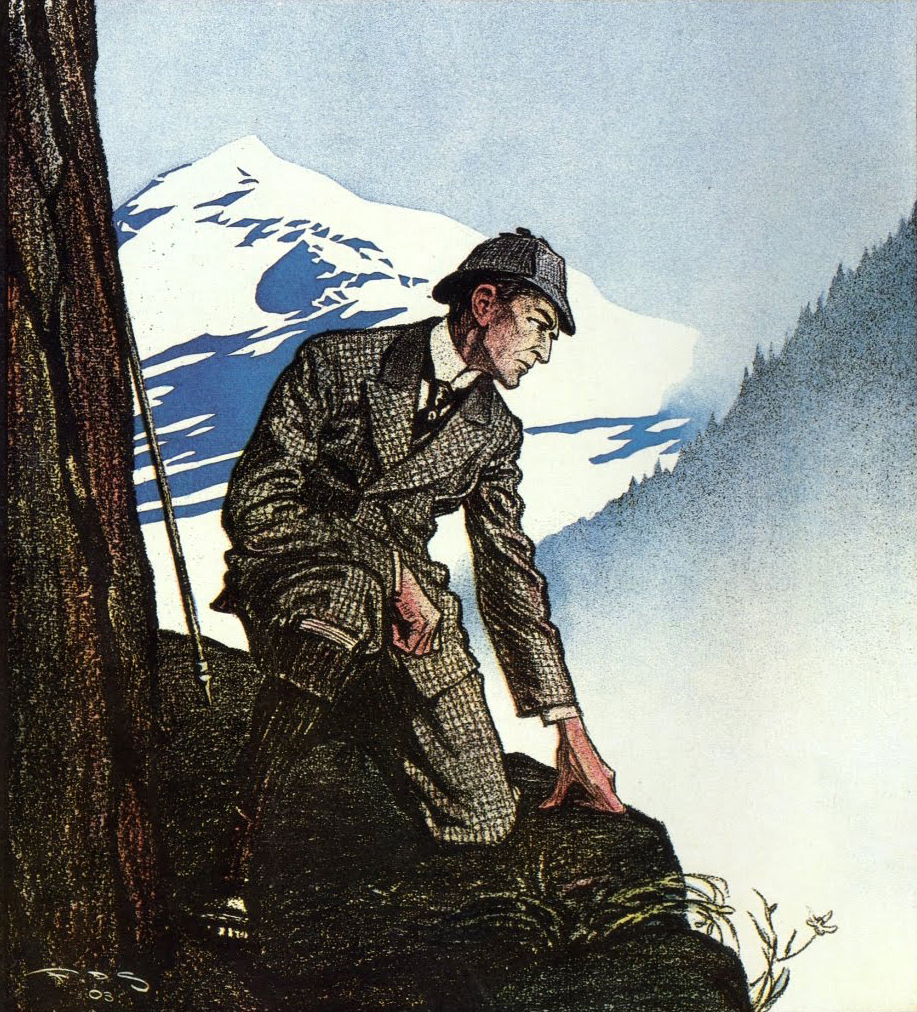
Last night as I was reading The Complete Sherlock Holmes in the wee hours of the morning, I came across a rather revealing quote about Sherlock Holmes and his personality type. Across the internet I have seen Holmes labeled as either an INTP or an INTJ (personality types in the Myers-Briggs system). From my own small knowledge of the types, I agree with those who say he is an INTP, which stands for Introverted iNtutive Thinking Perceiving. I'm not going to go into a full analysis, but I just want to show how this quote fits with this conclusion.
Holmes said, "I have an instinct for such things, and yet sometimes it has played me false. It seemed a certainty when it first flashed across my mind in the cell at Winchester, but one drawback of an active mind is that one can always conceive alternate explanations which would make our scent a false one." (The Problem of Thor Bridge, page 1069)
This quote points to the fact that Holmes is intuitive (the N) in INTP. There are many references to his instinct and intuition throughout the stories and events that are evidence of it. For more on Holmes' intuition, see the links below.
The fact that Holmes can "always conceive alternate explanations" to the one he already came up with shows that he is a P (perceiving). The official Myers-Briggs website describes the perceiving function thus: "in type language perceiving means 'preferring to take in information.'" The site states that the following statement is the sort of thing a perceiver might identify with, "Sometimes I stay open to new information so long I miss making decisions when they are needed" (The Myers & Briggs Foundation: Judging or Perceiving). Notice how similar this is to Holmes' own statement. He declares that his ability to come up with new explanations is a drawback of the active mind.
Quote from the book:
The Problem of Thor Bridge, in The Complete Sherlock Holmes, vol. II. By Sir Arthur Conan Doyle. Doubleday & Co, Inc. Garden City, New York. 1930.
For a description of the INTP personality type:
Typelogic INTP profile
For a fuller analysis of Sherlock Holmes' (of BBC's Sherlock) personality type, you might enjoy:
Thinker Intuitor Sensor Feeler: Sherlock's Myers-Briggs Type
 |
| By Frederic Dorr Steele |
This quote points to the fact that Holmes is intuitive (the N) in INTP. There are many references to his instinct and intuition throughout the stories and events that are evidence of it. For more on Holmes' intuition, see the links below.
The fact that Holmes can "always conceive alternate explanations" to the one he already came up with shows that he is a P (perceiving). The official Myers-Briggs website describes the perceiving function thus: "in type language perceiving means 'preferring to take in information.'" The site states that the following statement is the sort of thing a perceiver might identify with, "Sometimes I stay open to new information so long I miss making decisions when they are needed" (The Myers & Briggs Foundation: Judging or Perceiving). Notice how similar this is to Holmes' own statement. He declares that his ability to come up with new explanations is a drawback of the active mind.
Quote from the book:
The Problem of Thor Bridge, in The Complete Sherlock Holmes, vol. II. By Sir Arthur Conan Doyle. Doubleday & Co, Inc. Garden City, New York. 1930.
For a description of the INTP personality type:
Typelogic INTP profile
For a fuller analysis of Sherlock Holmes' (of BBC's Sherlock) personality type, you might enjoy:
Thinker Intuitor Sensor Feeler: Sherlock's Myers-Briggs Type
Subscribe to:
Posts (Atom)