Showing posts with label INTP. Show all posts

Tuesday, May 27, 2014

Confessions of an ISFJ


Confessions of an ISFJ:

1. I have no idea how to handle unforeseen social situations.
I think this is because I am a Sensor and I rely on my past experiences to guide my behavior. In a situation I have never experienced before I don't have the data of previous similar experiences needed to construct protocol. This causes me to him-haw or just gape stupidly while my brain wildly tries to figure out what to do.

2. I give myself a little talk before going to a social event, creating occasion-specific rules for myself. "You will not mention____. You will not push yourself forward. You will be quiet and not interrupt. The less you say, the less stupid things you'll say and regret later." Or, "You will exude quiet confidence, you will stand up for yourself and what's right." After any social event, I need time alone to analyze what just happened and create more rules for myself. (After typing this, I found this related quote on Funky MBTI Fiction which said ISFJs and ESFJs will "reevaluate their behavior, relationships, work experiences, and lifestyle to determine if it needs improvement.")

3. I once I wrote ten pages of sheer description of a painting for an assignment when only five where required.  Some were a little daunted by this assignment but I wasn't much because I was glad I didn't have to draw a conclusion or defend a theory. Child ISFjs might not be capable of summary, but instead feel the need to include ALL details (funny personal story). For more on ISFJ writing tendencies (almost all true for me) : http://andreajwenger.com/2010/03/06/isfj-writing-personality/

4. I like to go to the store as opposed to shopping by catalogue or online. I like to actually see and physically touch the items I'm thinking of buying. I think this could be a Sensor trait.

5. I've discovered that violent emotions will shut an INTP and an INTJ down. It will NOT create sympathy, they'll just leave the room as fast as possible and possibly think less of you. (Personal experience)

6. When I'm at an event I pick one person as my special buddy to stick to. Sometimes we part for a little while to chat with different people or play different games but I will come back to them and check-up on them or go and "stick to them" when I feel out of place elsewhere. They're my anchor for that event.

7. Don't forget my birthday. Doing so says, "I don't love you."  We don't want to ask people to do anything special for us, but forgetting our birthday hits upon deeply rooted convictions about love we're unaware of ourselves. If you do something for one of us ISFJs on our birthday, we will think of you with more warmth than we already did. (I'm guessing this principle is translatable to other special occasions instead of birthday, an ISFJ may have special inviolable traditions or ideas of how something should be celebrated.)

8. Sometimes my feelings take over. I will figure out what I think I should do and then when I'm confronted with the actual situation, I follow my heart anyhow. This is not for areas of major moral dilemma, just small things. For example, being placed on one team but switching to the other so as to be on the same team as your significant other.

9. I use emotion to communicate what I want to say even if I can't get the right words out. If I'm irritated, everybody knows. It's not so much in what I say, but in how I say it, or how I move, or huff, or glare.

10. I feel very honored when someone confides in me and comes to me for emotional support, advice, or protection.

11. Sometimes I look forward to danger or distress with anticipation because I like to protect people. So, if there's a weird guy annoying a friend and they ask me to help them, I am thrilled. I'll walk with that friend, I'll invent honest ways to break-up a conversation between him and her, whatever. So, if you're in trouble and I can help, I really enjoy helping or defending you, even though it's unfortunate you're in a tough spot. I find myself day-dreaming scenarios of potential problems and how I can be a hero in them. (This also prepares me for problems when they arise, since I don't think on my feet very well...?)

12. I seem shy and timid  but then suddenly I'll let my wild side show which shocks people. I even tone it down so as to freak people out less. According to Dave's video (link below too) this is caused by the ISFJ's secondary function: Extroverted Feeling (Fe): "This is why the ESFJ and ISFJ have the gold star for being the most crazy, bi-polar.....by day they're in a traditional job and they're very good at it and then at home all that extroverted feeling is allowed to come out."

13. Change just really freaks me out. When first confronted with a novel idea, my response is "NO." Five minutes later, I'll already be warmer to it than I was. I just need some time to think a new idea through and become used to it. If it's a request for help, this scenario may be reversed.

14. Defender mode. I scare myself sometimes....I growled at a soccer ball once while playing defense. I actually growled at it instinctively. Another time we were playing with larps and I was defending an imaginary king. A friend noticed that once my opponents got past me and attacked the king I would switch from just warding them of but not fulling engaging in combat to fighting madly like a berserk maniac to save and avenge my king (who didn't even exist).  If I've got someone to protect something just wells up inside and suddenly I'm not that timid and shy little person, suddenly "I've got the eye of the tiger, a fighter, dancing through the fire, I am a champion, and you're gonna hear me roar. (Katy Perry, Roar)."  

15. I wear comfortable, protective footwear so I'm ready for anything. Some studies suggest ISFJs tend to wear practical, comfortable shoes.

In Conclusion I'd like to say that just because another ISFJ does something doesn't make it right! These are not excuses for fits of rage or following your heart. If you are an ISFJ, I hope this helps you understand yourself better/gives you something to relate too. With some of these, I don't know that they're particularly ISFJ traits, but rather they are ways the ISFJ functions are exhibited in me in conjunction with my upbringing and my own function percentages/balance. Therefore, some ISFJs will relate and some probably won't but that doesn't make you any less an ISFJ.

If you're reading this and you are not an ISFJ, I hope this helps you understand your ISFJ better.

These are things that I've noticed about myself and seem to fit with what I've learned about ISFJs on these websites:
ISFJ Profile on TypeLogic by Marina Margaret Heiss and Joe Butt.
Portrait of an ISFJ at PersonalityPage
Sensor Feeler Thinker Intuitor on Sherlock Character Analysis tumblr. This one helped me see how the functions play out in an ISFJ.
ISFJ vs. ISFP by DaveSuperPowers, video on youtube This one says ISFJs can be crazy.
Type Contrast: ESFJ vs ISFJ on Funky MBTI Fiction

Thursday, May 15, 2014

Confusion, Counselors, Cats, and Comfort: An anecdote on MBTI types and emotion.

Continuing in my mini-series on personality types, here's another little snapshot of personalities playing out in my family. Enjoy!

I was sitting at the table talking to my mom about my emotional state.

My mom, an INFJ--this type is also known as The Counselor-- was listening, offering advice, and probing my heart.

As an ISFJ, "often unable to either hide or articulate any distress they may be feeling" (Joe Butt, TypeLogic), I sighed, "I don't even know what I feel." Numbness throbbed in my chest, partially obscuring my sadness and anger which was also strangely mixed with a dash of hope and excitement.

Now, both my dad and I love cats, and it's a bond that we have. On seeing I was sad, he reappeared with one of our cats which he wordlessly handed to me. It was like he was saying, "I can't fix your emotional problem, but have a cat. Cats are comforting."

I couldn't help chuckling as I hugged our gray cat. I had found the INTP solution to emotional distress: Apply cat directly to problem.

This thought caused further mirth as I pictured sticking my cat onto certain people's faces.

From my experience, INTPs are not comfortable with emotions in others, they don't know how to delve into them and explore them out. I think emotions distress them, they want to fix them and turn off negative emotions in others if they're not too overwhelming. The volatile and violent expression of emotions, like screaming in rage, will turn the INTP off, he'll just leave the room. Since mine were quietly expressed in this instance he was willing to try and comfort me.

~I read this to my dad before posting and he laughed.~


Friday, January 31, 2014

Dr. Watson's Writing Style and Personality Type

Dr. John H. Watson is generally accepted as an  ISFJ. His writing style certainly supports this idea. Watson writes clearly, succinctly, and yet with warmth.

John Le Carré wrote in the Introduction to The New Annoted Sherlock Holmes, "Dr. Watson doesn't write to you, he talks to you, with Edwardian courtesy, across a glowing fire. His voice has no barriers or affectations. It is clear, energetic, and decent."  Andrea Wenger labeled the ISFJ writing style as "Tangible Warmth." She wrote, "ISFJs focus on facts, which they often convey with warmth.." Although Holmes complains that Watson doesn't stick to the facts enough,* the stories stay focused on the mystery at hand and are told in a straight-forward fashion. He just diverges a little bit to give us a better glimpse of the characters and their lives-- one source of warmth. This warmth, or rather personability, is found in the feelings of the characters, such as their excitement, fear, love, and ideals.  

Warmth is also found in Watson's descriptions. Even if he is describing something dreary, it still has warmth because the description contains a perception of the subject and how it is interpreted by an imaginative human mind. It's like that scientific principle which says the temperature scale doesn't measure hot versus cold, but is rather a scale of heat. There isn't really such a thing as cold, but just a difference in warmth. It was explained to me somewhat like this: two objects that we perceive as cold, one being -10 degrees Fahrenheit and the other -20 degrees Fahrenheit  (cold to human touch) actually contain heat, for if they didn't there could be no energy transfer and the warmth from the -10 object wouldn't travel to the other and raise it's temperature to -15 degrees.

One example of Watson's descriptive warmth in speaking and writing is this exchange where his "SF" effusion is met with "NT" facts:

"'The Haven is the name of Mr. Josiah Amberley's house,' I explained. 'I think it would interest you, Holmes. It is like some penurious patrician who has sunk into the company of his inferiors. You know that particular quarter, the monotonous brick streets, the weary suburban highways. Right in the middle of them, a little island of ancient culture and comfort, lies this old home, surrounded by a high sun-baked wall mottled with lichens and topped with moss, the sort of wall--'
'Cut out the poetry, Watson,' said Holmes severely. 'I note that it was a high brick wall.' (The Adventure of the Retired Colour Man)

The description pulls you in. He personifies the house. He is bounteous with adjectives and in a painter-like fashion, he daubs moss and lichen onto the wall. Not only does he display warmth in this passage but also other characteristics in keeping with the ISFJ style, for Wenger writes, "They may also excel at sensory detail, drawing the reader in."

Furthermore, in Portrait of an ISFJ, we are told, "ISFJs have a rich inner world that is not usually obvious to observers. They constantly take in information about people and situations that is personally important to them, and store it away. This tremendous store of information is usually startlingly accurate, because the ISFJ has an exceptional memory about things that are important to their value systems. It would not be uncommon for the ISFJ to remember a particular facial expression or conversation in precise detail years after the event occurred, if the situation made an impression on the ISFJ. " This is evident in Watson's writing. He often wrote the stories years after they occurred (with the help of his notes) and yet the people have life and color, and the descriptions are explicit.

By Sidney Paget, The Strand Magazine, October 1891
ISFJs "Enjoy reading and writing about history or biography, but are less likely to gravitate toward business or technical writing" (Wenger). Watson writes about events, he recounts stories that have happened, which is, more or less, history. Holmes referred to him as his "biographer" on at least one occasion. Watson does not write the dry technical pieces Holmes would wish.*

Wenger also informs us that ISFJs "often write about topics they care about, although they may not let their own beliefs shine through. They prefer to present the facts, which they may do in great detail, then let readers make up their own mind."  We know that Watson finds the cases very interesting, his wife says as much. However, Watson doesn't make judgments on Holmes' handling of a case although he expresses his disapproval of his drug use and excessive untidiness.

"Tangible Warmth" (Wenger) is certainly an appropriate description for Dr. Watson's writing style. The facts told in vivid detail renders it tangible. Warmth emanates from the humanness of his descriptions, the emotions expressed, and the interactions between people that you come to know through his eyes.

~Please take a look at Andrea Wenger's article,  The ISFJ Writing Personality: Tangible Warmth. I was delighted with it. You may also enjoy reading her other articles. ~

Note:
*In The Sign of Four, Holmes said, "Detection is, or ought to be, an exact science, and should be treated in the same cold and unemotional manner. You have attempted to tinge it with romanticism, which produces much the same effect as if you worked a love-story or an elopement into the fifth proposition of Euclid."


Bibliography:

Doyle, Sir Arthur Conan, edited by Leslie J. Klinger, intro by John Le Carré. The New Annotated Sherlock Holmes, vol 1 & 2. W. W. Norton & Company. New York: 2005.

Wenger, Andrea. The ISFJ Writing Personality: Tangible Warmth.
http://andreajwenger.com/2010/03/06/isfj-writing-personality/


Portrait of an ISFJ
 

Saturday, November 16, 2013

Sherlock Holmes (Book character) as an Intuitive Perceiver

Last night as I was reading The Complete Sherlock Holmes in the wee hours of the morning, I came across a rather revealing quote about Sherlock Holmes and his personality type. Across the internet I have seen Holmes labeled as either an INTP or an INTJ (personality types in the Myers-Briggs system). From my own small knowledge of the types, I agree with those who say he is an INTP, which stands for Introverted iNtutive Thinking Perceiving. I'm not going to go into a full analysis, but I just want to show how this quote fits with this conclusion.

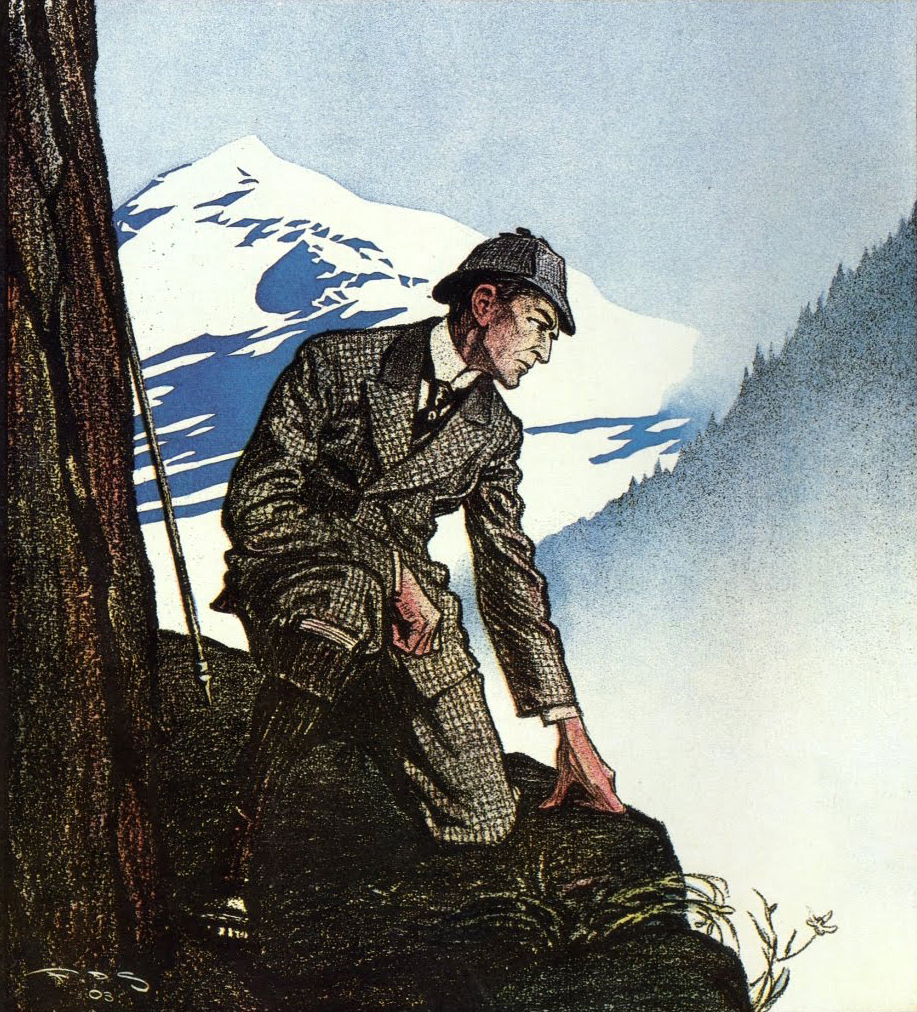
By Frederic Dorr Steele
Holmes said, "I have an instinct for such things, and yet sometimes it has played me false. It seemed a certainty when it first flashed across my mind in the cell at Winchester, but one drawback of an active mind is that one can always conceive alternate explanations which would make our scent a false one." (The Problem of Thor Bridge, page 1069)

This quote points to the fact that Holmes is intuitive (the N) in INTP. There are many references to his instinct and intuition throughout the stories and events that are evidence of it. For more on Holmes' intuition, see the links below. 

The fact that Holmes can "always conceive alternate explanations" to the one he already came up with shows that he is a P (perceiving). The official Myers-Briggs website describes the perceiving function thus: "in type language perceiving means 'preferring to take in information.'" The site states that the following statement is the sort of thing a perceiver might identify with, "Sometimes I stay open to new information so long I miss making decisions when they are needed" (The Myers & Briggs Foundation: Judging or Perceiving). Notice how similar this is to Holmes' own statement. He declares that his ability to come up with new explanations is a drawback of the active mind.

Quote from the book:
The Problem of Thor Bridge, in The Complete Sherlock Holmes, vol. II. By Sir Arthur Conan Doyle. Doubleday & Co, Inc. Garden City, New York. 1930.

For a description of the INTP personality type:
Typelogic INTP profile

For a fuller analysis of Sherlock Holmes' (of BBC's Sherlock) personality type, you might enjoy:
Thinker Intuitor Sensor Feeler: Sherlock's Myers-Briggs Type