Monday, May 21, 2012

Healing in the hands of the King

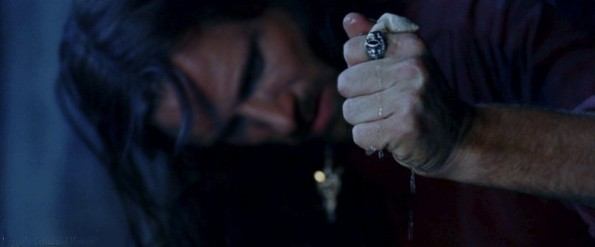
"Alas! If he should die. Would that there were kings in Gondor, as there were once upon a time, they say! For it is said in old lore: The hands of the king are the hands of a healer. And so the rightful king could ever be known." -Ioreth, a woman from the Houses of Healing in The Lord of the Rings, by J.R.R Tolkien.

Aragorn
Aragorn, the heir to the throne of Gondor came into the Houses of Healing and treated Faramir, Eowyn, and Merry so that they would not die. He was a skilled healer, using herbs and wisdom to cure his patients. Although he had not claimed the title of king yet, Faramir referred to him as a king. Ioreth heard and said, "King! Did you hear that? What did I say? The hands of a healer, I said." The passage continues by describing the spreading of the news: "And soon the word had gone out from the House that the king was indeed among them."

And so it was that Aragorn's power of healing testified that he was the rightful king of Gondor.

The kings of France justified their right to the throne by a concept called, "The Divine Right of Kings."  Basically, they claimed that God had given the Bourbon line the kingship of France and so their power must not be disputed because God said it was to be this way.   While the Bible does say to submit to governing authorities, it does not mean that a specific line has a right to the throne. God raises up rulers and God also deposes them (Read I-II Samuel, I-II Kings, and I-II Chronicles).  Because of King Saul's disobedience, God did not allow his dynasty to continue but brought David to the throne; he began a new royal line.

Because of the "Divine Right" in France, there was a tradition that the kings had miraculous healing powers. When Louis XVI was beheaded the people rushed forward to capture some of his blood, dipping cloth into it because they thought his blood would heal their sick.

That is some extreme irony right there.

It would seems that the French no longer believed in Divine Right. However, if they really did not believe in Divine Right, then they would not believe his blood had power.

While the blood of Louis held no healing power, and Aragorn is a fictional character, there is a King who can heal.  He healed thousands by the power of God while he was here on Earth.  He healed the lame, the blind, the deaf, the mute, the leprous, among other diseases. He even gave life to the dead.  The miracles he worked showed that he was, and is, the son of God, the King of the universe.
He was executed by the Romans for crimes he did not commit, and in dieing he was a sacrifice before God to cleanse all people from their sins. He rose from the dead and his healing work continues. He heals the scars on our hearts, breaks our addictions, and gives eternal life to those who are in his kingdom. His name is Jesus.

Monday, May 7, 2012

"Big as a house, gray as a mouse," and very loud!

The Song of Roland is an old French epic poem in which the knights of Charlemagne battle Saracen forces.
The leading knight, Roland, has a horn that they refer to as an "olifant."

Olifant
 "Olifant" is the Old French word for "elephant." In fact, the present day English word is derived from the French (The American Heritage Dictionary). What is an elephants tusk? Ivory. Roland's horn was probably made of ivory.

In The Lord of the Rings, by J. R. R. Tolkien, there are some large elephant-like creatures called, "Oliphaunts."  (The title of this post comes from a poem about Oliphaunts in the book.)

Boromir also had an important horn.  It is mentioned in his first appearance in the book, "on a baldric he wore a great horn tipped in silver that now was laid upon his knees." He blew it as he defended Merry and Pippin from the Orcs, calling his companions: "Then suddenly with a deep-throated call a great horn blew, and the blasts of it smote the hills and echoed in the hollows, rising in a mighty shout above the roaring of the falls."  As Aragorn raced towards the scene, the horn sounded "desperately" and then ceased abruptly. He arrived too late: the Orcs had already run off with the hobbits. Aragorn found Boromir sitting against a tree, dieing. His horn, symbolic of his life, lay broken at his side. "But Aragorn saw that he was pierced with many black-feathered arrows; his sword was still in his hand, but it was broken near the hilt; his horn cloven in two was at his side. Many Orcs lay slain, piled all around him and at his feet."

As Roland fought the attacking Saracens, his friend Olivier told him to blow the horn and call for the help of Charlemagne's army.  Roland refused, and as a result the entire rear guard was wiped out, including himself and Olivier. However, before the battle was completely over, Roland blew the horn long and loud and called the army back after there was no more hope of survival. Before they arrived, Roland blew his horn again, but much weaker this time and Charlemagne knew that Roland was scarcely alive. Before he died, the warrior placed his sword and horn beneath him lest they fall into enemy hands. Charlemagne and his knights found the battlefield covered in bodies.

Wednesday, April 18, 2012

Cu Chulainn and Achilles: Famous but Dead

Cu Chulainn (pronounced "Coo Chullen," ch as in loch) is the greatest hero in Irish lore. He is from the Ulster cycle of Irish lore/mythology and has some surprising similarities with Achilles, the Greek hero. In fact, David Greene's An Anthology of Irish Literature calls him "the Achilles of the Ulster cycle."

Both Achilles and Cu Chulainn were sons of a god and a royal human. Thetis (goddess) and Prince Peleus (mortal) were Achilles' parents. Cu Chulainn's mother was Deichtire, sister to King Conchubar. Some say his father was Lug, the Celtic god of light, while others say his father was an Irish chieftain.

Cu Chulainn
At any rate, he was not a normal human. The Boyhood Deeds of  Cuchulain says, "Now the stripling who by the time seven years were completed since his birth, had done such deeds: had destroyed the champions by whom two-thirds of the Ulstermen had fallen unavenged." 

Both had special horses.  As a wedding gift, Peleus and Thetis received two immortal horses named Balius and Xanthus. They came to be Achilles' horses.  Xanthus spoke to Achilles before his death. 

Cu Chulainn was found as a baby by the men of Ulster, and as they were taking him home, they heard a horse whinnying nearby. They stopped to check it out and found a mare who had just dropped her foal.  They took the newborn  horse, saying he was meant for the special baby.  The Gray of Macha, as the horse came to be called, served the warrior well in battle and was cognizant on an almost human level. Born the same day, they died the same day.

And now, moving on to the most important part. The greatest similarity between the warriors is their mindset and their fates.

In History 261, I learned that Achilles had a choice. He could become the greatest and most renowned warrior ever and live a short life, or live a peaceful, normal, and long life.  He chose renown and died in the Trojan War.  The funny things is, Cu Chulainn had the same choice.

When Cu Chulainn was just seven years old, he heard Cathbad the Druid tell his pupils that whoever took up arms that day would become the greatest warrior ever but lead a short life. Immediately he took up arms.

Cu Chulainn explained,  "For when they asked him what special virtue lay in this day, he told them that the name of whatsoever youth should therein for the first time take arms, would top the fame of all Erin's men; nor thereby should he suffer resulting disadvantage, save that his life must be fleeting short."

Cathbad confirmed his words, "noble and famous indeed thou shalt be, but transitory, soon gone."

"Little care I," said Cu chulainn, "nor though I were but one day or one night in being, so long as after me the history of myself and doings may endure."  The quotes are from The Boyhood Deeds of Cu Chulainn.

And so, the great Greek warrior Achilles and the great Celtic warrior Cu Chulainn faced the same decision, made the same choice, and died young but are still remembered today.

Sources:

The Cu Chulainn stories (except the story of Cu Chulainn's birth) are from David Greene's An Anthology of Irish Literature, vol. 1 
James Hunter's Achilles article
Thetis and Peleus
Xanthus
The picture of Cu Chulainn was cropped by Edana A. Click on the caption to see the original.

Wednesday, April 11, 2012

The Secret of Kells: The Artwork

The artwork in the 2009 film, The Secret of Kells, (director Tom Moore, co-director, Nora Twomy, art director, Ross Stewart,) reflects the beauty of The Book of Kells. The images in both are rich in color, iconic, and play with perspective.

The Book of Kells features "zoomorphic" designs. Basically, animals that are twisted, stretched, and bent into 2-D designs.  A bird might be chewing on his foot, his toes and beak woven like a piece of cloth. A dog's neck is stretched longer than a giraffe's and interlaces with those of four other dogs just like it to form a Celtic knot.   "Zoo" for "animal." "Morphic" for "formed/morphed/changed."

And of course, intricate Celtic knots and swirling designs of many colors fill the pages.

 The only real zoomorphic design in the film, (although certain creatures morph into other forms) appears when Crom Crรบiagh is chasing Brendan. 

 The film has iconic images, like the book. Some people are lumps or rectangles with heads. Aiden has squared-off fingers.  The edge of the forest is very organized: the tallest trees form arches for the ones beneath.
This images are also highly detailed and contain Celtic designs, like The Book of Kells.

The film also plays with perspective: A person in the distance will pass behind a tree and suddenly they are much, much closer. This depiction represents the actions going on. It's not meant to be taken literally, it's art. It's similar to changing angles on a film camera, except it all happens in the same frame. 

In order to respect copyright laws, I have not put pictures in this post. However, here are some links so you can see the features I discussed:  

The Chi Rho page, (mentioned in the film!): The Book of Kells
Besides Celtic designs, the page of the manuscript contains a zoomorph man, iconic figures, and animals.

See the gallery, it contains the images I was talking about: The Secret of Kells 

This is an informative video on The Book of Kells:  http://www.youtube.com/watch?v=HMvfMVBhUXI

On a side note:
Symbolism is found in the depiction of certain characters. The presence of monks from all over the world (Africa, Asia, Italy, and Ireland) at Kells symbolizes the fact that Ireland was an important center for Christianity during the period. It was a beacon of light in the Dark Ages. (See previous post for more on dark and light).

Tuesday, April 3, 2012

Turning Darkness into Light

Credit: Edana A.
"Turning Darkness into light."
This is a line from a 8th or 9th century poem by an Irish monk, called Pangur Ban.  In the poem, the monk talks about how he sits up at night writing while his white cat, Pangur Ban, hunts mice. ("Ban" means "white" in Irish Gaelic.)
Another word for the process of "turning darkness into light" is "illumination."  Additionally, this word can also refer to the practice of decorating and embellishing text with designs.  Perhaps the most well known example of an illuminated manuscript is The Book of Kells. 
The line and the cat also appear in the film, The Secret of Kells. (See The Secret of Kells)
In the film, Brendan learns the art of illumination and uses his skill to work on the legendary Book of Kells. Pangur Ban, a white cat who accompanied Brother Aiden from the Isle of Iona, joins Brendan on his adventures and becomes his friend.
Obviously, the poem was an inspiration for the film, for during the credits, the poem is read aloud in Irish.
To most, darkness means ignorance and light symbolizes truth and knowledge. Think of the word "enlighten." 
Although not mentioned specifically in film or poem, the phrase, "turning darkness into light," has a very profound significance, evoking Biblical truths. While the monks illuminate (enlighten) by preserving and sharing the Bible, it is Jesus who ultimately turns darkness into light.  Jesus said,“I am the light of the world. Whoever follows me will never walk in darkness, but will have the light of life.” John 8:12

Link to Pangur Ban and additional background on the poem: Irish Culture and Customs

Wednesday, March 28, 2012

The Secret of Kells


Brendan and Aisling, picture from Matthew Sernett, Fantasty Film Review
 The Secret of Kells is a 2009 film about The Book of Kells and its creation.

This film is unbelievably rich for those who have learned a bit about Irish history and culture. The creators blend Irish history and legend together in a way that is befitting. In an Anglo-Irish literature class, I was told that it's hard to know what is true about Irish history because history and myth are thoroughly mixed together.
Can you separate the ingredients of a cake after it is baked? No, but the cake sure is delicious. So it is with Irish history.

Just like the history of Ireland, myth and reality intermingle in the film.The boy, Brendan, befriends a fairy girl in the woods.  Cromm Crรบaich, a monster Brendan believes to be a myth is very real and dangerous.  Brendan's knowledge of Irish lore helps him find "the eye of Columkille," which is also the eye of the monster that the monks use as a crystal magnifying glass.

Brother Aiden tells a tale about St. Columkille, also known as St. Columba, the man attributed with bringing Christianity to Scotland. He was also a trouble maker, and was in fact sent to Scotland by his superiors because he got involved with a war between Irish chieftains.  As Aiden speaks, the tale is told in pictures. These pictures are comical and frank. When Columkille dies, his tongue slides out of his mouth and his eyes turn into Xs. Seems irreverent, but in this situation it works because it fits with the persona of Columkille as portrayed in lore: an ambiguous legendary figure, a Saint who was hot-headed and got into trouble.

This scene also demonstrates how tall tales are created. Brother Aiden says that St. Columkille was given "a third eye" to help him create the intricate designs in The Book of Kells.  The other monks chime in, saying he had a third hand, or a whole host of hands.  Aiden continues with his story about the third eye and St. Columkille.  It turns out the "eye" is actually a crystal that is quite simply used to magnify the images. It isn't magical and it isn't a third eyeball in Columkille's head. 

That said, the crystal is the eye of Cromm Crรบaich. This monster apparently has crystals for eyes. Brendan needs a crystal, so he takes the monster's eye. And so, the legend of St. Columkille is mixed with the lore of Cromm Crรบaich. Both are real in the film, not parts of alternate realities.

Aisling, the fairy, uses a famous Irish saying in a scene. Brendan provides the English translation for us.  This is symbolic: Aisling uses the native language and represents the old ways of Ireland before St. Patrick, the time when fairies and Celtic gods walked the land. Brendan represents life post-Patrick. Not a complete loss of the old way of life, but a new outlook. (By the way, this is NOT how English became the dominate language of Ireland. Here the use of the two languages is symbolic). When St. Patrick came, the worship of Celtic gods was diminished and they were relegated to the realm of stories. The Irish monks wrote down the ancient Irish legends (heretofore only in oral form) and thus preserved Irish "history." They tweaked some, adapting them to the Christianity, but not altogether discarding them because Patrick recognized the beauty and value of these colorful tales.

The Giant's Causeway
The beauty of nature is a backdrop for many scenes of the movie. This too is an important ingredient because the nature of Ireland is celebrated by Irish poets and people around the world.  Through the iconic and stylized designs the wonder of the forest is portrayed. Additionally, there is a quick scene with the Giant's Causeway, a distinctly Irish landmark.


Play around on: 
The Secret of Kells website

Full movie available here:
IMBd review